Where to Put a Litter Box: A Vet's Room-by-Room Placement Guide
Feline veterinarian Dr. Priya Anand, DVM gives room-by-room verdicts on where a litter box belongs, the five spots to never use, what to compromise in a small apartment, and access for senior cats.
Updated
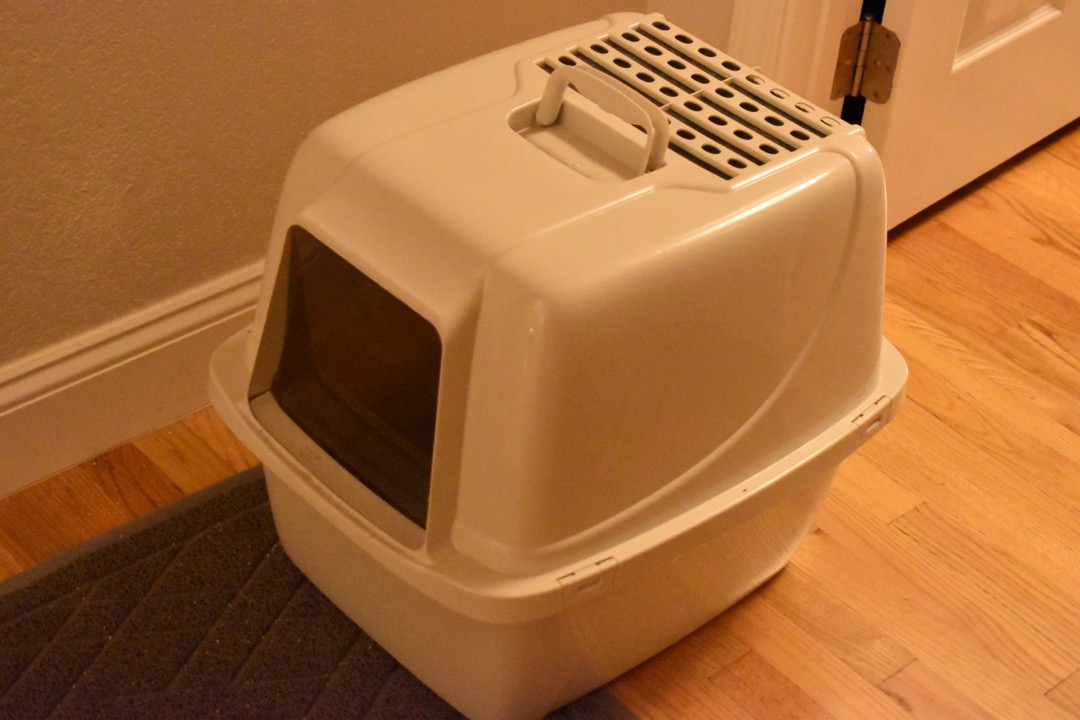
Almost everyone asks me this as a decorating problem. Where can the box go so I do not have to look at it, smell it, or explain it to guests? The cat is answering a safety question instead. Can I crouch here, in the open, without being cornered, startled, or ambushed?
Placement is one of the very few house-soiling variables an owner controls completely, and the only one you can fix for free this afternoon. You cannot change your cat’s bladder. You can move a box across a room and take a closet door off its hinges. A real share of the “my cat is peeing on the rug” cases I see resolve on a placement change and nothing else.
Below is the room-by-room verdict, the spots I ask owners to abandon, the honest version for a studio apartment, and what changes when a cat gets old and stiff.
The Short Answer
- Pick a quiet, low-traffic spot. The house-soiling guidelines state that most cats prefer private places to eliminate rather than busy ones.
- Make it easy to reach, with no stairs and no doors in the way.
- Keep the sightlines open, so the cat sees anyone approaching and can leave without squeezing past them.
- Keep it well away from food and water bowls.
- Put at least one box on every level of the house.
- One box per cat plus one spare, in separate locations, never clustered.
- Nothing beside it that switches on by itself: washer, dryer, furnace, dishwasher, air duct.
- No dead ends, no tight cupboards, nothing behind a door that gets closed.
Why Placement Is a Medical Question
The AAFP and ISFM feline environmental needs guidelines sort a cat’s needs into five pillars, and placement sits in Pillar 2: “Provide multiple and separated key environmental resources: food, water, toileting areas, scratching areas, play areas, and resting or sleeping areas.” The word doing the work is separated. The same document asks that “ample physical separation should be maintained between toileting areas and other environmental resources.”
The reasoning is about threat. The guidelines describe cats as “solitary survivors” that “tend to ‘avoid and evade’ rather than confront perceived threats.” A cat in a litter box is committed for a moment and cannot evade, so it assesses the spot first. When the spot fails, the cat goes somewhere else or waits.
Going somewhere else is what brings owners into my exam room, usually after a rug is lost. Waiting concerns me more, because you cannot see it. A cat holding urine because the only available box feels exposed is a well-recognised thread in how house-soiling and lower urinary tract complaints present in practice. I would sooner put a box where you find it inconvenient.
Placement does not rescue a dirty box, and the two problems compound; scooping technique is in my guide on how to clean a litter box. It does not rescue an undersized box either: the guidelines want a rectangular box about 1.5 times the cat’s length from nose to base of tail, which is a good deal bigger than most people picture. Sizing is in my roundup of the best cat litter boxes.
Room by Room: Where a Litter Box Actually Works
| Room | Verdict | Why |
|---|---|---|
| Bathroom | Good | Quiet, hard floor, easy cleanup. Humidity and a shut door are the caveats. |
| Laundry room | Avoid | Washer and dryer start without warning and startle a cat mid-use. |
| Spare bedroom | Good | Private, quiet, a door you can prop, room for a full-size box. |
| Home office | Workable | Fine if your day is quiet. Poor if you take loud calls or the chair blocks the exit. |
| Main bedroom | Workable | Often the best spot for a senior cat. Needs real distance from any food bowl. |
| Living room | Workable | Works in a corner with two open sides, off the walking route to the sofa. |
| Hallway or landing | Workable | Good access and sightlines. People brushing past mid-use is the risk. |
| Closet | Workable | Only with the door removed or permanently open, and only if the cat is not walled in. |
| Basement | Workable | Stairs and a door that gets shut are the failure points. Never the only box. |
| Garage | Avoid | Temperature swings, the car, chemicals, a door the cat cannot open. |
| Kitchen | Avoid | The feeding station, and the guidelines warn against food and water near the box. |
The bathroom earns its reputation. It meets nearly every behavioural criterion at once: quiet, private, a floor you can wipe, a room nobody lingers in. Two things spoil it. The first is humidity, because a bathroom that runs a hot shower daily keeps the litter bed damp, and damp litter clumps poorly and breaks down faster. That penalty falls hardest on plant-based litters and non-clumping clay, which I compare in clumping vs non-clumping litter. The second is the door, which gets closed for privacy, for guests, for a bath. A closed door turns the best-placed box in the house into no box at all. Fit a doorstop.
The bedroom is not automatically wrong, and I say so to clients who have been told otherwise. It is quiet, low-traffic overnight, and already a room the cat treats as safe. For an older cat it is explicitly supported: the house-soiling guidelines advise that “placement of night lights and additional litter boxes close to sleeping areas will help minimize anxiety in older cats.” The downsides are that you sleep beside the odour, so the cleaning bar rises, and that bedrooms are where people park a water bowl. If the box lives in the bedroom, the bowls move out.
Basements and garages get chosen because they hide the box, and they fail for the same reasons: the cat negotiates stairs, a door usually stands in the way, and you pass by too rarely to catch a problem early. A basement box works if it is easy to reach, the door is never closed, and it is not the only box in the house. A garage almost never qualifies, between the temperature swings, the solvents, and a vehicle moving in and out. For an arthritic or elderly cat, treat a flight of stairs as a wall. Ohio State puts the reason plainly, that cats do not like to walk far to get to the nearest litter box, and stairs count for far more than horizontal distance.
The Five Places to Never Put a Litter Box
- Beside the food and water. The house-soiling guidelines are direct: “avoid placing food and water close to the litter box, as this discourages elimination in that location.” A cat that will not eat beside a toilet will not toilet beside its food either. If your feeding station and box share a corner today, separating them is the highest-yield change available to you. Water is the easier half to move, since a cat water fountain relocates easily, dishes of wet food along with it.
- Next to something that turns itself on. The Ohio State Indoor Pet Initiative asks owners to keep boxes “away from appliances or air ducts that could suddenly come on and startle the cat.” A furnace kicking in or a floor vent blowing mid-squat is the kind of event that gets a location permanently blacklisted in a cat’s mind. One bad startle is often enough.
- A dead end with one way out. The back of a narrow closet, a walled alcove, behind a couch. A single exit can be blocked by a person, a dog, or another cat.
- Behind any door that gets closed. Bathrooms, spare rooms, laundry rooms, basements. The box exists only during the hours the door is open.
- Crammed into a tight spot. The same source warns against “tight-spots such as under vanity sinks or low tables,” and adds next to a dog bed and behind a couch. A box the cat must crouch to enter is one it cannot stand up in and turn around in, which is the minimum size test.
Sightlines: The Rule Almost Nobody Gets Right
Privacy to a human means enclosure. Privacy to a cat means seeing whatever is coming before it arrives. That gap is why so many well-intentioned placements fail, and the guidelines put it neatly: “If the cat cannot see a potential threat, it feels safer, even if its whole body is not fully concealed.” Partial cover with an open view beats full concealment. Ohio State gives the practical version: place the box so the cat can watch people and other animals approaching rather than being snuck up on.
In a normal room that means a box against a wall with a clear view of the doorway, not one wedged into a corner facing inward. Two lines of retreat where the floor plan allows, a view of the only exit at minimum. A corner feels safe to us and reads as a trap to a cat, because anything arriving at its mouth has the cat cut off. If you change one thing after reading this, turn the box so the opening faces the room.
How Many Boxes, and Where They Go
Count and placement are one problem. Both guidelines and Ohio State land on the same rule, which Ohio State calls “the Golden Rule”: one litter box per cat, plus one. The house-soiling guidelines add the line owners skip, that “households with a single cat should have two litter boxes in two separate locations.” One cat, two boxes, two rooms.
Separate locations is the operative phrase. Adjacent boxes do not count as two, because “cats perceive litter boxes located adjacent to each other as one large box.” Where two must stay close, the guidelines say the openings “should not be facing each other, but should be positioned at right angles or around the corner from each other.” A row of three boxes along one wall is one box with extra litter in it.
Vertical distribution matters as much. The house-soiling guidelines state that at least one box belongs on each level of a multilevel home, and Ohio State agrees. That is not a convenience rule. It is what keeps an older cat from making a decision on the landing.
Spread the other resources the same way, so no cat has to pass another to reach anything it needs; a well-placed cat tree does that job vertically. If the cats are still learning to tolerate each other, the resource map matters more again, and I walk through it in my guide on introducing cats to each other.
Multi-Cat Homes: Placement Is Territory
Cats in one household do not necessarily form one social group. The environmental needs guidelines are specific: “each group in the same household should have physically separate resources so that they do not have to share access with other social groups.” Two boxes in one utility room serve one social group, not two.
In a house it looks subtle. One cat sits in the hallway, apparently doing nothing, and the other turns around. One cat uses the box only when the other is asleep, or holds until the house is quiet overnight. None of it looks like fighting, which the avoid-and-evade framing explains. Blocking is normal cat behaviour and nearly invisible.
The tell is specific. A cat that uses one box happily and consistently avoids another is telling you about that location, not that box. Swap the litter between them and nothing changes. Move one to a different room, ideally a different floor, and the avoidance often ends within days.
Small Apartments and Studios: Making the Compromise
A one-room apartment cannot give you separate rooms for feeding and toileting, and pretending otherwise helps nobody. Compromise in this order.
Distance is compressible. Opposite corners of a studio, box on one wall and bowls on the other, is real separation even without a wall between them. Room count is compressible too: two boxes can go in the bathroom and the far corner of the main room, satisfying “two separate locations” in the only way the floor plan allows.
Accessibility and sightlines are not compressible. Whatever else goes, the cat must reach the box without a closed door in the way, and must see the room from inside it.
Furniture enclosures and screens are fine within limits. A cabinet or bench that hides a box works if the entry is generous, the cat can turn around and leave easily, and the enclosure is not a dead end. What an enclosure reliably does is concentrate odour and make scooping awkward, which raises the cleaning bar rather than lowering it. Expect to scoop at least daily and to dump the bed more often than in an open box. Litter choice earns its keep here: the materials are in my guide to the best cat litter, and the refill schedule is in how often to change cat litter.
Senior and Arthritic Cats: Placement Is Accessibility
Feline osteoarthritis is far more common than owners assume. In one retrospective radiographic study, about three-quarters of the cats examined had radiographic evidence of appendicular osteoarthritis. Most were not limping, because cats with sore joints do not limp. They stop doing things.
The FDA’s consumer guidance on feline osteoarthritis lists urinating or defecating outside the litter pan, and not being able to jump as easily as before, among the signs. That is the clinical point I most want owners to take away. A senior cat that starts missing the box is giving you a mobility history. Before anyone calls it spite or stress, check whether the cat is being asked to climb stairs, step over a high side, or cross the house to reach a box.
The fixes are mechanical. The house-soiling guidelines recommend a box with a very shallow opening for arthritic cats, and Ohio State notes that low-sided boxes suit older cats with mobility problems. Both also back night lights and extra boxes close to where the cat sleeps, which is the clearest permission you will get to put a box in a bedroom. Add a box on whichever floor the cat spends its day on. Low-entry models are in my roundup of the best cat litter boxes.
Automatic Boxes Have Their Own Placement Rules
A self-cleaning box adds two variables: it moves, and it makes noise. Both push toward more clearance and less enclosure. Leave space at the sides and in front, so a cycle starting while the cat is nearby does not feel like something arriving. Do not corner it, and do not tuck it into a cabinet where the mechanism noise reflects back at the cat.
It also needs an outlet, and that constraint quietly drives a lot of bad placements. An outlet in the laundry room is not a reason to put a box next to the washer. Run the cord instead.
Everything above still applies: quiet, sightlines, separation from food and water, one per level, a door that stays open. A motorised box in a bad location is a bad location with a motor in it. Cycle noise varies a great deal, and I compare it alongside capacity in my review of the best automatic litter boxes.
When There Is Genuinely Nowhere Good
Sometimes the floor plan wins. When it does, compromise from the bottom of this list upward, never from the top down.
- Accessibility. Give this up last. A box the cat cannot reach, or can only reach past a closed door or a staircase, is not a box.
- Sightlines and an escape route. The opening faces the room. The cat can see the doorway.
- Separation from food and water. A different room where possible, a different wall at minimum.
- Quiet. Low traffic, nothing nearby that switches on by itself.
- Ventilation. Pleasant for you, and it keeps the litter bed drier.
- Aesthetics. The first thing to sacrifice, every time.
Read that as explicit permission. A box in the corner of your living room that you can see from the sofa beats a perfectly concealed one behind a closed bathroom door. If the only spot satisfying the first four items is somewhere you would rather not look, put it there and put a mat under it.
How to Move a Litter Box Without Causing an Accident
Moving a box is where good intentions produce a puddle. The safe method is to add rather than relocate.
- Add a new box in the new spot and leave the old one where it is. The cat gains an option instead of losing one, and nothing is at stake if the new spot gets rejected.
- Run both boxes in parallel, scooping both daily so neither becomes the dirty choice. If you are short of the one-per-cat-plus-one count, you needed it anyway.
- If you must move the only box, do it in short increments. A short distance at a time, with several days in between, inside the same room where possible, rather than one move across the house.
- Watch closely in the days afterward. Note which box gets used, how often, and whether either cat has started waiting for the other to leave the room.
- Read a missed use as information. One accident near the old location usually means the move went too fast. Accidents elsewhere, straining, frequent small urinations, or any blood mean a vet visit first. Straining with little or no urine in a male cat is a same-day emergency.
- Clean accidents with an enzymatic product, not a household cleaner. Residual scent marks the spot as a toilet and invites a repeat. My picks are in the guide to the best cat urine enzyme cleaners, and laundry needs its own method, covered in how to get cat pee smell out of clothes.
For a kitten, placement is part of training rather than a correction. Put a box in every room the kitten can access while it is learning, so a small bladder never has to weigh up the distance, then consolidate as it grows. The sequence is in my guide to litter training a kitten.
Frequently Asked Questions
Where should you not put a litter box?
Five locations. Next to food and water bowls, which the house-soiling guidelines say discourages elimination there. Next to anything that switches on by itself, since Ohio State warns about appliances and air ducts that could startle a cat. In a dead end with one exit. Behind a door that gets closed. And crammed into a tight spot, with vanity sinks and low tables named specifically.
Is it okay to put a litter box in the bedroom?
Yes, and for some cats it is the best room in the house: quiet, low-traffic overnight, already somewhere the cat feels safe. The house-soiling guidelines explicitly recommend night lights and extra boxes near sleeping areas for older cats. Two conditions. The bowls move out, and you accept a higher cleaning standard, because you are sleeping beside the box.
Is it okay to put a litter box in the living room?
It can work well. A living room is usually large with more than one exit, which suits a cat better than a cupboard. Put the box against a wall in a corner with two open sides, opening facing the room, off the walking route between door and sofa. Avoid anywhere someone will regularly pass close by mid-use.
What is the golden rule for litter boxes?
One box per cat, plus one spare. Ohio State calls it the Golden Rule, and the AAFP and ISFM house-soiling guidelines use the same rule of thumb for multi-cat homes: at least one more box than the total number of cats. People skip that it applies to single-cat homes too, where the guidelines ask for two boxes in two separate locations, spread out rather than lined up.
Do cats prefer covered or open litter boxes?
The research shows no group preference. In a study of 28 cats given both a covered and an uncovered box, cleaned daily, there was no significant difference overall: four cats preferred the covered box, four the uncovered one, and the rest showed no preference. The authors concluded that blanket recommendations for uncovered boxes are not necessarily justified. The AAFP still prefers open boxes, but for the owner’s sake, since you can see what is in there and scoop promptly.
Do cats need a litter box upstairs and downstairs?
Yes. The house-soiling guidelines state that at least one litter box should be placed on each level of a multilevel home, and Ohio State requires the same, because cats do not like to walk far to the nearest box. Stairs are a bigger barrier than horizontal distance, so count each floor as a separate household.
Can cat food be in the same room as a litter box?
Ideally no. The environmental needs guidelines ask that each key resource sit in its own location with ample physical separation between toileting and other resources, and the house-soiling guidelines warn that food and water close to the box discourage a cat from using it. In a large room, bowls on the opposite wall and out of the box’s sight can work. In a small room, move them.
Where is the most sanitary place to put a litter box?
A quiet room with a hard, washable floor and decent ventilation, where you will see the box daily. Tile or sealed wood beats carpet, because tracked litter and overspray wipe up instead of soaking in. Ventilation keeps the bed drier, which slows odour. The most important sanitary variable is not the room: it is whether the spot is convenient enough that you scoop every day.
How far should a litter box be from food and water?
There is no published distance, and I would be suspicious of any article giving you one in feet. The guidelines say what they can defend: each resource in its own separate location, with ample physical separation between toileting areas and other resources. In practice I aim for a different room where the floor plan allows, and an opposite wall out of the box’s sight line where it does not.
Why won’t my cat use the box in its current spot?
Work through the location the way a cat would. Can the cat reach it without stairs or a closed door? Does the opening face the room, with a view of the doorway and a way out? Is anything within earshot that switches on by itself? Are food and water too close? Can another cat block the approach? If a previously reliable cat has just started missing, book a vet visit first, because urinary disease and arthritis both present this way.
Related Articles
How to Clean a Litter Box: A Veterinarian's Step-by-Step Guide
litter-boxes
How to Litter Train a Kitten: A Veterinarian's Step-by-Step Guide
litter-boxes
8 Best Automatic & Self-Cleaning Litter Boxes of 2026
litter-boxes
11 Best Cat Litter Boxes of 2026
litter-boxes
Clumping vs Non-Clumping Cat Litter: A Vet's Honest Comparison
litter-boxes
About the Reviewer

Dr. Priya Anand, DVM, ABVP (Feline)
DVM, Cornell University College of Veterinary Medicine
Dr. Priya Anand is a veterinarian board-certified by the ABVP in Feline Practice, with over a decade caring for cats in a feline-exclusive clinic. She has guided thousands of cat owners through nutrition, litter-box troubleshooting, enrichment, and senior-cat care. She founded House of Mittens in 2026 to cut through pet-aisle marketing and recommend the food, litter, and gear that actually keep cats healthy and happy — judged the way she'd advise her own patients.