11 Best Cat Urine Enzyme Cleaners of 2026, Vet-Reviewed
Feline vet Dr. Priya Anand ranks the 11 best cat urine enzyme cleaners of 2026, and names the two sold as enzyme cleaners that contain no enzymes at all.
Updated
In feline practice, the cat urine conversation almost never starts with a cleaner. It starts with an owner who has scrubbed the same square foot of carpet four times, who can still smell it on humid days, and who is starting to wonder whether the cat is doing it on purpose. The cleaner matters, and choosing the right one is the difference between a spot that is genuinely gone and a spot that keeps announcing itself, but the reason it matters is behavioural as much as cosmetic. A cat that can still smell its own urine on a patch of floor reads that patch as a legitimate toilet, and the habit reinforces itself every week the residue stays there.
The best cat urine enzyme cleaner is the one that digests uric acid crystals rather than covering them, that you are willing to use in enough volume to reach the depth the urine reached, and that does not leave a fragrance strong enough to push a scent-sensitive cat away from an area you have just made clean. For this 2026 roundup I worked through the ingredient and feature claims on every widely sold product in the category and kept eleven, including two that are sold and searched as enzyme cleaners and are not enzymatic at all. Those two are on the page, labelled, rather than quietly omitted, because knowing which is which is the single most useful thing an owner can take away from this category. If the underlying problem is the box rather than the floor, start with our guides to choosing a litter box and cleaning a litter box properly before you buy anything here.
Find the Best Enzyme Cleaner for Your Situation
Jump straight to the situation you are dealing with:
- Best cat urine enzyme cleaners overall
- Best for carpet
- Best for hardwood and hard floors
- Best for mattresses and upholstery
- Strongest for old, set-in urine
- Best for concrete and garage floors
- Best unscented and fragrance-free
- More cleaners by type and situation
How We Evaluated These Cleaners
The thing that separates this page from most of what is written about cat urine cleaners is that I read the ingredient and feature claims on every listing before I read a single review, and sorted the category into three groups by mechanism. True enzymatic products name what is in them: protease, amylase, live enzyme cultures, bio-enzymatic, or bacteria and enzymes working together. Oxidizers name hydrogen peroxide, sodium percarbonate or chlorine, and they work by chemical attack rather than digestion. Maskers name nothing at all, because there is nothing to name beyond fragrance and surfactant.
Nine of the eleven products here sit in the first group. Two do not, and they are on the page because they are among the most widely bought products in the category and owners deserve to know what they are actually buying rather than to find out in July when the smell comes back. One is a citrus-oil deodorizer whose feature bullets never mention enzymes or bacteria, and whose own reviewers report needing to reapply every few days. The other is a well-liked neutralizing formula that works by chemistry rather than biology, and which I would still hand to a scent-sensitive household with the caveat stated plainly. Beyond mechanism, I weighted independent certification, surface-specific formulation, review depth on the individual listing rather than the pooled variant family, and per-gallon cost, because volume is what most treatments actually run out of.
Best Cat Urine Enzyme Cleaners Overall
These are the full reviews, starting with the pick I name most often in the exam room and working through budget, upgrade and the specialty options. Every product is reviewed once here, and the use-case sections that follow simply point back to the right one for your situation.
Best Overall: Rocco & Roxie Professional Strength Enzyme Stain & Odor Eliminator
Rocco & Roxie is the bottle I would put in front of most owners first, and the reason is a certification rather than a marketing claim. It carries the Carpet & Rug Institute Seal of Approval, which is the only independent, carpet-specific certification available in this category. The CRI programme tests whether a cleaner actually removes soil, whether it damages carpet fibres, and crucially whether it leaves residue that causes the spot to re-soil faster afterwards. That last point is the one owners never think about and the one that ruins the most carpets. Every other efficacy claim on this page was written by the company selling the product. This one was not.
The formula is genuinely bio-enzymatic and chlorine-free, and the surface list is unusually broad: carpet, hard floors, furniture, clothing, litter boxes, kennels, carriers and car interiors. That range matters in practice because a cat problem rarely stays in one place. The same bottle that treats the carpet treats the plastic carrier that now smells of stress urination and the corner of the car boot the carrier sat in. Reviewers report it working on old stains as well as fresh ones, which is the harder job, and the volume of that feedback is the largest in the category.
I want to be precise about that volume, because the number is easy to misread. The 127,810 rating figure is pooled across the Rocco and Roxie size and variant family rather than earned by this specific 32 ounce bottle. That is still the deepest trust base here by a wide margin, and the listing is sold by the brand’s own parent company rather than a reseller adding a margin, but it is not 127,810 people reporting on this exact bottle and I am not going to write it as though it were. The two honest caveats are that the scent divides reviewers, with a minority finding it lingers, and that stepping up to the gallon size is a steep jump for a household that only needs a bit more than a spray bottle.

Rocco & Roxie Professional Strength Enzyme Stain & Odor Eliminator, 32 Fl Oz
by Rocco & Roxie
The bottle I would put in front of most owners first: genuinely enzymatic, independently certified for carpet, and rated for the litter box and the carrier as well as the floor.
Pros
- Carries the Carpet & Rug Institute Seal of Approval, which is the only independent carpet-specific certification anywhere in this category and the only claim on this page that was tested by somebody other than the manufacturer
- Reviewers report it working on old, set-in stains as well as fresh accidents, which is the harder of the two jobs and the one most cleaners quietly fail
- Rated for litter boxes, carriers and car interiors as well as carpet, so one bottle covers the three places a cat problem usually spreads to
- The rating pool across the Rocco and Roxie line is the largest trust base in this category by a wide margin, and it is sold by the brand's own parent company rather than a markup reseller
Cons
- The scent divides reviewers sharply, and a minority find it lingers longer than they want on a treated spot
- Stepping up from the 32 ounce bottle to the gallon is a steep jump in price for a household that only needs a little more
- The 127,810 rating figure is pooled across the size and variant family rather than earned by this single bottle
Budget Pick: Nature’s Miracle Cat Urine Destroyer Plus
The most common mistake I see is not buying the wrong cleaner, it is buying the right one and then using a quarter of what the job needed. That is why the budget pick here matters more than a budget pick usually does. Nature’s Miracle Cat Urine Destroyer Plus sits at the affordable end of this guide, and a cheaper bottle is a bottle an owner is willing to empty onto a spot rather than ration. For fresh accidents on carpet, bedding and blankets, which is where most indoor accidents actually land, that is the whole game.
The formula is explicitly enzymatic and keeps working as long as bio-based residue is present, which is a useful property on a spot that was under-treated on the first pass. It does not simply stop when the surface dries: as long as moisture returns and residue remains, the breakdown continues. That makes it forgiving in a way that a purely chemical cleaner is not. It is also a common choice in multi-cat households, where the pattern is usually two or three recurring spots treated repeatedly rather than one dramatic accident.
Two honest limitations. Some reviewers find 32 ounces small for what a repeat-offender spot consumes, which is a fair observation and an argument for the gallon if you have more than one problem area. And it is not the strongest formula in the Nature’s Miracle range: the Severe Mess version reviewed below outperforms it on old, crystallised stains. For fresh messes on fabric, though, this is the sensible place to start, and it pairs naturally with a proper box routine, which our guide to how often to change cat litter covers in detail.

Nature's Miracle Cat Urine Destroyer Plus, Enzymatic Cleaner, 32 oz
by Nature's Miracle
The cheapest of this guide's four picks, and the right call for a household treating fresh accidents rather than a years-old spot under a rug.
Pros
- Priced low enough to empty onto a spot rather than ration, which matters because the mistake owners make is using too little product rather than the wrong product
- The formula keeps working as long as any bio-based residue is present, so a spot that was under-treated on the first pass continues to break down rather than stalling
- Rated for bedding and blankets as well as carpet, which is where a large share of indoor accidents actually land
- Popular in multi-cat households, where repeat treatment of the same few spots is the normal pattern rather than the exception
Cons
- Some reviewers find a 32 ounce bottle small for what a repeat-offender spot consumes
- It is not the strongest formula in the Nature's Miracle range, and the Severe Mess version outperforms it on old stains
Upgrade Pick: Skout’s Honor Cat Urine and Odor Destroyer Gallon Refill
The upgrade here is not a more sophisticated chemistry, it is volume, and for a large share of the households that ask me about this category volume is the actual constraint. Skout’s Honor sells a true 128 ounce gallon, and once you are treating a concrete garage floor, a whole room of carpet, or the same three spots every fortnight, per-ounce cost stops being an abstraction. The per-ounce value on this jug is the strongest on the page, and the format is what makes a genuinely saturating application affordable rather than something you talk yourself out of.
The formula is plant-powered and marketed as eliminating odour at the molecular level, and reviewers consistently describe complete breakdown rather than a temporary improvement that fades over a week. It dries quickly and leaves no sticky residue, which matters on a floor a cat will walk across within the hour. The brand also donates a shelter meal for every bottle sold, which is a real programme rather than a label flourish.
I do want to be straight about one thing. Its own bullet copy is less explicit about live enzyme cultures than the Rocco & Roxie and Nature’s Miracle listings are. It is enzymatic-positioned and plant-powered rather than carrying an explicit live-culture guarantee, and on a page where I am sorting products by stated mechanism, that distinction belongs in the open. The practical complaints are a nozzle that clogs and a jug that is awkward to store and pour, both of which are solved by decanting into a labelled spray bottle the day it arrives.

SKOUT'S HONOR Cat Urine and Odor Destroyer One Gallon Refill, 128 oz
by Skout's Honor
The gallon I reach for when the problem is volume rather than chemistry, with the honest caveat that its own listing is vaguer about live cultures than the top two picks are.
Pros
- A true 128 ounce gallon at the strongest per-ounce value on this page, which is what repeat treatment of a concrete floor or a whole room actually requires
- Quick-drying with no sticky residue reported, which matters on a surface a cat will walk across again within the hour
- Reviewers consistently describe complete urine breakdown rather than a temporary improvement that fades over a week
- The brand donates a shelter meal for every bottle sold, which is a real programme rather than a label flourish
Cons
- Nozzle clogging is a recurring complaint, and a clogged sprayer on a gallon jug is genuinely annoying to clear
- The jug is awkward to store and to pour accurately without decanting into a spray bottle first
- The bullet copy is less explicit about live enzyme cultures than the Nature's Miracle and Biokleen listings, so it is enzymatic-positioned rather than enzyme-guaranteed
Runner-Up: Nature’s Miracle Advanced Cat Stain & Odor Eliminator, Severe Mess
This is the bottle I name when an owner tells me they have already cleaned the spot twice. Nature’s Miracle Advanced is purpose-built for severe and set-in messes rather than being the standard formula with a different label, and that distinction is the whole reason it exists. An old stain is a different chemical problem from a fresh one: the water-soluble components are long gone, and what remains is crystallised uric acid bonded into the fibre and the backing, which needs a stronger, longer-dwelling enzymatic attack to break apart.
It also carries a claim that most of this category ignores entirely, which is that the formula is designed to discourage re-soiling of the same spot. That addresses the behavioural half of the problem. A cat returns to a spot because the spot still carries a scent cue that says this is a toilet, and a product that removes the cue thoroughly enough is doing behaviour work as well as stain work. The 17,890 ratings behind this single SKU, not a pooled variant family, make it one of the most deeply reviewed individual listings on this page.
The trade-offs are real. Scent strength divides reviewers, and it is noticeably more fragranced than the Biokleen or Kids ‘N’ Pets options, which puts it lower on my list for a scent-sensitive cat. And several owners feel the price per bottle is high for 32 ounces, which is a fair complaint given how much product a severe stain genuinely consumes.

Nature's Miracle Advanced Cat Stain & Odor Eliminator, Severe Mess, 32 oz
by Nature's Miracle
The formula I name when an owner tells me they have already cleaned the spot twice, because it is built for the crystallised residue rather than the fresh puddle.
Pros
- Built specifically for severe and set-in messes rather than being the standard formula in a different bottle, which is the distinction that matters on a stain you have already tried to clean once
- Formulated to discourage re-soiling of the same spot, which addresses the behavioural half of the problem and not just the stain
- 17,890 ratings on this single SKU, one of the deepest single-listing review records on this page
- Comes from the longest-running formula lineage in the category, with decades of reformulation behind it
Cons
- Scent strength divides reviewers, and it is noticeably more fragranced than the Biokleen or Kids 'N' Pets options
- Some owners feel the price per bottle is high for 32 ounces given how much a severe stain consumes
Biokleen Bac-Out: The Mattress and Eco Pick
Biokleen Bac-Out is the cleanest formulation on this page and the only product here whose listing states live enzyme cultures explicitly, rather than using enzyme as an adjective and leaving you to assume. That is a meaningfully stronger claim than most of this category makes, and it is backed by an equally specific ingredient story: plant-based, no artificial fragrance, no dyes, no phosphates, no chlorine, no ammonia. For a household with an asthmatic cat, an asthmatic person, or a cat with documented scent sensitivity, that list is the reason to choose it.
It is also, uniquely here, explicitly rated for mattresses and pillows. Almost nothing in this aisle will commit to that in writing, and the reason owners need it in writing is that a mattress is the one surface where a mistake is expensive and unrecoverable. Made in the USA, never tested on animals, and priced only slightly above the Nature’s Miracle bottles per ounce.
Two caveats that matter. The review base is a few hundred ratings, which is far thinner than the category leaders carry, so there is less accumulated evidence behind it than behind the top picks. More practically, stock runs scarce and it ships from a third-party seller rather than Amazon directly, which means it is not reliably available on the day a cat soils a mattress. If you want it for that job, buy it before you need it, and keep a second option in the cupboard.

Biokleen Bac-Out Pet Stain Remover, 32 Ounce
by Biokleen
The cleanest formulation here and the only one that puts mattresses and pillows in writing, on a thin review base and with availability you cannot count on.
Pros
- The listing states live enzyme cultures explicitly rather than using enzyme as a marketing adjective, which is a meaningfully stronger claim than most of this category makes
- Explicitly rated for mattresses and pillows, which almost nothing else in the aisle will commit to in writing
- No artificial fragrance, no dyes, no phosphates, no chlorine and no ammonia, which makes it the cleanest formulation on this page for a scent-sensitive or asthmatic household
- Made in the USA and never tested on animals, which matters to a meaningful share of the owners who ask me about this category
Cons
- A few hundred ratings is a much thinner review record than the category leaders carry
- Formulated as a general pet stain and odor remover rather than a cat-urine-specific product, so it is not tuned to the uric acid crystals that make cat urine the hardest case
- Stock runs scarce and it ships from a third-party seller, so it is not reliably available the day you need it
Unique Pet Odor & Stain Eliminator Concentrate: The Cost-Per-Gallon Winner
The Unique concentrate is the answer to a question most of this category does not even acknowledge: what do you use when the surface is porous and the volume required runs into gallons. One 32 ounce bottle dilutes into more than two and a half gallons of working solution, which is the lowest cost per gallon on this page by a very wide margin. On a basement slab, a garage floor, or a stretch of tile grout, that arithmetic is the difference between treating the problem properly and treating a third of it.
The mechanism is stated plainly on the listing as a bio-enzymatic formula using bacteria and enzymes together, which is the combination that keeps digesting residue after the surface has dried and re-wetted. Reviewers specifically report it clearing set-in urine out of tile grout, which is one of the hardest porous surfaces in a house because the grout line wicks liquid sideways and holds it. The company also runs a direct expert support line, which sounds like a small thing until you are trying to work out whether to treat a subfloor or replace it.
The obvious cost is convenience. You have to dilute and mix it, which is one more step than anybody wants in the middle of an accident, and the upfront price looks steep next to a ready-to-use spray until you do the per-gallon maths. Keep a ready-to-use bottle for emergencies and this for planned, large-area work.

Unique Pet Odor & Stain Eliminator Enzyme Cleaner Concentrate, 32 oz
by Unique
The concentrate that makes volume affordable, which is exactly what a porous surface like concrete or grout demands and exactly what a 32 ounce spray cannot deliver.
Pros
- One bottle makes more than 2.5 gallons of working solution, which is the lowest cost per gallon on this page by a wide margin
- The listing states a bio-enzymatic formula using both bacteria and enzymes, which is the specific combination that keeps digesting residue after the surface dries
- Reviewers report it clearing set-in urine out of tile grout, which is one of the hardest porous surfaces in a house
- The manufacturer runs a direct expert support line, which is genuinely useful when you are treating something unusual like a subfloor
Cons
- It has to be diluted and mixed, which is one more step than a household in the middle of an accident wants
- The upfront price looks steep next to a ready-to-use spray until you do the per-gallon arithmetic
OUT! Pet Stain & Odor Remover: The Everyday Option You Can Buy Tonight
OUT! earns its place for a plain reason: it is stocked in physical stores as well as online. That matters at ten at night when a cat has just soiled the carpet and the thing you need is a bottle in your hand rather than a delivery in two days. Fresh urine treated within the hour is a far easier job than the same spot treated next week, so the bottle you can actually get today is often the one that does the most good.
It is confirmed bio-enzymatic on the listing, so this is a genuine enzyme cleaner rather than a gentle masker positioned as one. The directions are short: saturate the spot so the product reaches as deep as the urine did, let it work for about 10 minutes, then blot. The label covers water-safe surfaces such as rugs, carpets, upholstery and fabrics.
A few limits are worth knowing before you buy. The label says not to use it on wool, silk or leather, so a natural-fibre rug needs a different plan, and a call to a rug cleaner is the safer first step for anything valuable. Sprayer and topper leaking is reported by multiple reviewers, which turns a cupboard into a small disaster if the bottle is stored on its side. And several owners find it too gentle for the worst messes. For a set-in stain on ordinary synthetic carpet, reach for the Severe Mess formula instead.

OUT! Pet Stain & Odor Remover, 32 oz, USA Made
by OUT! PetCare
The easy-to-find bio-enzymatic option for fresh accidents on carpet and upholstery, with the trade-off that it struggles on the worst stains and its label rules out wool and silk.
Pros
- Labeled for any water-safe surface, including rugs, carpets, upholstery and fabrics, so one bottle covers the soft furnishings a cat is most likely to soil
- Short, gentle directions: saturate, let it work for 10 minutes, then blot rather than scrub, which keeps carpet pile from being roughed up
- Confirmed bio-enzymatic on the listing rather than positioned as enzymatic through implication
- Stocked in physical stores as well as online, which is a real advantage at ten at night when a cat has just soiled the rug
Cons
- Sprayer and topper leaking is reported by multiple reviewers, and a leaking bottle in a cupboard is its own small disaster
- Several owners find it too gentle for the worst messes and reach for something stronger on an old stain
- The label rules out wool, silk and leather, so it is not the bottle for a natural-fibre rug
Simple Solution Extreme: The Applicator Advantage
Simple Solution Extreme does two things that are genuinely distinct on this page. The first is a strength claim you can actually evaluate: it is stated as two times stronger than the brand’s own standard formula. That is a comparison against a defined reference, which is worth considerably more than a professional strength banner that names nothing. The second is the patented 3-in-1 nozzle, which switches between mist, foam and stream.
The nozzle sounds like packaging and is not. Treating cat urine properly involves two different jobs. A wide, diffuse area of carpet, the sort you find when a cat has sprayed along a wall, wants a broad mist so the product goes down evenly without pooling in one place. A single deep spot where a cat has urinated repeatedly wants a stream, delivered slowly into the same point, so the liquid follows the path the urine took down into the backing and the pad. Most bottles give you one spray pattern and you compromise on one of those jobs. This one does not.
The formula is rated across carpet, upholstery, bedding, fabric toys, clothing and water-safe hard surfaces, which covers most of a house, and it works on old stains as well as new. Two honest limitations. Nozzle leakage is reported repeatedly, which appears to be the recurring weakness of the multi-setting design. And at least one reviewer flags it as unsuitable for chemical sensitivities, which is a real consideration in an asthmatic household where I would point you to the Biokleen instead.

Simple Solution Extreme Cat Stain Remover, Cat Spray Odor Eliminator, 32oz
by Simple Solution
The most versatile applicator on the page, and the reason it matters is that a stream soaks a deep spot while a mist treats a wide area, and those are different jobs.
Pros
- A verifiable 2 times strength claim measured against the brand's own standard formula, which is a more meaningful comparison than a vague professional strength line
- The patented 3-in-1 nozzle switches between mist, foam and stream, which genuinely changes how you treat a wide carpet area versus a single deep spot
- Works on both fresh and old stains, and reviewers report it succeeding on spots that had already been cleaned with something weaker
- Rated across carpet, upholstery, bedding, fabric toys, clothing and water-safe hard surfaces, so one bottle covers most of a house
Cons
- Nozzle leakage is reported repeatedly, which is a recurring weakness of the multi-setting sprayer design
- At least one reviewer flags it as unsuitable for chemical sensitivities, which is worth knowing in an asthmatic household
Nature’s Miracle Hard Floor Cleaner: The Sealed Wood Specialist
Most owners treating a hardwood floor reach for whatever carpet bottle is under the sink, and that is the wrong instinct. A carpet formula is designed to be applied heavily and left wet for fifteen minutes, which on wood means liquid sitting in the seams between boards and dwelling against the finish. This is the only genuinely hardwood-specific bio-enzymatic formula on this page, engineered for sealed wood rather than being the carpet formula in a different bottle, and reviewers confirm no staining and no finish damage.
It is also the least expensive product here, which makes it very easy to justify as a second bottle alongside a carpet cleaner rather than an either-or decision. For a household with wood downstairs and carpet upstairs, that is exactly what it should be.
Three limitations, all of them about scope rather than quality. It is for sealed floors only, and an unsealed, waxed or oiled floor should not be wet-treated at all without advice from whoever finished it. At 24 ounces it is small if you are treating a whole room rather than a spot. And it has no carpet use, so it genuinely is a second bottle rather than a replacement for one. Apply it in thin passes rather than pooling it, and wipe the seams.

Nature's Miracle Hard Floor Cleaner, Stain & Odor Remover, 24 oz
by Nature's Miracle
A dedicated sealed-wood enzymatic formula rather than a carpet cleaner with a different label, which is the whole reason to buy it as a second bottle.
Pros
- The only genuinely hardwood-specific bio-enzymatic formula on this page, built for sealed wood rather than being the carpet formula relabelled
- Reviewers confirm no staining and no finish damage on sealed wood, which is the exact failure owners fear when they treat a floor
- One of the two cheapest bottles here, which makes it easy to justify as a second bottle alongside a carpet cleaner
- Comes from the most established name in the category, with the deepest formulation history behind it
Cons
- Sealed floors only, so it is not the answer for unsealed, waxed or oiled wood
- 24 ounces is small if you are treating a whole room rather than a spot
- No carpet use, so it is a second bottle rather than a replacement for one
Angry Orange: Popular, Well-Liked, and Not an Enzyme Cleaner
This is the most useful honest thing on this page, so I will state it plainly. Angry Orange is not an enzyme cleaner. Its feature bullets never mention enzymes, proteases or bacterial cultures anywhere, because it is a citrus-oil odour eliminator. It works by putting a strong, pleasant scent into a space in place of an unpleasant one. Its own reviewers confirm the behaviour independently, reporting that it needs reapplication every few days, which is the signature of masking rather than removal. An enzyme cleaner that has digested the residue does not need reapplying, because there is nothing left to digest.
With 129,163 ratings and strong satisfaction on scent, it is genuinely good at the job it actually does. If you want a garage, a basement or a tiled utility room to stop smelling before people arrive, it will do that, it is safe on tile, hardwood, laminate and sealed concrete, it is free of parabens, sulfates and phthalates, and it works on contact with no dwell time. What it will not do is break down the uric acid crystals that make the smell return on the next humid day, which is why I have listed it as a hard-surface deodorizer rather than a urine treatment.
There is also a feline-specific caution. Citrus and orange oil are irritating to cats, and the ASPCA Animal Poison Control Center treats concentrated essential oils as a genuine feline hazard. Cats lack efficient hepatic pathways for several of these compounds, and a strongly citrus product is a poor choice for any surface a cat lies on, walks across and then grooms off its paws. Use it on a garage floor if you like. Do not use it on the carpet in the room your cat sleeps in.
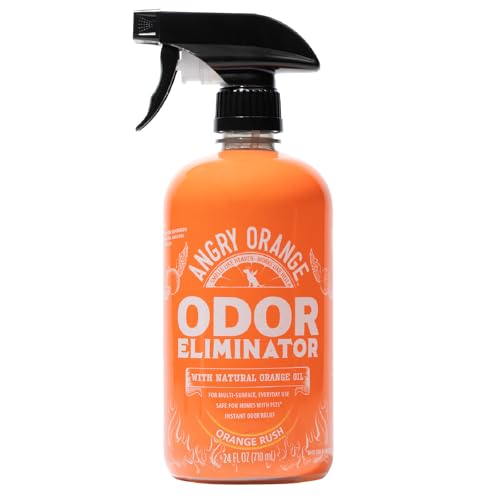
ANGRY ORANGE Pet Odor Eliminator for Dog and Cat Urine, 24 oz
by Angry Orange
A popular citrus deodorizer that is sold into enzyme cleaner searches without being one, and a poor choice for any surface a cat lies on given how irritating citrus oils are to cats.
Pros
- 129,163 ratings with strong owner satisfaction on scent, which is the specific thing this product is actually good at
- Safe across tile, hardwood, laminate and sealed concrete, so it will not damage a hard floor the way a harsh solvent can
- Free of parabens, sulfates and phthalates, and made in the USA
- Works on contact with no dwell time, which is genuinely convenient when you want a room to stop smelling before guests arrive
Cons
- It is not an enzyme cleaner, and it covers odor rather than breaking down the uric acid crystals that make the smell come back
- Owners report needing to reapply every few days, which is the signature of masking rather than removal
- Spray mechanism leaking is a recurring complaint
Kids ‘N’ Pets: The Genuinely Unscented Option, With a Caveat
Kids ‘N’ Pets is tied for the highest rating on this page at 4.6, across more than six thousand ratings, and reviewers consistently report the single property that makes it worth listing: no harsh fumes. It is effectively unscented, requires no rinsing, and is rated across carpet, upholstery, mattresses, clothing and hard surfaces. It is non-toxic and cruelty-free and carries the Parent Tested Parent Approved mark, which is one of very few third-party marks in this aisle. In a household with an asthmatic cat or a fragrance-sensitive person, all of that counts for a lot.
It is not an enzyme cleaner. The listing describes a patented formula that neutralizes and eliminates odours, and nowhere on it is there an enzyme or bacteria claim. Historically this is a non-enzyme oxidizer and surfactant formula, and it works by chemical neutralization rather than biological breakdown. In practice that means it can do a good job on the visible stain and on the immediately detectable smell, while potentially leaving the deeper uric acid residue that produces the ammonia cue a cat responds to. It also carries no CRI certification or other carpet-specific third-party testing behind its carpet claims.
I still recommend it, but for a specific household: one where fragrance is the binding constraint, on fresh accidents rather than year-old stains, and ideally as the follow-up wipe after a true enzymatic product has done the digesting. Buying it believing it is an enzyme cleaner is the mistake. Buying it knowing exactly what it is is a reasonable decision.
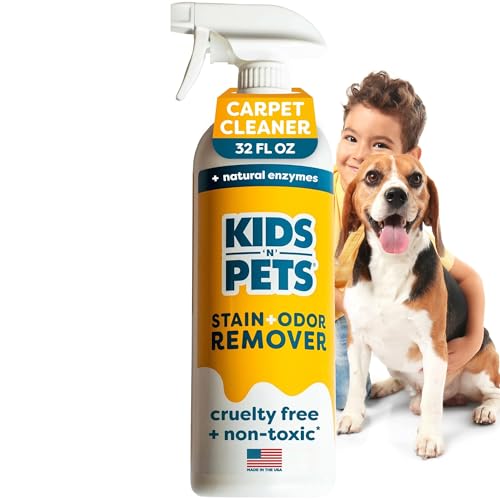
KIDS 'N' PETS Instant All-Purpose Stain & Odor Remover, 32 oz
by Kids 'N' Pets
The closest thing to a genuinely fragrance-free product here and the one I would hand a scent-sensitive household, as long as they understand it neutralizes rather than digests.
Pros
- Tied for the highest rating on this page at 4.6, across more than six thousand ratings, which is a strong satisfaction record for a product this widely used
- Non-toxic and cruelty-free with a Parent Tested Parent Approved award, which is one of the few third-party marks in this aisle
- No rinsing required, so there is no second pass needed on a mattress or a cushion that you cannot easily extract water from
- Reviewers consistently report no harsh fumes, which is the practical reason to choose it in a scent-sensitive or asthmatic household
Cons
- It is not enzymatic, and it works by chemical neutralization rather than biological breakdown, so it may not fully clear the ammonia cue that triggers re-marking
- No CRI certification or other carpet-specific third-party testing behind the carpet claims
Best Cat Urine Enzyme Cleaner for Carpet
Carpet is the hardest common surface because urine does not stay in the pile. It travels down through the backing into the pad and sometimes into the subfloor, so the treatment has to travel the same route. It is also the surface where a badly formulated cleaner can do lasting damage by leaving a sticky residue that attracts soil and makes the spot re-dirty faster than the carpet around it. That is precisely what the Carpet & Rug Institute Seal of Approval tests for, and exactly one product on this page carries it. If you are treating carpet and want an efficacy claim that somebody other than the manufacturer verified, that narrows the field to one. Pair the cleanup with a box routine that stops the accidents recurring, which our guide to cleaning a litter box walks through step by step.
| Product | Price | Buy |
|---|---|---|
| Rocco & Roxie Professional Strength Enzyme Stain & Odor Eliminator, 32 Fl OzBest for carpet overall The only CRI-certified product here, independently tested for carpet efficacy and for re-soiling | $23.92 | View on Amazon |
| Nature's Miracle Advanced Cat Stain & Odor Eliminator, Severe Mess, 32 ozBest for set-in carpet stains Built for severe and set-in messes, and formulated to discourage re-soiling of the treated spot | $13.57 | View on Amazon |
| Unique Pet Odor & Stain Eliminator Enzyme Cleaner Concentrate, 32 ozBest for whole-room carpet treatment Dilutes to more than 2.5 gallons, which is what a large carpeted area actually consumes | $21.99 | View on Amazon |
Best Cat Urine Enzyme Cleaner for Hardwood and Hard Floors
Hard floors need a different approach from carpet, and the difference is dwell behaviour rather than strength. A carpet formula wants to sit wet for fifteen minutes, and on sealed wood that means liquid pooling in board seams and working against the finish. A hard-floor formula is built to do its work in a thinner, shorter application. Apply in passes, wipe the seams, and never let a puddle stand on wood. For unsealed, waxed or oiled floors, get advice from whoever finished them before you wet-treat anything.
| Product | Price | Buy |
|---|---|---|
| Nature's Miracle Hard Floor Cleaner, Stain & Odor Remover, 24 ozBest for sealed hardwood The only dedicated sealed-wood bio-enzymatic formula here, with no reported finish damage | $8.99 | View on Amazon |
| Rocco & Roxie Professional Strength Enzyme Stain & Odor Eliminator, 32 Fl OzBest all-surface enzymatic Bio-enzymatic and rated for hard floors as well as carpet, so one bottle covers a mixed-surface home | $23.92 | View on Amazon |
| ANGRY ORANGE Pet Odor Eliminator for Dog and Cat Urine, 24 ozHard-surface deodorizer only Freshens rather than breaks down: a citrus deodorizer for hard surfaces, not a urine treatment | $16.98 | View on Amazon |
Best Cat Urine Enzyme Cleaner for Mattresses and Upholstery
Foam is the surface owners get most wrong, because the visible stain on a mattress represents a fraction of what is actually in there. Urine soaks down into the foam and spreads outward, and a surface spray physically cannot reach the depth it travelled. The technique that works is saturation: deliver the cleaner in volume, slowly, into the same point, so it follows the path the urine took. Some people use a needleless syringe or a squeeze bottle to inject the solution into the foam rather than misting the surface. Then leave it wet for the full dwell time, press a towel down hard to draw liquid back up, and air dry with a fan. Never apply heat, and never put a still-damp mattress back under bedding.
| Product | Price | Buy |
|---|---|---|
| Biokleen Bac-Out Pet Stain Remover, 32 OunceBest for mattresses Live enzyme cultures and the only listing here explicitly rated for mattresses and pillows | $12.34 | View on Amazon |
| KIDS 'N' PETS Instant All-Purpose Stain & Odor Remover, 32 ozBest fume-free option for foam No rinsing required and effectively unscented, though it neutralizes rather than digests | $19.99 | View on Amazon |
| Rocco & Roxie Professional Strength Enzyme Stain & Odor Eliminator, 32 Fl OzBest widely available alternative Reliably in stock and rated for furniture, the fallback when the Biokleen is unavailable | $23.92 | View on Amazon |
Strongest Enzyme Cleaner for Old, Set-In Cat Urine
An old stain is a fundamentally different chemical problem from a fresh one, and understanding why explains most of the frustration in this category. The water-soluble components of urine leave within days. What stays is uric acid, which forms crystalline salts that are not water-soluble, bond firmly to fibres, and remain chemically stable indefinitely. They are also hygroscopic, meaning they take up water from the air. When humidity rises, those crystals partly dissolve and release their odour compounds again. That is why a spot you cleaned in January announces itself on a damp day in July, and why nothing short of an enzymatic breakdown genuinely finishes the job. Expect two or three passes, long dwell times, and more product than feels sensible.
| Product | Price | Buy |
|---|---|---|
| Nature's Miracle Advanced Cat Stain & Odor Eliminator, Severe Mess, 32 ozStrongest for set-in urine Purpose-built for severe and set-in messes rather than the standard formula relabelled | $13.57 | View on Amazon |
| Simple Solution Extreme Cat Stain Remover, Cat Spray Odor Eliminator, 32ozBest for repeat deep-spot treatment Two times the brand standard strength, and the stream setting drives product to full depth | $14.99 | View on Amazon |
| Rocco & Roxie Professional Strength Enzyme Stain & Odor Eliminator, 32 Fl OzBest certified all-rounder for old stains Reviewers report success on old stains as well as fresh, with independent CRI testing behind it | $23.92 | View on Amazon |
Best Cat Urine Enzyme Cleaner for Concrete and Garage Floors
Concrete is the most porous surface most households will ever have to treat. Urine soaks several millimetres into the slab and spreads sideways, which means a garage floor problem is measured in gallons rather than ounces, and a 32 ounce spray bottle is simply the wrong tool. The economics matter here more than anywhere else on this page: a concentrate that dilutes to more than two and a half gallons, or a true gallon jug, makes a genuinely saturating application affordable. Flood the area, keep it wet for at least fifteen minutes and longer if you can, and expect a second treatment. Sealed concrete behaves more like tile and needs far less.
| Product | Price | Buy |
|---|---|---|
| Unique Pet Odor & Stain Eliminator Enzyme Cleaner Concentrate, 32 ozBest cost per gallon for concrete One bottle makes 2.5+ gallons, and reviewers report it clearing set-in urine from tile grout | $21.99 | View on Amazon |
| SKOUT'S HONOR Cat Urine and Odor Destroyer One Gallon Refill, 128 ozBest ready-to-use volume A true 128 ounce gallon, rated for concrete, with no mixing step before you start | $34.99 | View on Amazon |
| Rocco & Roxie Professional Strength Enzyme Stain & Odor Eliminator, 32 Fl OzBest for small sealed-concrete areas Rated for kennels, garages and car interiors when the area is small enough for a spray bottle | $23.92 | View on Amazon |
Best Unscented and Fragrance-Free Enzyme Cleaner
I have to be honest about this one, because the search demand is high and the market does not currently serve it. There is no well-reviewed, genuinely enzymatic, truly fragrance-free cat urine cleaner widely available right now. The closest true enzymatic product has no added fragrance and no dyes, but it carries a thin review record and unreliable stock. The genuinely unscented product with a deep review base is not enzymatic. You are choosing between those two compromises, and anyone telling you otherwise has not read the listings.
One cautionary note belongs here. A widely sold product marketed specifically as an unscented cat urine enzyme cleaner turns out, from its own manufacturer’s FAQ, to use a chlorine-based formula, described there as chlorine similar to salt rather than bleach. Amazon’s own review summary for it surfaces both bleach concerns and asthma complaints. As a veterinarian I have to be blunt: chlorine chemistry plus the ammonia in cat urine is a chloramine risk, and chloramine gas in a closed room is a genuine respiratory hazard for you and for your cat. Fragrance-free does not mean gentle, and it does not mean enzymatic.
Why this matters clinically: cats have roughly 200 million scent receptors to our five million. A fragranced cleaner applied to a spot the cat has already chosen to soil replaces one strong scent signal with another, and for a sensitive cat that can drive continued avoidance of the area or re-marking on top of it. The same reasoning is why I default to unscented litter, which our cat litter guide covers in more detail.
| Product | Price | Buy |
|---|---|---|
| Biokleen Bac-Out Pet Stain Remover, 32 OunceClosest true enzymatic, fragrance-free No artificial fragrance, no dyes, live enzyme cultures, on a thin review base and scarce stock | $12.34 | View on Amazon |
| KIDS 'N' PETS Instant All-Purpose Stain & Odor Remover, 32 ozBest genuinely unscented, not enzymatic Effectively unscented with no harsh fumes reported, but it neutralizes rather than digests | $19.99 | View on Amazon |
| Unique Pet Odor & Stain Eliminator Enzyme Cleaner Concentrate, 32 ozBest low-fragrance for large areas Light scent, bacteria plus enzymes, and dilutable so you control the working concentration | $21.99 | View on Amazon |
More Cat Urine Cleaners by Type and Situation
A few needs come up often enough to deserve a direct pick. Each product below is reviewed in full above, and this is simply the fastest route to the right one.
| Product | Price | Buy |
|---|---|---|
| Biokleen Bac-Out Pet Stain Remover, 32 OunceBest natural and plant-based Plant-based with live enzyme cultures, no dyes, no phosphates, no chlorine and no ammonia | $12.34 | View on Amazon |
| Nature's Miracle Cat Urine Destroyer Plus, Enzymatic Cleaner, 32 ozBest everyday standard formula A low-cost true enzymatic bottle, sensible for routine fresh accidents on fabric | $12.72 | View on Amazon |
| Simple Solution Extreme Cat Stain Remover, Cat Spray Odor Eliminator, 32ozBest spray-format flexibility Mist, foam and stream from one nozzle, which lets you match delivery to the size of the spot | $14.99 | View on Amazon |
Why Cat Urine Is Different From Every Other Mess
Cat urine is chemically unlike almost anything else that lands on a floor, and every frustrating thing about cleaning it traces back to three compounds.
The first is urea. It is the bulk of what makes urine smell in the first hours, and it is harmless on its own, but bacteria on the surface break it down into ammonia. That is the sharp smell you get from a box that has not been scooped, and it is also why the smell of a fresh accident gets worse over the first day rather than fading. Downstream of that, bacterial action produces mercaptans, the sulfur compounds that are also responsible for the smell of skunk spray.
The second is felinine. Cats excrete this sulfur-containing amino acid, and it is largely unique to them. Felinine itself is nearly odourless when fresh, but it degrades over hours and days into volatile sulfur compounds, principally a thiol, and those are responsible for the distinctive tomcat smell that nothing else in a house produces. Intact males excrete the most, which is why an unneutered male’s urine is in a category of its own, but every cat excretes some. This is the compound that makes cat urine recognisably cat urine rather than simply urine.
The third is uric acid, and it is the reason this page exists. Uric acid forms crystalline salts that are not water-soluble. They bond tightly to carpet fibres, to grout, to the pores of concrete and to the foam in a mattress, and ordinary detergent cleaning slides straight past them. They are also hygroscopic, taking up moisture from humid air, which partly dissolves them and releases the odour again. That is the mechanism behind the single most common complaint in this category: a spot that was cleaned thoroughly in January smells again in July, and the owner reasonably concludes the cat has re-offended when in fact nothing new has happened at all.
An enzyme cleaner is the only household option that addresses the third compound. The proteases and amylases in a bio-enzymatic formula, often alongside live bacterial cultures that continue producing them, chemically digest those organic residues into small, water-soluble, odourless fragments. A detergent lifts and suspends soil so you can blot it away. An enzyme takes the molecule apart. Against uric acid, only one of those two approaches finishes the job.
What Never to Use on Cat Urine
Five things, and each one makes the problem worse rather than merely failing to help.
Ammonia-based cleaners. Cat urine already smells of ammonia. Applying an ammonia cleaner to a spot a cat has soiled is, from the cat’s point of view, a scent signal that says another cat has been here. That is an invitation to re-mark, not a cleanup, and it is one of the most common accidental reinforcements of a soiling habit I see.
Bleach. Two problems. Bleach oxidises rather than digests, so it attacks colour and some odour without touching the uric acid crystals underneath. More importantly, chlorine bleach reacting with the ammonia in urine produces chloramine gas. Never mix them, never use a chlorine product on a fresh urine spot, and be sceptical of any pet cleaner whose manufacturer describes its chlorine content as being like salt.
Steam cleaners and hot-water extraction on an untreated stain. This is the one that causes the most permanent damage and the one almost nobody warns about. Heat denatures the proteins in urine exactly the way it sets a blood stain in fabric. Run a steam cleaner over an untreated urine spot and you have permanently fixed the residue into the fibre before any enzyme could reach it, and no product sold afterwards will fully undo it. Treat enzymatically first, at room temperature. Steam later, or not at all.
Vinegar and baking soda. Not useless, just incomplete. Vinegar breaks down some of the alkaline salts, baking soda adsorbs odour from the air, and between them they handle the water-soluble portion of a fresh accident reasonably well. Neither touches the uric acid crystals, because that needs a protease. This is why the vinegar-and-baking-soda approach works for about a fortnight and then stops working. There is a second reason to be careful with vinegar specifically: its sharp smell is unpleasant to many cats, so applying it to a spot the cat is already targeting can reinforce avoidance of that area.
Homemade DIY enzyme recipes. The citrus-peel, sugar and water fermentation recipe circulates widely and is worth addressing directly, because roughly 2,300 searches a month go to it and nobody with a veterinary credential appears to have corrected it. What that recipe produces is a mildly acidic surfactant solution containing some citric acid and some yeast metabolites. It contains no protease. There is no protein-digesting enzyme in it, because you cannot ferment one into existence from sugar and orange peel in a jar on a windowsill. It will clean a greasy worktop. It will not break down uric acid crystals, and the citrus content makes it a poor choice around cats regardless.
How to Actually Use an Enzyme Cleaner
Technique matters at least as much as product choice here, and this is the sequence I give owners in the exam room.
Find every spot first. Use a UV blacklight in a fully dark room before you open anything. Urine fluoresces, and owners are routinely surprised by how many spots there are and how much larger each one is than the visible stain. Treating three of five spots leaves the scent cue intact and the habit continues, so map the whole problem before you start and mark each spot with tape.
Blot, never rub. On a fresh accident, press an old towel down hard and lift, repeatedly, until you are drawing up very little. Rubbing spreads urine outward through the fibres and grinds it deeper, which makes the treatable area larger and the treatment harder.
Saturate to the depth the urine reached. This is the step almost everyone under-does. Urine travels down into carpet backing and pad, into foam, into the pores of concrete. Pour or stream the cleaner slowly into the same spot until it has clearly gone as deep as the urine did, which on carpet usually means noticeably more product than feels reasonable. On a mattress, deliver it into the foam rather than misting the surface.
Keep it wet for the full dwell time. Ten to fifteen minutes minimum, thirty or more for an old stain. Enzymes need moisture to work, so a cleaner that dries in two minutes has done almost nothing. In a dry room, lay a damp towel or a sheet of foil over the treated area to slow evaporation.
Blot and air dry with no heat. Press the liquid back out with towels, then let it dry naturally, with a fan if you want to speed it up. Do not use a hairdryer, a heater or a steam cleaner at any point in this process.
Cover the spot while it dries. An upturned laundry basket, a sheet of foil or a chair placed over the area stops the cat re-marking it during the hours it is drying and smelling interesting. This one small step prevents a great deal of repeat work.
Re-treat old stains. One pass rarely finishes a set-in spot. Let it dry completely, check it with the blacklight again and by smell at floor level, and treat it a second time if anything remains. Two thorough treatments beat five half-hearted ones.
While you are working on the floor, it is worth reviewing the box setup at the same time, since the two problems usually travel together. Our guides to litter box selection, automatic litter boxes and clumping versus non-clumping litter cover the variables most likely to be driving avoidance, and the free calculator for how much litter to put in a litter box settles the depth question, which more cats object to than owners realise.
When It Is Not Behavior: Medical Causes of House-Soiling
This is the part of the conversation that no cleaner article has, and it is the part that matters most. A cat urinating outside the box is a clinical sign until proven otherwise. Before you conclude that your cat is being difficult, spiteful or territorial, it needs a physical examination and a urinalysis, because a large share of the cases I see in practice turn out to have a medical driver.
FLUTD and feline idiopathic cystitis. Feline lower urinary tract disease is the umbrella term, and idiopathic cystitis is the most common form in cats under ten. It causes bladder inflammation, urgency and pain. A cat that experiences pain in the box begins to associate the box with the pain and starts going elsewhere, which is a perfectly rational response and not a behavioural failure. Stress is a recognised trigger for flares.
Urinary tract infection. Less common in young cats than owners assume, more common in older cats and in cats with diabetes or kidney disease. It causes frequency and urgency, and it requires a urine culture to diagnose properly rather than a guess.
Urethral obstruction in male cats, which is an emergency. A male cat straining in the box, crying, going in and out repeatedly, producing small amounts or nothing at all, is potentially blocked. A complete obstruction becomes life-threatening within a day or two through acute kidney injury and dangerous potassium elevation. This is a go now, not tomorrow situation, and it is the single most important paragraph on this page.
Diabetes mellitus and chronic kidney disease. Both increase urine volume substantially. A cat producing three times its normal volume may simply be unable to hold it long enough to reach the box, particularly if the box is on another floor. Increased drinking alongside accidents is the pattern to watch for.
Osteoarthritis. Badly under-diagnosed in cats and extremely common in older ones. Radiographic evidence of degenerative joint disease is present in the majority of cats over twelve. A high-sided box or one requiring a jump becomes painful to use, and the cat chooses the floor instead. This is one of the easiest causes to address, often by simply providing a box with a low entry, which our litter box guide covers.
Cognitive dysfunction. In senior cats, a syndrome comparable to dementia can mean the cat forgets where the box is or loses the learned habit entirely. More boxes in more locations helps considerably.
No product on this page treats any of these. What thorough cleaning does is remove the scent cue that perpetuates the habit once the medical cause is being managed, and that is a genuinely important half of the solution. But if you treat the carpet and skip the veterinary visit, you will be treating that carpet indefinitely. If your cat is a kitten still learning, our guide to litter training a kitten is the better place to start.
How to Choose a Cat Urine Enzyme Cleaner
Buyer's Guide
Most of the advice written about this category assumes every bottle on the shelf does the same thing. It does not, and two of the eleven products on this page are not enzyme cleaners at all despite being sold and searched as such. These are the six things I actually check before I tell an owner which bottle to buy.
Enzymatic, Oxidizer, or Masker: Read the Bullets, Not the Brand Name
There are three distinct chemistries sold into cat urine searches and only one of them removes the compound that makes the smell come back. A true enzymatic cleaner names its mechanism: protease, amylase, live enzyme cultures, bio-enzymatic, or bacteria and enzymes. Those products digest the organic residue including the uric acid crystals. An oxidizer names hydrogen peroxide, sodium percarbonate or chlorine, and it destroys the colour and much of the odour by chemical attack rather than digestion, which works but can bleach fibres and, in the case of chlorine, should never go near fresh urine. A masker names nothing at all: the bullets talk about eliminating odour and leaving a fresh scent without ever saying how, and the ingredient story is fragrance plus surfactant. On this very page, two products fall into the third group. One is a citrus-oil deodorizer with 129,163 ratings and no enzyme claim anywhere on the listing, and the other is a well-reviewed neutralizing formula that works by chemistry rather than biology. Neither is a bad product. Neither is an enzyme cleaner. Read the bullets before the brand name, because the front of the bottle will not tell you which of the three you are holding.
Dwell Time and Volume, the Two Things Owners Get Wrong
The single most common reason a good enzyme cleaner appears not to work is that it was never given the conditions it needs. Enzymes are biological catalysts suspended in water. They need to be in physical contact with the residue, they need to stay wet, and they need time, usually ten to fifteen minutes for a fresh accident and half an hour or more for a set-in stain. Two failures follow from that. The first is volume: urine travels down into carpet backing, into the pad, into foam, into the pores of concrete, and a light mist over the visible surface never reaches most of what is actually there. The correct amount of product almost always feels excessive, because you are aiming to saturate the full depth the urine reached rather than to dampen the stain you can see. The second is drying. A mist evaporates in a couple of minutes, so even a patient owner who waits a quarter of an hour has given the enzymes almost no working time. Apply generously, cover the spot with a damp towel or a sheet of foil if the room is dry, blot rather than rub, and let it air dry without heat. Buy a bottle size that makes that generosity affordable, because a household that is rationing product is a household that under-applies.
Match the Formula to the Surface
A single multi-surface bottle is the right answer more often than not, but there are three situations where it is genuinely wrong. Sealed hardwood is the first: a carpet formula applied heavily to wood can pool in seams and dwell against the finish for fifteen minutes, which is exactly what a hardwood-specific formula is engineered to avoid, and an unsealed or waxed floor should not be wet-treated at all without professional advice. Foam is the second: a mattress, a sofa cushion or a pet bed absorbs urine to a depth a surface spray cannot reach, and the product has to be delivered in volume, slowly, in the same place, so that it travels the same path the urine did. Porous concrete is the third: a garage floor or a basement slab can hold urine several millimetres deep across a wide area, and treating it properly means gallons rather than ounces, which is why a concentrate or a gallon jug beats a 32 ounce spray on cost alone. Read the surface list on the bottle rather than assuming, and be particularly careful with wool and silk rugs: some labels rule them out entirely, agitation damages a natural-fibre pile whatever you use, and a hidden-corner test comes before any spray.
Fragrance and the Feline Nose
Cats have roughly 200 million scent receptors against our five million, which means a fragrance that reads as faint and pleasant to you is not faint to the cat that has to lie on the treated spot. That matters more than a comfort preference, because the spot you are cleaning is usually a spot the cat has already chosen to soil, and the outcome you want is for the cat to find that area neutral and unremarkable again. A heavily fragranced cleaner replaces one strong scent signal with another, and for a scent-sensitive cat, or one with a history of litter-box avoidance or feline idiopathic cystitis, that can drive continued avoidance of the area or re-marking on top of it. The same logic is why I default to unscented litter, covered in more detail in our litter guide. The honest state of this market is that there is no well-reviewed, genuinely enzymatic, truly fragrance-free product widely available right now. The closest true enzymatic option has no added fragrance or dyes but a thin review record and unreliable stock, and the genuinely unscented option with a deep review base is not enzymatic. That is a real gap, and it is better to know it than to buy something marketed as unscented that turns out to be chlorine-based.
Cost Per Use, Not Cost Per Bottle
The price ranking on the shelf reverses once you account for how much product a real treatment consumes. A 32 ounce ready-to-use spray is the default format, and for a household treating the occasional fresh accident on carpet it is the right one. But a single set-in stain on carpet with a pad underneath can consume a third of a bottle in one pass, and it usually needs two passes. A multi-cat household with three recurring spots, or anyone treating a concrete floor, is buying gallons rather than bottles, and at that point the arithmetic changes completely. A 128 ounce gallon at roughly a third of a cent per ounce more than a small bottle is not really the premium option, it is the value one. A concentrate that dilutes to more than two and a half gallons from a single 32 ounce bottle is cheaper per gallon than anything else here by a wide margin, with the trade-off that you have to mix it. Work out how many treatments you actually expect to do, multiply by the volume a proper saturation takes, and buy the format that makes you willing to use enough product. Rationing an expensive small bottle is how good cleaners get blamed for failures they did not cause.
Certification and Safety Signals Worth Anything
Most of the trust language on these bottles is unregulated. Natural has no legal definition on a household cleaner. Non-toxic has no standard behind it and no testing requirement. Pet safe is a marketing phrase, not a certification, and it appears on products I would not use on a surface a cat sleeps on. Professional strength means nothing measurable unless the brand states what it is stronger than, which is why a 2 times stronger than our standard formula claim is worth more than a professional strength banner. The signals that do mean something are narrower. The Carpet & Rug Institute Seal of Approval involves independent testing for cleaning efficacy and for whether the product damages carpet fibres or accelerates re-soiling, and exactly one product on this page carries it. A clearly stated mechanism on the ingredient panel, naming enzymes, bacteria, peroxide or percarbonate, tells you more than any front-of-bottle phrase. And one safety rule overrides all of it: never combine a chlorine-based product with urine or with any ammonia cleaner, because chloramine gas is the result and it is a genuine respiratory hazard in a closed room.
The Bottom Line on Cat Urine Enzyme Cleaners
For most households, Rocco & Roxie Professional Strength is where I would start. It is genuinely bio-enzymatic, it carries the only independent carpet certification available in this category, and it is rated for the litter box and the carrier as well as the floor, which is where a cat problem usually spreads. If the budget is the constraint, Nature’s Miracle Cat Urine Destroyer Plus is one of the least expensive true enzymatic bottles here and it is the right call for fresh accidents on carpet and bedding, which is most accidents. If the constraint is volume rather than money, the Skout’s Honor gallon is the upgrade, because the single most common application error is using too little product and a gallon is what makes generosity affordable.
The distinction to carry away from this page is the one the category works hard to blur. Nine of these eleven products digest urine residue. Two of them, including one of the best-selling products in the entire category, change how a room smells without touching the uric acid crystals that make the smell come back. Both of those two are good at what they actually do, and neither is what you want if the goal is for the spot to be genuinely gone. Read the bullets, apply enough product, keep it wet, and do not put heat anywhere near an untreated stain.
And if the accidents are new, or the pattern has changed, treat that as a medical question before a cleaning one. A cat that has started urinating outside a box it used reliably for years is telling you something, and the most common answers are painful, treatable and worth catching early. Clean the floor thoroughly so the scent cue stops driving the habit, and get the cat examined so you are solving the cause rather than repeating the cleanup.
Cover photo via Wikimedia Commons.
Frequently Asked Questions
Do enzyme cleaners actually work on cat urine, or is it marketing?
Enzyme cleaner versus vinegar and baking soda: which actually removes the smell?
What should you never use on cat urine?
How long should an enzyme cleaner sit before you blot it up?
Why does the cat urine smell keep coming back after I have already cleaned it?
Related Articles
8 Best Enzyme Cleaners for Cat Urine Laundry of 2026, Vet-Reviewed
cleaning
8 Best Cat Dewormers of 2026, Vet-Reviewed
health-wellness
11 Best Cat Treats of 2026, Vet-Reviewed
cat-food
10 Best Cat Dental Treats of 2026, Vet-Reviewed
cat-food
12 Best Cat Hairball Treats and Remedies of 2026, Vet-Reviewed
cat-food
About the Reviewer

Dr. Priya Anand, DVM, ABVP (Feline)
DVM, Cornell University College of Veterinary Medicine
Dr. Priya Anand is a veterinarian board-certified by the ABVP in Feline Practice, with over a decade caring for cats in a feline-exclusive clinic. She has guided thousands of cat owners through nutrition, litter-box troubleshooting, enrichment, and senior-cat care. She founded House of Mittens in 2026 to cut through pet-aisle marketing and recommend the food, litter, and gear that actually keep cats healthy and happy — judged the way she'd advise her own patients.