8 Best Cat Dewormers of 2026, Vet-Reviewed
Feline vet Dr. Priya Anand reviews the best cat dewormers of 2026. Pyrantel will not touch a tapeworm and praziquantel will not touch a roundworm, and matching the drug to the parasite is the whole decision.
Updated
Most owners who arrive in my consulting room holding a box of cat dewormer are holding the wrong one, and it is not their fault. The word dewormer is used on Amazon to describe at least three unrelated medicines that kill different parasites and share almost no overlap. Praziquantel clears tapeworms and will not touch a roundworm. Pyrantel pamoate clears roundworms and hookworms and will not touch a tapeworm. Fenbendazole reaches the widest range of the three and still misses the flea tapeworm that most indoor cats actually carry. Buying the wrong one does not partly work. It does nothing, the cat stays infected, and the owner concludes that dewormers do not work.
So this page is organised around the one decision that matters: matching the active ingredient to the parasite in front of you. I have checked each product’s disclosed drug and strength against its own listing rather than its marketing copy, verified which Amazon category each is actually filed under, and been explicit where a listing is really a dog product wearing a cat-adjacent title. There is a parasite matrix below the table that maps each worm to the drug that kills it and to the products here that carry that drug.
One piece of context to carry into everything that follows. The commonest tapeworm in a house cat, Dipylidium caninum, does not pass from cat to cat. It arrives inside a flea, swallowed during grooming. That means a cat that keeps getting tapeworm has a flea problem rather than a deworming problem, and until the fleas are gone you will be buying praziquantel every few weeks forever. If that describes your household, read our guide to flea treatment for cats alongside this one, because deworming without flea control is a treadmill.
Which Dewormer Kills Which Worm
This is the table I wish came printed on the shelf. Find the parasite, read across to the drug that kills it, and buy a product carrying that drug. Nothing else in this category is more useful than getting this right.
| Parasite | Active ingredient that kills it | Products here that carry it | How you would recognise it |
|---|---|---|---|
| Tapeworm (Dipylidium caninum, Taenia taeniaeformis) | Praziquantel. Fenbendazole reaches some Taenia species but is unreliable against Dipylidium | Elanco Tapeworm, OZIPCO, Poxo praziquantel liquid, Elanco Drontal | Rice-grain or sesame-seed segments around the tail base, in the bedding, or moving on a fresh stool |
| Large roundworm (Toxocara cati) | Pyrantel pamoate or fenbendazole | Bipinelyt liquid, OZIPCO, Elanco Drontal, YOUERYOU fenbendazole, Revolution Plus | Spaghetti-like worms in vomit or stool, a pot-bellied kitten, dull coat, poor growth |
| Hookworm (Ancylostoma species) | Pyrantel pamoate or fenbendazole | Bipinelyt liquid, OZIPCO, Elanco Drontal, YOUERYOU fenbendazole, Revolution Plus | Dark tarry stool, pale gums, weight loss. The worms themselves are too small to see |
| Whipworm | Fenbendazole only | YOUERYOU fenbendazole liquid | Uncommon in cats. Mucousy or bloody diarrhoea, diagnosed on a faecal float rather than by eye |
| Giardia | Nothing sold over the counter reaches it | None on this page, and none in the aisle | Soft, pale, greasy, foul-smelling diarrhoea that comes and goes. This is a veterinary appointment |
| Heartworm | Prevention only (selamectin). There is no safe treatment in cats | Revolution Plus | Coughing or sudden collapse. Prevented, never treated, which is why prevention matters |
Two things follow from that table and both are worth stating plainly. First, no single product sold over the counter covers tapeworm, roundworm, hookworm, whipworm and Giardia together, so any listing that implies total coverage is overselling itself. Second, if your cat has soft, greasy, recurring diarrhoea and repeated deworming has changed nothing, stop buying dewormers. That pattern is Giardia or coccidia far more often than it is a resistant worm, and neither responds to anything on this page.
Find the Right Cat Dewormer for Your Situation
Jump straight to the section that matches your cat:
- Best cat dewormers overall
- Best cat dewormer for tapeworms
- Best over-the-counter cat dewormer
- Best cat dewormer for all worms
- Best liquid cat dewormer
- Best cat dewormer tablets and pills
- Best cat dewormer for roundworms
- Best natural cat dewormer
- More cat dewormers by parasite and situation
How We Chose These Cat Dewormers
Every product here was assessed on its declared active ingredient first, read off the listing’s own specification rather than its marketing copy, because the marketing copy in this category is close to useless. Titles routinely say broad spectrum when the product contains one drug covering one parasite family. Where a listing disclosed a milligram strength, I recorded it, and disclosure itself became a selection criterion. In an aisle dominated by anonymous white-label sellers, a listing that tells you it contains 18.2 mg of praziquantel and 72.6 mg of pyrantel per tablet is behaving like a medicine, and a listing that names two drugs and refuses to say how much of either is in the tablet is behaving like a supplement. That single distinction did more to separate credible products from filler than any other test I applied.
I also checked Amazon’s own Best Sellers Rank category for every candidate, which turned out to be the most revealing step in the whole process. Products marketed with cats in the title are routinely filed by Amazon under Dog Wormers, and one of the strongest-looking options in the category is filed under Prescription Cat Medications and cannot be bought without a veterinarian’s authorisation. Two products on this page carry that flag openly in their reviews because the honest description of what they are is more useful than a tidier page would be.
The finding that surprised me most concerns the cheap end of this aisle. Every low-cost, established-brand dewormer I checked on Amazon US, including Durvet 2X, PetArmor Sure Shot, PetArmor 7 Way, Sentry WormX Plus, Triple Wormer and Elanco Quad, is labelled for dogs. Those brands have ceded the inexpensive end of the cat aisle almost entirely. The one exception is Elanco’s single-drug tapeworm tablet, and it treats tapeworm only, which is why this page still has no budget pick. The cat-labelled combination products sit close together on price, and going meaningfully cheaper than them means buying a product formulated and dosed for a different species. That is also why the dog-product warning further down is not a technicality. It is the predictable consequence of a price gap that owners will try to close by themselves.
For protocol, the standing reference is the Companion Animal Parasite Council, whose feline guidance underlies the kitten schedule below and the recommendation to repeat a dose rather than treat once and assume the job is finished.
Best Cat Dewormers Overall
These are the full reviews in order, starting with the product I would put in front of most owners and working through the established-brand tapeworm tablet, the tapeworm liquid, the veterinary-brand box, the other liquids, the dog-labelled caution and the prescription preventative.
Best Overall: OZIPCO Praziquantel and Pyrantel Tablets
This is the product most owners think they are buying when they reach for something labelled broad spectrum, and it is the one I would put in front of most of them. It contains two actives rather than one: praziquantel for tapeworm, and pyrantel pamoate for roundworm and hookworm. That is the same pairing the established veterinary combination product uses, so one tablet covers the three parasites behind the overwhelming majority of intestinal worm burdens in domestic cats. If rice-grain segments by the tail brought you here, it treats that. If a pot-bellied kitten did, it treats that too. You do not have to be certain which worm it is before you buy.
What earns it a place ahead of dozens of visually identical marketplace listings is that it tells you how much of each drug is in the tablet: 18.2 mg of praziquantel and 72.6 mg of pyrantel, as pyrantel pamoate. That sounds like a small detail and it is the most important trust signal in this entire category. A dosing instruction is meaningless without a strength behind it, and if something goes wrong, the first question any veterinarian will ask is how many milligrams per kilogram the cat received. A seller who will not publish that number has not given you a medicine, they have given you a tablet. The label’s weight chart runs from half a tablet to two, so a kitten or a small cat gets a set fraction rather than a guess, and it is labelled from six weeks and two pounds.
Elanco’s single-purpose tapeworm tablet held the top spot here until October, when Amazon briefly sold it only through its grocery delivery service. It is back on ordinary delivery and reviewed just below, but I have kept the combination tablet first, because it is the right purchase when you are not yet sure which worm you are dealing with. The reasons for caution here are clear and I would rather say them than bury them. With 36 ratings the household evidence behind it is thin, and a thin record cannot tell you about uncommon problems. It is a marketplace white-label product without a long manufacturing history to check. And the fifty-tablet count suits a breeder or a rescue better than a home with one cat, where most of the box will reach its expiry date unused. If pilling is the barrier in your house, our guide to giving a cat a pill will get you further than a second purchase will.

Cat Dewormer Tablets - Praziquantel and Pyrantel Pamoate Wormer for Cats and Kittens, Broad Spectrum Tapeworm, Roundworm and Hookworm Dewormer, 50 Tablets
by OZIPCO
The over-the-counter tablet I would put in front of most owners: the same two-drug pairing veterinarians use, covering tapeworm, roundworm and hookworm in one dose, from the rare marketplace listing that tells you exactly how many milligrams of each it contains. The review record behind it is still short.
Pros
- It discloses its actual drug strengths, 18.2 mg praziquantel and 72.6 mg pyrantel (as pyrantel pamoate) per tablet, which is the single most useful trust signal in a category where most listings disclose nothing at all
- Two actives in one tablet means it covers tapeworm, roundworm and hookworm together, so it is the right drug whether the segments by the tail or a pot-bellied kitten brought you here
- The label's weight chart starts at half a tablet, so a small cat or a kitten gets a set fraction rather than a guess
- Labelled from six weeks and two pounds, which brings most weaned kittens inside its range
Cons
- 36 ratings is a thin evidence base, and a thin base cannot tell you much about rare problems
- It is a marketplace white-label product rather than an established veterinary brand, so there is no long manufacturing record to check
- Fifty tablets is far more than a single-cat household will ever use before the expiry date matters
Best for Tapeworms: Elanco Tapeworm Dewormer Tablets
If the only thing you have seen is rice-grain segments by the tail or in the bedding, this is the tablet I would hand you. It contains praziquantel and nothing else, which is exactly right for Dipylidium caninum, the flea-borne tapeworm behind most feline cases, and for Taenia taeniaeformis, the one cats pick up from hunting rodents. It is the established-brand version of the drug, sold and shipped by Amazon, and it carries the deepest review record on this page by a wide margin.
Dosing runs by weight band on the label: half a tablet for a cat of four pounds or less, one tablet from five to eleven pounds, and one and a half above that, from six weeks of age. It can be given whole or crumbled into a little food, and the label says fasting is neither necessary nor recommended. As with any praziquantel, you will usually see nothing come out afterwards, because the drug lets the gut digest the worm.
Its limits are the limits of a single drug. It does nothing for roundworm or hookworm, so a pot-bellied kitten or a rescue of unknown history needs the combination tablet above instead. Three tablets covers a dose and a repeat for one cat, not a multi-cat household. And because the flea tapeworm arrives inside a flea, it will clear today’s infection without preventing the next one. Treat the fleas at the same time, with something from our flea treatment for cats guide, or the segments will be back.
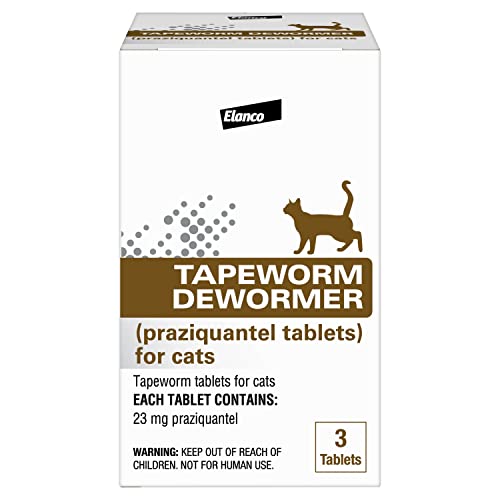
Elanco Tapeworm Dewormer (Praziquantel Tablets) for Cats and Kittens 6 Weeks and Older, 3 Count
by Elanco
The established-brand praziquantel tablet: the right drug for rice-grain segments by the tail, from Elanco, sold by Amazon, with the deepest review record on this page. It treats tapeworm and nothing else, so when the parasite is in doubt the combination tablet comes first.
Pros
- Praziquantel is the drug that clears Dipylidium caninum, the flea-borne tapeworm most house cats carry, and this is the established-brand version of it
- The deepest review record of any product on this page, by a wide margin
- Weight-banded dosing on the label, from half a tablet for a cat of four pounds or less, and the tablet can be given whole or crumbled into food
- Sold and shipped by Amazon on ordinary delivery, with no fasting needed before or after the dose
Cons
- Praziquantel only, so it does nothing for roundworm or hookworm and is the wrong purchase for a pot-bellied kitten
- Three tablets covers a dose and a repeat for one cat, not a multi-cat household
- It clears today's flea tapeworm without preventing the next one, so it needs flea control alongside it
Best Tapeworm Liquid: Poxo Praziquantel Liquid
If an owner describes something like a grain of rice moving near their cat’s tail, the conversation is effectively over and the answer is praziquantel. Those segments are proglottids, the reproductive packets a tapeworm sheds, and praziquantel is the drug that clears them. It works differently from the other actives on this page: rather than paralysing the worm, it damages the tapeworm’s protective outer layer so the parasite is digested inside the intestine. That mechanism matters for one practical reason. You will usually not see a dead tapeworm come out, so owners frequently assume the dose failed. It did not. The correct endpoint is that new segments stop appearing over the following week or two.
This is the praziquantel liquid I would choose today. It publishes its strength, 50 mg of praziquantel per millilitre, which is the number you need to check the by-weight dose against your cat. And it is a liquid, so a cat that has learned to defeat a tablet can still get a full dose, given into the cheek pouch or mixed into a small portion of wet food you watch disappear. It is labelled from six weeks, and Amazon files it under Cat Wormers rather than under a dog category.
The limits are real. Only 15 ratings stand behind it, the thinnest record on this page, so I am recommending it on its drug and its disclosure rather than on accumulated household experience. The listing also oversells itself. It says the product handles common worms as well as tapeworm, and praziquantel does not touch roundworm or hookworm. It promises no side effects, which no dewormer can honestly promise. Read it as what its active ingredient says it is: a tapeworm treatment. That also makes it the wrong bottle for a kitten with a roundworm burden, where you want pyrantel or the combination tablet above.

Tapeworm Treatment for Cats & Kittens (6+ Weeks), Praziquantel Liquid, 100 mL
by Poxo
Single-purpose praziquantel in a liquid with a published strength, for the healthy adult cat with rice-grain segments by the tail, or a cat that will not take a tablet. Ignore the listing's broader claims: it treats tapeworm and nothing else, and only 15 ratings stand behind it.
Pros
- Praziquantel is the correct drug for feline tapeworm, including Dipylidium caninum, the species cats get from swallowing a flea
- It publishes its strength, 50 mg of praziquantel per mL, so the by-weight dose can be checked rather than taken on trust
- A liquid dosed by the millilitre avoids splitting tablets and can go straight into the cheek pouch or into a small portion of wet food
- Labelled for kittens from six weeks and filed by Amazon under Cat Wormers, so the dosing instruction was written for the species you are treating
Cons
- 15 ratings is the thinnest review record on this page, so there is almost no household evidence behind it yet
- Its listing claims it handles common worms and has no side effects. Praziquantel does not touch roundworm or hookworm, and no dewormer is free of side effects
- A tapeworm-only drug is the wrong purchase for a kitten with a roundworm burden
Best for Multi-Cat and Rescue: Elanco Drontal Broad Spectrum Dewormer
Drontal is the broad-spectrum feline dewormer most veterinarians will name without hesitating, and this listing is the genuinely over-the-counter version of it. That distinction is worth spelling out, because the small three-count Drontal listing on Amazon is prescription-gated, and I verified that this fifty-tablet box is not. It contains the same praziquantel and pyrantel pamoate pairing, dosed at one tablet per four to eight pounds of body weight, covering tapeworm, roundworm and hookworm in a single administration.
Two things make it the upgrade pick rather than simply another combination tablet. It comes from Elanco with a long veterinary record behind the formulation, sold first-party by Amazon, and carries 1,074 ratings, which is far more real-world evidence than any other broad-spectrum product here. And its label runs from one month and one and a half pounds, the lowest age and weight floor on this page. For anyone fostering litters, that floor is the specification that matters most, because very young kittens are exactly the population with the heaviest roundworm burdens and the fewest labelled options.
The honest problem is the box. Amazon’s own review summary captures it accurately: buyers find it highly effective and are split on value, with some calling it very expensive. The per-tablet cost works out modest, so this is not poor value in any arithmetic sense, and the barrier is that you must buy fifty tablets at once to get there. A single-cat household does not need fifty tablets and should not buy them. A rescue, a foster programme, a multi-cat household or a barn colony is exactly who this box is for, and for that reader it is the most sensible purchase on the page. Note the same limit as every praziquantel and pyrantel product: it does not reach whipworm, and it does nothing for Giardia.
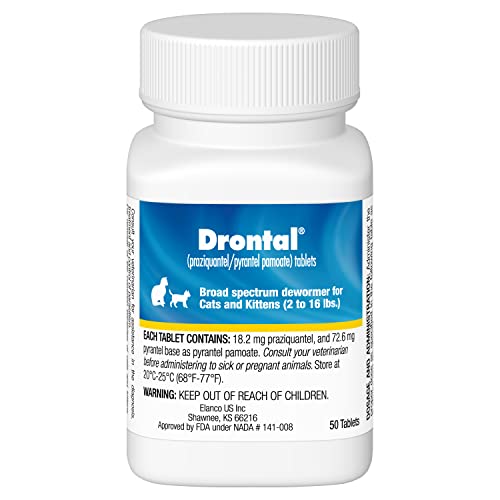
Elanco Drontal Broad Spectrum Cat and Kittens Dewormer, 50 Tablets
by Elanco
The established veterinary broad-spectrum dewormer in an over-the-counter fifty-tablet box: the per-tablet cost is modest and the box price is the barrier, which makes it a multi-cat, foster and rescue answer rather than a single-cat purchase.
Pros
- Drontal is the established veterinary broad-spectrum feline dewormer, and this is the genuinely over-the-counter listing of it rather than one of the prescription-gated packs
- Praziquantel and pyrantel pamoate together cover tapeworm, roundworm and hookworm in one tablet, dosed at one tablet per four to eight pounds
- Sold directly by Amazon.com as a first-party listing, with 1,074 ratings behind it, which is far more real-world evidence than any other broad-spectrum option here
- Labelled from one month and one and a half pounds, the lowest age and weight floor of anything on this page, which matters for fostered litters
Cons
- The box price is the barrier: Amazon's own review summary says buyers find it highly effective but split on value, with some calling it very expensive
- Fifty tablets is a supply for a colony, a rescue or a foster programme, and a single-cat household does not need fifty tablets
- Like every praziquantel and pyrantel product, it does not reach whipworm and does not touch Giardia
Best Fenbendazole Option: YOUERYOU Fenbendazole Liquid for Cats
Fenbendazole is the broadest-spectrum active you can buy without a prescription. It reaches roundworm, hookworm, whipworm and some tapeworm species, which is more ground than praziquantel or pyrantel cover individually, and it is the only over-the-counter drug that touches whipworm at all. Whipworm is uncommon in cats, which is precisely why it is the parasite most likely to be missed by an owner working through combination tablets that cannot reach it.
The reason this particular product earns a place is narrower and more specific than its spectrum. It is the only genuinely cat-labelled fenbendazole I could find, in a category where essentially every fenbendazole listing on Amazon is sold, ranked and reviewed as a dog product. That matters because it means the dosing instruction in front of you was written for the species you are treating. Delivered as a 10 percent liquid mixed into food, it also avoids the pilling problem entirely, and the 150 mL bottle is enough to run a full course through more than one cat without reordering halfway.
Two limits, both real. With 48 ratings this has a thin review record, so there is very little accumulated household experience to draw on and I would not pretend otherwise. And fenbendazole is not a one-and-done drug: it is normally given as a three-day course rather than a single dose, which is more compliance than a single tablet demands, and stopping after one day is a common way to get a disappointing result. One more thing to be clear about. Fenbendazole is unreliable against Dipylidium caninum, the flea tapeworm, so if what you are looking at is rice-grain segments, go back to praziquantel.

Fenbendazole Dewormer for Cats & Kittens, Liquid, 150 mL
by YOUERYOU
The only cat-labelled fenbendazole on this page, and the only product here that reaches whipworm, given as a multi-day course mixed into food and carried by a review record of just 48.
Pros
- Fenbendazole is the broadest-spectrum active sold over the counter, reaching roundworm, hookworm, whipworm and some tapeworm species, which no praziquantel or pyrantel product can claim
- It is the only genuinely cat-labelled fenbendazole product on this page, in a category where almost every fenbendazole listing is sold for dogs
- A 10 percent liquid mixed into food avoids pilling entirely, which is often the difference between a full dose and a spat-out half dose
- The 150 mL bottle covers a multi-day course for more than one cat without reordering mid-course
Cons
- 48 ratings is a thin review record, so there is very little household evidence behind it
- Fenbendazole is normally given as a three-day course rather than a single dose, which is more compliance than a one-tablet product asks for
- It does not reliably clear Dipylidium caninum, the flea tapeworm, so it is not the answer to rice-grain segments
Best for Cats That Cannot Be Pilled: Bipinelyt Pyrantel Pamoate Liquid
Some cats cannot be pilled. Not will not, cannot: an eight-week-old kitten is too small to handle safely for a tablet, an elderly cat with a painful mouth should not be held open, and some adults have simply learned the routine and will defeat you every time. For those cats a liquid suspension with a syringe is not a lesser option, it is the only one that reliably delivers a full dose.
Pyrantel pamoate is also the right drug for the population that most needs a liquid. It is poorly absorbed from the gut, which gives it a wide safety margin, and it is the standard first dewormer for very young kittens for that reason. This product is labelled from four weeks of age and dosed at half a millilitre per pound, with a 1 mL syringe included. It discloses its strength as well, 4.54 mg of pyrantel base per millilitre, which is what turns that dosing instruction into something you can actually verify against your cat’s weight rather than take on trust.
Two honest limits, and the first is the more important. This is a pyrantel-only product. It covers roundworms and hookworms and does not touch tapeworm, so if you have seen segments around your cat’s tail this is the wrong bottle and no amount of it will help. The second is that Amazon’s own review summary reports effectiveness as genuinely mixed, with a real share of buyers saying it did not work for them. I take that seriously while noting that some of it is predictable: a pyrantel product bought for a tapeworm will always read as a failure. Weigh the cat, measure the dose, and repeat in two to three weeks, because a single dose never clears larvae that were still developing at the time.

Liquid Dewormer for Cats & Kittens, Pyrantel Pamoate Oral Suspension with Dosing Syringe, 50 mL
by Bipinelyt
A syringe-dosed pyrantel liquid for the kitten or the unpillable cat, with a disclosed strength and an honest caveat: it covers roundworm and hookworm only, and reviewer experience is genuinely mixed.
Pros
- A liquid suspension with an included 1 mL syringe is the most practical way to dose a kitten or a cat that cannot be pilled at all
- It discloses its strength, 4.54 mg of pyrantel base per mL, which is what makes the half-millilitre-per-pound instruction something you can actually check
- Labelled from four weeks of age, which covers the early kitten deworming window when roundworm burdens matter most
- Pyrantel pamoate is poorly absorbed from the gut and has a wide margin of safety, which is why it is the standard first dewormer for very young kittens
Cons
- It treats roundworms and hookworms only and does not touch tapeworm, so it is the wrong purchase for a cat with segments around the tail
- Amazon's own review summary reports effectiveness as genuinely mixed, with a real share of buyers saying it did not work for them
- A 50 mL bottle is small once you are dosing an adult cat at half a millilitre per pound
The Dog-Labelled Fenbendazole: Panacur C Canine Dewormer
This product is on the page as a caution, not as a bargain, and I want to be exact about why it is here at all. Fenbendazole is a legitimately useful drug in cats and veterinarians do prescribe it off label, frequently. Panacur is an established veterinary brand with a real manufacturing record. The granules dissolve into wet food and are easy to administer. None of that is in dispute, and it is precisely why so many owners end up with this box in the cupboard.
The problem is everything the listing tells you about its intended patient. The product name says Canine. Amazon files it under Dog Wormers. The dosing table printed on the packet is calibrated for dogs, by weight, for canine parasites. And its 5,888 ratings, which look impressive next to everything else here, are overwhelmingly dog owners: Amazon’s own review summary surfaces dog tolerance as a recurring topic, and one reviewer describes using it on aquarium planaria. None of that record is evidence about cats. Do not read the price or the rating on this listing as information about how it performs in a cat, because it is not.
So the instruction is narrow and I will not soften it. Do not calculate a feline dose yourself by reading across the canine table. Cats differ from dogs in the liver pathways that clear drugs, dose conversions between species are not proportional, and the fact that a drug is used off label means a veterinarian decided the dose, not that the dose on the box transfers. If your vet has told you to use fenbendazole and given you a feline dose in milligrams per kilogram, this is a perfectly reasonable product to buy. If nobody has given you that number, buy the cat-labelled fenbendazole liquid above instead.

Panacur C Canine Dewormer (Fenbendazole), 1 Gram, 3 Count
by Panacur
A legitimate fenbendazole product that is labelled, ranked and reviewed as a dog dewormer. Vets do use fenbendazole off label in cats, which is exactly why this belongs here as a caution: get the feline dose from your vet rather than reading across from the dog table.
Pros
- Fenbendazole is a genuinely useful drug in cats and veterinarians do prescribe it off label, so this is a legitimate product used in a clinical context rather than a gimmick
- Panacur is an established veterinary brand with a long manufacturing record, which is rare at this end of the aisle
- The granule packets dissolve into wet food, so administration is straightforward once you have been given a correct feline dose
- It reaches whipworm and some tapeworm species alongside roundworm and hookworm, which is the broadest single-drug coverage available without a prescription
Cons
- It is dog-labelled: the product name says Canine, Amazon files it under Dog Wormers, and the dosing table on the packet is calibrated for dogs
- The 5,888 ratings are overwhelmingly from dog owners, with Amazon's own review summary surfacing dog tolerance as a topic and one reviewer using it on aquarium planaria, so none of that record is evidence about cats
- Do not work out a feline dose yourself from a canine table. Ask your veterinarian for the cat dose before you open the box
Best Monthly Prevention: Revolution Plus Topical Solution
Everything else on this page treats an infection that has already happened. This one is the other half of the problem, and for a lot of households it is the half that actually ends the cycle. Selamectin and sarolaner applied monthly to the skin cover roundworms, hookworms, heartworm, fleas, ticks and ear mites in a single product. That breadth matters here for a reason specific to this page: by removing the flea it removes the transmission route for Dipylidium caninum, which is how most indoor cats acquire a tapeworm in the first place. It does not kill the tapeworm. It stops the next one arriving.
Heartworm is the part owners overlook and the part I would not. Feline heartworm disease cannot be safely treated the way it can in dogs. There is no approved adulticide protocol for cats, the presentation can be sudden respiratory collapse, and prevention is genuinely the only intervention available. A monthly topical that covers heartworm alongside the intestinal worms and the flea is doing several jobs at once, and compliance with a topical is far better than with a tablet course, because nobody has to open a cat’s mouth.
Two things have to be said clearly. This is prescription only. Amazon files it first in Prescription Cat Medications, it ships from Vetsource as a licensed veterinary pharmacy, and the listing says so itself, so it requires your veterinarian’s authorisation rather than a click. And it does not treat an existing tapeworm. If your cat has segments right now, you need praziquantel for the current infection and something like this for the reinfection, which is a two-product answer rather than one. The pack here is sized for cats between 11.1 and 22 pounds, so check your cat’s weight band before ordering. If a topical flea product is not workable in your household, our guide to oral flea treatment for cats covers the tablet route to the same outcome.

Revolution Plus Topical Solution for Cats, 11.1-22 lbs, 6-Month Supply
by Zoetis
The monthly prevention answer rather than a treatment: it stops roundworm, hookworm and heartworm and removes the flea that carries tapeworm, but it requires a prescription and it will not clear an infection your cat already has.
Pros
- Selamectin and sarolaner cover roundworms, hookworms, heartworm, fleas, ticks and ear mites in one monthly topical, which is the closest thing to a single answer in this whole category
- Removing the flea removes the tapeworm's transmission route, so it prevents the most common feline tapeworm indirectly by breaking the life cycle
- A monthly topical bypasses pilling entirely, which is why compliance with it is so much better than with a tablet course
- It ships from Vetsource, a licensed veterinary pharmacy, so the cold-chain and authenticity questions that hang over grey-market parasiticides do not apply
Cons
- It is prescription only. Amazon files it first in Prescription Cat Medications and the listing says so itself, so it needs your veterinarian's authorisation and is not a walk-up purchase
- It does not treat an existing tapeworm infection. If your cat already has segments, this will not clear them and you still need praziquantel
- This pack is sized for cats between 11.1 and 22 pounds, so a smaller cat needs a different weight band
Best Cat Dewormer for Tapeworms
Tapeworm is the parasite owners diagnose themselves most often, and they are usually right, because it is the one you can see. The segments are shed from the end of the worm, pass out with the stool, and dry into hard yellowish grains that look like sesame seeds stuck to the fur around the tail base or scattered in the bedding. If you find those, you are looking at a tapeworm and you need praziquantel. Nothing else reliably clears Dipylidium caninum, the flea-borne species that accounts for most feline cases.
For a healthy adult cat where segments are the only sign, the Elanco tapeworm tablet is the purchase: the drug that clears the flea tapeworm, from an established brand with years of household use behind it. If the cat is a rescue of unknown history or a kitten, start with the combination tablet instead, because it also covers the roundworm and hookworm you may not have noticed. The praziquantel liquid is for a cat that will not take a tablet, and the fifty-tablet veterinary-brand box is for a household treating several cats together.
One reminder that saves a lot of worry. Praziquantel dissolves the tapeworm inside the intestine rather than paralysing it, so you will usually see nothing come out. Judge the result by whether new segments appear over the following two weeks, not by what turns up in the litter box the next morning.
| Product | Price | Buy |
|---|---|---|
| Elanco Tapeworm Dewormer (Praziquantel Tablets) for Cats and Kittens 6 Weeks and Older, 3 CountBest for tapeworms overall Established-brand praziquantel, dosed by weight band from six weeks, sold by Amazon and backed by the deepest review record on this page. | $19.97 | View on Amazon |
| Cat Dewormer Tablets - Praziquantel and Pyrantel Pamoate Wormer for Cats and Kittens, Broad Spectrum Tapeworm, Roundworm and Hookworm Dewormer, 50 TabletsBest if other worms are possible Praziquantel for the tapeworm plus pyrantel for roundworm and hookworm in one tablet, with both milligram strengths published. | $39.99 | View on Amazon |
| Tapeworm Treatment for Cats & Kittens (6+ Weeks), Praziquantel Liquid, 100 mLBest tapeworm liquid for cats that refuse tablets Single-purpose praziquantel at a published 50 mg per mL, dosed by weight from six weeks. Its review record is still very short. | $29.99 | View on Amazon |
Best Over-the-Counter Cat Dewormer (No Vet Prescription)
Most of what a healthy adult cat needs is available without a prescription, and the products below are the ones I would actually trust off a shelf. What the over-the-counter route cannot give you is a diagnosis. You are choosing the drug based on what you have seen, which works well when what you have seen is unambiguous, such as tapeworm segments or whole roundworms in vomit, and works badly when the presenting sign is diarrhoea or weight loss that a dozen different things can cause.
That is the honest boundary. If your cat is a well adult with visible segments, buy praziquantel and treat at home. If your cat is a kitten, is unwell, has blood or mucus in the stool, has recurring greasy diarrhoea, or has already had one correctly chosen dose that changed nothing, the useful purchase is a faecal test rather than a second box. Giardia and coccidia both present as worm-like illness and neither responds to anything sold over the counter.
Among the over-the-counter options, I weight disclosure heavily. A product that publishes its milligram strength lets you check the dosing instruction against your cat’s actual weight, and in a marketplace flooded with unbranded tablets that single behaviour separates the sellers worth trusting from the rest.
| Product | Price | Buy |
|---|---|---|
| Cat Dewormer Tablets - Praziquantel and Pyrantel Pamoate Wormer for Cats and Kittens, Broad Spectrum Tapeworm, Roundworm and Hookworm Dewormer, 50 TabletsBest over-the-counter overall Publishes both drug strengths per tablet and covers tapeworm, roundworm and hookworm together, though only 36 ratings stand behind it. | $39.99 | View on Amazon |
| Elanco Tapeworm Dewormer (Praziquantel Tablets) for Cats and Kittens 6 Weeks and Older, 3 CountBest praziquantel-only option Elanco's praziquantel tablet, for the clearest and most common self-diagnosis in this category: visible tapeworm segments. | $19.97 | View on Amazon |
| Elanco Drontal Broad Spectrum Cat and Kittens Dewormer, 50 TabletsBest veterinary brand without a prescription The over-the-counter fifty-tablet box of the veterinary standard, sold by Amazon itself. | $221.99 | View on Amazon |
Best Cat Dewormer for All Worms (Broad-Spectrum)
Broad spectrum is the most abused phrase in this aisle, so start with what it can honestly mean. A praziquantel and pyrantel combination covers tapeworm, roundworm and hookworm, which is genuinely broad and is the standard veterinary answer for a cat of unknown parasite status. Fenbendazole covers roundworm, hookworm, whipworm and some tapeworm species, which is broad in a different direction, reaching whipworm that the combinations cannot while being unreliable against the flea tapeworm they handle well.
What broad spectrum never means, on any product sold over the counter, is everything. No product on this page or in this category covers tapeworm, roundworm, hookworm, whipworm and Giardia together. Giardia is not a worm at all, it is a protozoan, and it requires a prescription medication your veterinarian will choose after a faecal test. If a listing implies otherwise, that is a reason to distrust the rest of its claims.
For a newly adopted cat with no history, the praziquantel and pyrantel combination is where I would start. If diarrhoea persists after that and the faecal test points at whipworm, fenbendazole is the follow-up rather than the starting point.
| Product | Price | Buy |
|---|---|---|
| Elanco Drontal Broad Spectrum Cat and Kittens Dewormer, 50 TabletsBest broad-spectrum overall Praziquantel plus pyrantel from an established veterinary brand, with the lowest age and weight floor on this page at one month and a pound and a half. | $221.99 | View on Amazon |
| Cat Dewormer Tablets - Praziquantel and Pyrantel Pamoate Wormer for Cats and Kittens, Broad Spectrum Tapeworm, Roundworm and Hookworm Dewormer, 50 TabletsBest broad-spectrum for a small household The same two-drug pairing with both strengths published per tablet, dosed from half a tablet for kittens and small cats. | $39.99 | View on Amazon |
| Fenbendazole Dewormer for Cats & Kittens, Liquid, 150 mLWidest single-drug coverage Fenbendazole reaches whipworm as well as roundworm and hookworm, which no combination tablet here does, but it is unreliable against the flea tapeworm. | $36.99 | View on Amazon |
Best Liquid Cat Dewormer
A liquid exists to solve one problem: getting the full dose into a cat that will not take a tablet. That problem is more common than owners expect and it is the single biggest reason home deworming fails. Half a tablet on the kitchen floor is an underdose, an underdose leaves survivors, and the owner believes the infection has been treated. A measured liquid drawn into a syringe and delivered into the cheek pouch does not have that failure mode, and mixing a dose into wet food removes the struggle entirely provided your cat eats the whole bowl.
The three liquids here are not interchangeable, and the difference is the drug rather than the format. The pyrantel suspension covers roundworms and hookworms, is labelled from four weeks of age, and is the appropriate choice for a young kitten. The fenbendazole liquid covers a wider range including whipworm and is given over a three-day course rather than as a single dose. Neither is a reliable answer for the flea tapeworm. The praziquantel liquid is, and it treats nothing else.
If you are dosing by weight from a bottle, weigh the cat rather than estimating. Our cat diet calculator is built around an accurate current weight, and the same number is what you should be dosing from.
| Product | Price | Buy |
|---|---|---|
| Liquid Dewormer for Cats & Kittens, Pyrantel Pamoate Oral Suspension with Dosing Syringe, 50 mLBest liquid for kittens Pyrantel pamoate with a published strength per millilitre and a 1 mL syringe included, labelled from four weeks. Roundworm and hookworm only. | $26.99 | View on Amazon |
| Tapeworm Treatment for Cats & Kittens (6+ Weeks), Praziquantel Liquid, 100 mLBest liquid for tapeworm Praziquantel at a published 50 mg per mL, labelled from six weeks. Tapeworm only, and the review record is still very short. | $29.99 | View on Amazon |
| Fenbendazole Dewormer for Cats & Kittens, Liquid, 150 mLBest liquid for the widest coverage Cat-labelled fenbendazole at 10 percent, mixed into food, covering whipworm as well as roundworm and hookworm over a multi-day course. | $36.99 | View on Amazon |
Best Cat Dewormer Tablets and Pills
A tablet is the most precisely dosed form of any dewormer, and precision is the reason to prefer one when your cat will tolerate it. You know exactly what went in, there is no measuring error, and the combination products that cover three parasites at once exist almost exclusively in tablet form. A scored tablet extends that precision downward, which is what makes accurate dosing of a two-pound kitten possible at all.
The catch is administration, and it is worth being realistic about it. A tablet only counts if the cat swallows it, and cats are extremely good at holding a pill in the cheek and depositing it behind the sofa ten minutes later. Check the mouth afterwards, follow with a small amount of water or wet food to make sure it has gone down, and watch for the tell-tale foamy drooling that means the tablet was chewed and tasted rather than swallowed. If pilling is genuinely not workable in your house, our step-by-step guide to giving a cat a pill will improve your odds considerably, and the liquids above are the fallback when it still will not work.
Crushing into food is the common workaround and it is acceptable for most of these products, with one caveat: you lose certainty about how much was consumed, particularly in a multi-cat household where bowls get traded. Feed separately if you are going to crush.
| Product | Price | Buy |
|---|---|---|
| Cat Dewormer Tablets - Praziquantel and Pyrantel Pamoate Wormer for Cats and Kittens, Broad Spectrum Tapeworm, Roundworm and Hookworm Dewormer, 50 TabletsBest tablet overall, dosed from half a tablet Dosed from half a tablet so a kitten or a small cat gets an accurate fraction, with both milligram strengths published, covering tapeworm, roundworm and hookworm. | $39.99 | View on Amazon |
| Elanco Drontal Broad Spectrum Cat and Kittens Dewormer, 50 TabletsBest veterinary-brand tablet Praziquantel plus pyrantel dosed at one tablet per four to eight pounds, from an established veterinary brand, in a fifty-tablet box. | $221.99 | View on Amazon |
| Elanco Tapeworm Dewormer (Praziquantel Tablets) for Cats and Kittens 6 Weeks and Older, 3 CountBest tapeworm-only tablet Praziquantel alone, given whole or crumbled into food, with half a tablet for a cat of four pounds or less. | $19.97 | View on Amazon |
Best Cat Dewormer for Roundworms
Roundworms are the parasite that matters most in kittens and the one owners most often mistake for something else. Toxocara cati passes to kittens in the queen’s milk, so a very large share of kittens carry them from the first weeks of life regardless of how clean the household is. The classic picture is a pot-bellied kitten with a dull coat that is not growing as it should, and the confirmation is unmistakable when it comes: whole worms, several inches long and spaghetti-like, in vomit or in the stool.
Pyrantel pamoate is the standard first treatment, and for good reason. It is poorly absorbed from the gut, which gives it a wide safety margin in animals that are very small and often already debilitated. Fenbendazole is the alternative and covers more ground. What does not work, at all, is praziquantel on its own, so the tapeworm-only liquid is the wrong purchase here.
The repeat dose is not optional with roundworm. A single treatment kills the adult worms present that day and does nothing to the larvae still migrating through tissue, which mature and repopulate the intestine within a fortnight. Treat, then treat again two to three weeks later, and follow the kitten schedule below rather than stopping after one visible improvement. If you are raising a litter, our guide to kitten food covers the nutritional side of the same recovery.
| Product | Price | Buy |
|---|---|---|
| Liquid Dewormer for Cats & Kittens, Pyrantel Pamoate Oral Suspension with Dosing Syringe, 50 mLBest for roundworms in kittens Pyrantel pamoate from four weeks of age with a dosing syringe included, which is the standard approach for a young kitten. | $26.99 | View on Amazon |
| Cat Dewormer Tablets - Praziquantel and Pyrantel Pamoate Wormer for Cats and Kittens, Broad Spectrum Tapeworm, Roundworm and Hookworm Dewormer, 50 TabletsBest if tapeworm is also suspected Pyrantel for the roundworm plus praziquantel for the tapeworm in one tablet, with both strengths published. | $39.99 | View on Amazon |
| Elanco Drontal Broad Spectrum Cat and Kittens Dewormer, 50 TabletsBest for a litter or a multi-cat home Labelled from one month and a pound and a half, the lowest floor here, in a box large enough to treat a whole litter and the queen. | $221.99 | View on Amazon |
Best Natural Cat Dewormer
I want to handle this section carefully, because the honest answer is not the one the category wants me to give. There is no natural product I can recommend as a dewormer. Pumpkin seed, diatomaceous earth, garlic, wormwood and black walnut all circulate as home remedies and none of them has evidence supporting a reliable parasiticidal effect in cats at any dose that is safe to give.
The specific product owners find first is worth naming as a pattern rather than as a purchase. There is a herbal liquid marketed as an intestinal defence supplement that sits near the top of the cat dewormer search results, and it is one of the most-reviewed products in the whole category. It is not a dewormer. It contains no praziquantel, no pyrantel and no fenbendazole. It is a wormwood and black walnut herbal preparation, Amazon files it under Dog Herbal Supplements rather than under any wormer category, and its own title leads with dogs. More importantly, Amazon’s own review summary surfaces a distinct safety topic on that listing and states that while some customers find it safe, others warn about potential toxicity to cats. Both black walnut and wormwood carry documented toxicity concerns in cats, and wormwood in particular contains thujone, a neurotoxic compound.
So this is not simply a placebo, and that distinction is the reason I am spending a paragraph on it. A placebo costs you the purchase price. A herbal preparation with a reviewer-flagged safety signal costs you the purchase price, plus the weeks during which a growing kitten’s worm burden goes untreated, plus whatever risk the preparation itself carries. A kitten with a heavy roundworm load is losing nutrition it cannot afford to lose, and the window in which that matters is short. If you want the gentlest legitimate option, pyrantel pamoate is the answer: it is minimally absorbed from the gut, it is safe enough to give a four-week-old kitten, and it actually kills the parasite. Buy the drug that works.
| Product | Price | Buy |
|---|---|---|
| Cat Dewormer Tablets - Praziquantel and Pyrantel Pamoate Wormer for Cats and Kittens, Broad Spectrum Tapeworm, Roundworm and Hookworm Dewormer, 50 TabletsBuy this instead, for a broader burden Praziquantel plus pyrantel covering tapeworm, roundworm and hookworm, with both milligram strengths published on the listing. | $39.99 | View on Amazon |
| Elanco Tapeworm Dewormer (Praziquantel Tablets) for Cats and Kittens 6 Weeks and Older, 3 CountBuy this instead, for tapeworm Elanco's praziquantel tablet, which actually clears the flea tapeworm, rather than a herbal preparation that does not. | $19.97 | View on Amazon |
More Cat Dewormers by Parasite and Situation
The four products below cover the remaining situations owners search for specifically: hookworm, kittens, and the two single-drug routes when you already know which active you need.
| Product | Price | Buy |
|---|---|---|
| Liquid Dewormer for Cats & Kittens, Pyrantel Pamoate Oral Suspension with Dosing Syringe, 50 mLBest pyrantel-only option for hookworm and kittens Pyrantel pamoate from four weeks with a syringe, covering hookworm and roundworm. It does not touch tapeworm. | $26.99 | View on Amazon |
| Fenbendazole Dewormer for Cats & Kittens, Liquid, 150 mLBest fenbendazole option for cats The only cat-labelled fenbendazole here, given as a multi-day course mixed into food, and the only product reaching whipworm. | $36.99 | View on Amazon |
| Panacur C Canine Dewormer (Fenbendazole), 1 Gram, 3 CountFenbendazole, dog-labelled, vet direction only A legitimate fenbendazole product labelled and reviewed for dogs. Use only at a feline dose your veterinarian has given you. | $10.99 | View on Amazon |
| Revolution Plus Topical Solution for Cats, 11.1-22 lbs, 6-Month SupplyBest praziquantel-free monthly prevention Monthly topical covering roundworm, hookworm, heartworm and fleas. Prescription only, and it will not clear an existing tapeworm. | $170.34 | View on Amazon |
The Flea to Tapeworm Loop, and Why Deworming Alone Never Ends It
This is the conversation I have most often after a second or third tapeworm treatment in a season, and once an owner understands the life cycle the frustration usually resolves into a plan. Dipylidium caninum cannot pass directly from one cat to another. It has to go through a flea. A flea larva in the carpet eats a tapeworm egg shed in a previous infection, that larva matures into an adult flea, the flea jumps onto your cat, and your cat swallows it while grooming. Two to three weeks later a new tapeworm is shedding new segments and the owner is back where they started, holding another box of praziquantel.
That means the reappearance of segments is not a treatment failure. Praziquantel worked. The cat simply ate another infected flea. Anyone selling you a stronger dewormer for that pattern is selling you the wrong product, because the intervention that ends the cycle is flea control, applied to every animal in the household and to the environment at the same time. Fleas spend most of their life cycle off the cat, in carpet, bedding and floor cracks, so treating the cat alone leaves a reservoir that reinfests within weeks. This is also why one treated cat in a multi-pet home rarely stays clear.
The practical plan is simple and has three parts. Clear the current infection with praziquantel. Put every cat and dog in the household on continuous flea prevention, not a single treatment. Wash bedding hot and vacuum thoroughly, especially along skirting boards and under furniture where larvae shelter. Our guide to flea treatment for cats covers the topical options and our oral flea treatment guide covers the tablet route for cats that will not tolerate a spot-on. Whichever you choose, run it continuously. Seasonal flea control produces seasonal tapeworm, reliably.
A Kitten Deworming Schedule by Age
Kittens are not small adults where parasites are concerned, and the reason is a route of transmission adults do not have. Toxocara cati larvae lie dormant in the queen’s tissues, reactivate during lactation and pass into her milk, so kittens commonly acquire roundworms in the first days of life regardless of how clean the environment is. Treating a kitten once at the first vet visit is not enough, because each dose kills only the worms present that day while larvae still migrating through tissue mature and repopulate the intestine within a fortnight.
The Companion Animal Parasite Council’s protocol is the one I follow, and it is built around repetition rather than strength:
- From 2 weeks of age, begin deworming, and repeat every 2 weeks until 8 to 9 weeks old. Pyrantel pamoate is the usual choice in this window because of its safety margin, and a syringe-dosed liquid is far easier than any tablet in a kitten this small.
- From 9 weeks to 6 months, continue monthly. This is the period when the tissue larvae are still emerging and where owners most often stop too early.
- Deworm the nursing queen alongside the litter, on the same schedule. Reinfection passes in both directions in a nest, and treating the kittens while the mother stays infected achieves very little.
- From 6 months, move onto a year-round broad-spectrum preventative, or a schedule your veterinarian sets based on whether the cat goes outdoors and hunts.
Two practical notes. Weigh each kitten before every dose rather than reusing last fortnight’s number, because a healthy kitten’s weight changes fast and a dose calculated three weeks ago is no longer the right dose. And if a kitten is genuinely unwell rather than simply wormy, with lethargy, pale gums, persistent diarrhoea or a distended abdomen, that is an examination rather than a second dose at home. While you are working through the first six months, our kitten vaccination schedule maps onto the same visits, and our kitten food guide covers the growth nutrition that a heavy worm burden interferes with.
Why Dog Dewormers Are the Most Dangerous Shortcut in This Aisle
The price gap between the cat and dog sections of this aisle is wide, visible, and the single most tempting mistake an owner can make. Every inexpensive, established-brand dewormer I checked on Amazon US is labelled for dogs, and it is entirely understandable that an owner holding a cat with worms and looking at that gap concludes the drug is the same and the dose can be scaled. Sometimes the drug genuinely is the same. The reasoning still fails, for three separate reasons.
First, cats are not small dogs metabolically. They are deficient in several liver conjugation pathways, glucuronidation in particular, that dogs rely on to clear drugs and their metabolites. A compound that is routine in a dog can accumulate to a toxic concentration in a cat at a dose that looks proportionate on paper. Second, dose conversions between species are not linear, so dividing a canine dose by a weight ratio does not produce a feline dose, it produces a guess. Third, and most seriously, the other ingredients in a canine formulation are not always benign in a cat. Permethrin is the classic case. It is a common active in canine flea and combination parasite products, well tolerated by dogs, and in cats it causes severe tremors and seizures that are frequently fatal. Feline practice sees these cases regularly, usually from a well-intentioned owner, and sometimes from nothing more than a freshly treated dog sleeping pressed against the cat.
Fenbendazole is the legitimate exception and it proves the rule rather than undermining it. Veterinarians do use fenbendazole off label in cats, which is exactly why a dog-labelled fenbendazole product appears on this page. Off label means a veterinarian calculated the dose in milligrams per kilogram for the patient in front of them. It does not mean the canine table on the packet applies. If you have a dog product in the cupboard and a cat with worms, the correct move is a phone call to your practice asking for the feline dose, not an estimate. And if a dog product has already been applied to a cat, particularly a spot-on flea treatment, do not wait to see what happens. That is an emergency.
How to Choose the Best Cat Dewormer
Buyer's Guide
The reason so many owners buy the wrong dewormer is that the category shares one word for three unrelated medicines, and the front of the box rarely tells you which one you are holding. These are the six things I actually weigh when an owner asks me what to buy, ordered by how much difference each makes to the cat.
Match the Active Ingredient to the Parasite
This is the entire decision and everything else is detail. Praziquantel kills tapeworms and does nothing measurable to roundworms or hookworms. Pyrantel pamoate kills roundworms and hookworms and does nothing at all to tapeworms. Fenbendazole is the broadest of the three, reaching roundworm, hookworm, whipworm and some tapeworm species, though it is unreliable against Dipylidium caninum, the flea tapeworm that most indoor cats actually get. Nothing sold over the counter reaches Giardia. That means a cat with rice-grain segments around the tail needs praziquantel, and a pyrantel product bought because the box said dewormer is a complete waste of the dose. It also means no single over-the-counter product covers tapeworm, roundworm, hookworm, whipworm and Giardia together, and any listing implying it does is overselling itself. Identify the parasite first, by what you can see or by a faecal test, then buy the drug that kills it.
Whether the Listing Discloses a Drug Strength At All
In a category flooded with anonymous white-label listings, the single most reliable trust signal is whether the seller will tell you how many milligrams of active are in each tablet or millilitre. A listing that says praziquantel and pyrantel pamoate and stops there is asking you to dose a drug blind. A listing that says 18.2 mg of praziquantel and 72.6 mg of pyrantel per tablet, or 4.54 mg of pyrantel base per millilitre, has given you the number you need to check the dosing instruction against your cat's weight and to describe accurately to a veterinarian if something goes wrong. Three of the marketplace products on this page disclose their strengths and that is the main reason they are here rather than the dozens I excluded. It is a low bar. Most of this aisle does not clear it.
Over the Counter Versus Prescription, and What a Fecal Test Actually Buys You
Most of what you need is available without a prescription, and that is genuinely fine for the common case: a healthy adult cat with visible tapeworm segments treated with praziquantel. What a prescription route adds is not a stronger drug but a better diagnosis. A faecal flotation identifies what your cat has rather than what you inferred, and it catches the impostors: Giardia, coccidia and lungworm all produce diarrhoea and poor condition that owners read as worms, and none of them respond to anything on a shelf. Prescription monthly preventatives add a further layer by covering heartworm, which cannot be treated in cats and can only be prevented. My line is this: a kitten, a sick cat, blood in the stool, or a cat that failed a first correctly chosen dose all belong in a consulting room. A well adult cat with segments does not necessarily.
Form: Tablet, Liquid or Topical, and the Cat You Actually Have
The best dewormer is the one that gets fully inside the cat, and that depends far more on your cat's temperament than on the chemistry. A tablet is the most precisely dosed option and the hardest to administer, and a dose half of which is on the kitchen floor is an underdose that leaves a surviving worm population behind. A liquid suspension with a syringe is the practical answer for kittens, for elderly cats and for any cat that has taught you what happens when you approach with a tablet, though it needs accurate measuring against body weight. Granules and liquids mixed into food avoid the fight entirely but only work if the whole bowl gets eaten, which is unreliable in a multi-cat household where bowls get swapped. A monthly topical bypasses the mouth altogether and has the best compliance of anything here, at the cost of needing a prescription. Be honest about which cat you have before you buy, not after.
Weight, Age and Getting a Full Dose In
Dewormers are dosed by body weight and the margins matter in both directions. Underdose and you leave survivors, which is worse than not treating at all because you will believe the problem is handled. Overdose a two-pound kitten and the safety margin that makes these drugs routine starts to shrink. Weigh the cat rather than estimating, because owners systematically underestimate the weight of fluffy cats and overestimate the weight of small ones, and our cat weight tools will get you a real number. Check the age and weight floor on the specific product too: they start at four weeks on one liquid here and at six weeks on most of the tablets, and a product labelled from one month and a pound and a half is not interchangeable with one labelled from six weeks. Then plan the repeat. A single dose kills what is present that day and nothing that is still developing, so a second dose two to three weeks later is part of the treatment rather than an optional extra.
Fleas, Hunting and Why the Worms Come Back
This is the factor that decides whether you deworm once or deworm forever. The tapeworm that indoor cats get, Dipylidium caninum, does not spread from cat to cat. It requires a flea as an intermediate host: a flea larva eats a tapeworm egg, an adult cat swallows that flea during grooming, and a new tapeworm establishes in the intestine. That means every reinfection is telling you there are still fleas in the house, and that deworming without flea control just resets the clock every few weeks. Hunting is the other route. A cat that catches mice, birds or rabbits picks up Taenia taeniaeformis and roundworm larvae directly from prey, and an outdoor hunter needs a repeating schedule rather than a single course. If your cat is reinfected, the dewormer is not the thing that failed. Treat every animal in the household for fleas, treat the environment, and keep the prevention running.
The Bottom Line on Cat Dewormers
For most cats, buy the OZIPCO combination tablet. It pairs praziquantel for tapeworm with pyrantel for roundworm and hookworm, it publishes both strengths, and its label doses a small cat from half a tablet. If rice-grain segments by the tail are the only sign and you would rather give one drug, the Elanco tapeworm tablet is the narrower purchase, and the Poxo praziquantel liquid does the same job for a cat that will not take a tablet. With any of them, expect to see no dead tapeworm come out, and judge the result by whether new segments stop appearing over the next two weeks. If your cat’s history is unknown, or you are treating several cats, or you are fostering a litter, the Elanco Drontal fifty-tablet box is the upgrade: the same praziquantel and pyrantel pairing your veterinarian would use, covering tapeworm, roundworm and hookworm in one tablet, with the lowest age and weight floor here. The per-tablet cost is modest and the box is sized for a household with more than one cat.
For a kitten, start with the pyrantel liquid and a syringe, follow the every-two-weeks schedule above, and weigh before each dose. For a cat that needs whipworm coverage or where a faecal test pointed at something the combination tablets cannot reach, the cat-labelled fenbendazole liquid is the option to use, given as a full multi-day course rather than a single dose. And if you want to stop the cycle rather than keep treating it, a prescription monthly preventative is the only product here that covers heartworm, which cannot be treated in cats and can only be prevented.
Two things are worth carrying away from this page more than any single product. The first is that the drug has to match the parasite. Pyrantel will not touch a tapeworm and praziquantel will not touch a roundworm, and the most common reason a dewormer appears not to work is that it was never the right drug. The second is that a cat who keeps getting tapeworm does not have a dewormer problem, it has a flea problem, and until that is solved you will be buying praziquantel indefinitely. Sort the fleas out with our flea treatment guide, repeat the dose at two to three weeks rather than treating once, and if the picture is at all unclear, a faecal test at your veterinary practice will cost you less than three wrong purchases.
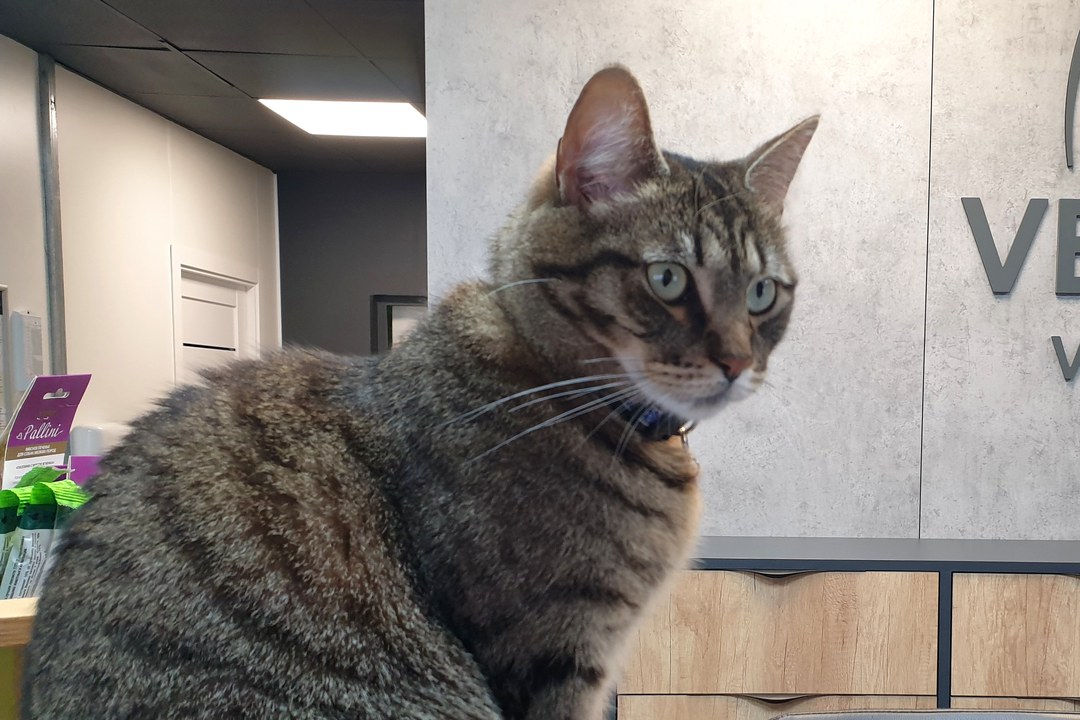
Cover photo by Tess Mattew, CC BY-SA 4.0, via Wikimedia Commons.
Frequently Asked Questions
What are the side effects of cat dewormers, and is diarrhoea normal?
How fast does a cat dewormer work, and will I see worms in the stool?
How much does deworming a cat cost, and what does a vet visit add?
Can I give cat dewormer to a dog, or dog dewormer to a cat?
Can I deworm a pregnant or nursing cat?
Related Articles
About the Reviewer

Dr. Priya Anand, DVM, ABVP (Feline)
DVM, Cornell University College of Veterinary Medicine
Dr. Priya Anand is a veterinarian board-certified by the ABVP in Feline Practice, with over a decade caring for cats in a feline-exclusive clinic. She has guided thousands of cat owners through nutrition, litter-box troubleshooting, enrichment, and senior-cat care. She founded House of Mittens in 2026 to cut through pet-aisle marketing and recommend the food, litter, and gear that actually keep cats healthy and happy — judged the way she'd advise her own patients.