11 Best Cat Repellent Sprays of 2026
Feline vet Dr. Priya Anand reviews the 11 best cat repellent sprays of 2026, and which cat deterrent spray suits furniture, yards, scratching or marking.
Updated
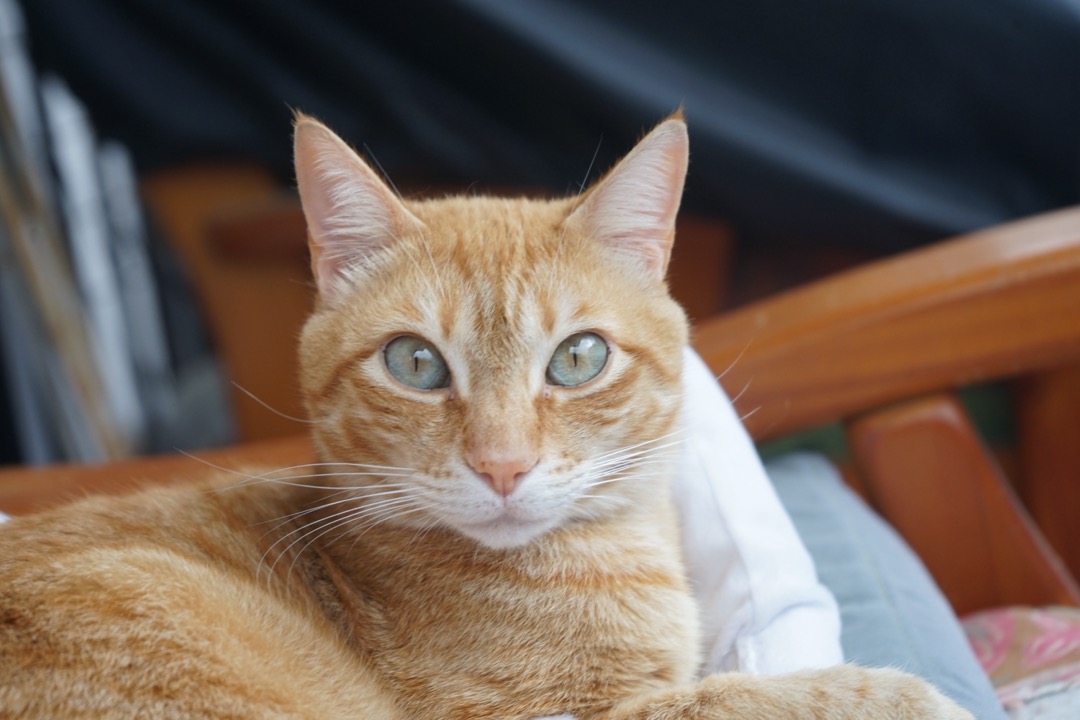
The deterrent question I hear most in the exam room is a short one: what can I spray so my cat stops doing that? Sometimes “that” is the arm of a new sofa. Sometimes it is a neighbor’s cat digging in the vegetable bed, or a puddle by the back door. The best cat repellent spray depends on which of those you are dealing with, and more often than owners expect, a spray is not the first thing I would reach for.
For this guide I read the labels of eleven cat repellent sprays and deterrent devices sold on Amazon in 2026: scent sprays, a bitter-taste spray, two motion sprinklers and a motion-activated air spray. I gave what each label discloses as much weight as what owners report, because a cat grooms off whatever lands on its coat. If scratching is your problem, read our guide on how to stop a cat scratching furniture as well, since any cat deterrent spray works only alongside a better place to scratch.
Find the Best Cat Repellent Spray for Your Need
Jump to the section that matches what your cat is doing:
- Best cat repellent sprays overall
- Best cat repellent spray for furniture
- Best outdoor cat repellent spray
- Best cat scratch deterrent spray
- Best cat deterrent spray for peeing
- Best natural cat repellent spray
- More use cases: cars, counters, chewing, indoors, plants
How We Chose These Cat Repellent Sprays
Every product here sits on a live Amazon listing that we checked for stock and buy-box price on the day this guide was published. I then read each label. A spray that names its active ingredients and its essential oils, with percentages, ranked above one that does not, because that is the only way to judge the risk to a cat. I left out a popular scratch spray whose label lists clove oil, which is on the poison list covered below, and another whose maker publishes no ingredient list at all. I read owner reviews for the failures that keep repeating, such as sprays that fade within hours and sprinklers that leak. We did not run a controlled test, and I quote range and coverage only where the maker publishes a figure.
Best Cat Repellent Sprays Overall
Each product is reviewed once here. The use-case sections further down point back to the right ones.
Best Overall: Four Paws Keep Off Cat Repellent Spray
Four Paws Keep Off is the cat repellent spray I would put in front of most owners first, and I want to be plain about the reason. Owners do not describe dramatic results. They describe modest ones, and some say their cat was back within an hour. I rank it first because its label is the easiest on this page to judge: one disclosed active, methyl nonyl ketone at 1.9% with related compounds at 0.1%, no essential oils, and registration under federal pesticide law. Methyl nonyl ketone is an EPA-registered repellent.
The label covers furniture, carpets, trees, shrubs and garbage cans, indoors and out, and tells you to apply it daily until the habit breaks. Read the fabric warning before you start. It may stain or soften some fabrics and plastics, and one owner reports a ruined rug, so test a hidden spot or spray a cloth and lay it on the object. People find the smell strong. It is for external use only: spray the furniture, never the cat, and keep your cat out of the room until it dries.
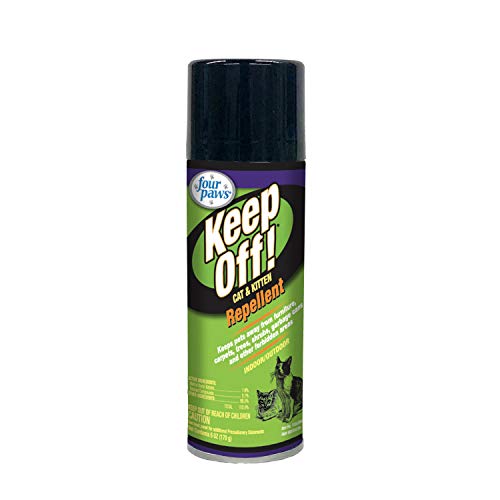
Four Paws Keep Off Cat Repellent Spray, Outdoors and Indoors, 6 oz
by Four Paws
The easiest label on this page to judge: one disclosed, EPA-registered active and no essential oils, with modest results owners describe honestly.
Pros
- One disclosed active, methyl nonyl ketone, and no essential oils
- Methyl nonyl ketone is an EPA-registered repellent
- Label covers furniture, carpets, trees, shrubs and garbage cans, indoors and out
- Aerosol lets you spray a cloth laid on the object instead of the surface itself
Cons
- Strong smell to people, and some owners say their cat was back within an hour
- May stain or soften some fabrics and plastics; one owner reports a ruined rug
- Needs daily reapplication until the habit breaks
Best Budget: Nature’s Miracle Cat Pet Block Repellent Spray
Nature’s Miracle Pet Block is a low-commitment way to find out whether a scent deterrent changes your cat’s mind about one spot. The listed base is short: water, citric acid, sodium benzoate, potassium sorbate and xanthan gum, with a scent blend of rosemary, cinnamon, citronella and cornmint. The directions are clear too. Use three sprays per 3,000 square inches, daily, after a color test on fabric, and never apply it to the pet.
My reservation is the label. It names four essential oils but gives a percentage for none of them, and cinnamon is one the Pet Poison Helpline lists as known to poison cats. Some owners say their cat became curious rather than deterred, and others that the effect fades within hours. The reviews also pool several pack sizes and a newer formula, so read the bottle you receive rather than the listing.

Nature's Miracle Cat Pet Block Repellent Spray, 8 oz
by Nature's Miracle
A low-commitment test of whether scent works on your cat, held back by a label that names its oils but not how much of each.
Pros
- Short listed base: water, citric acid, sodium benzoate, potassium sorbate, xanthan gum
- Names the four essential oils in its scent blend
- Clear dosing: three sprays per 3,000 square inches, daily
- Label says to color-test fabric and never to apply it to pets
Cons
- No percentage given for any of its four essential oils, one of which is cinnamon
- Some owners say their cat grew curious rather than deterred, and the effect fades within hours
- Reviews pool several pack sizes and a newer formula
Best Upgrade: Orbit Yard Enforcer Motion-Activated Sprinkler
For the yard, the Orbit Yard Enforcer is the step up, and it is one of the two products here I like most on safety grounds because it sprays nothing but water. A cat that walks into its field gets a sudden burst and leaves, and nothing is left on its coat to groom off afterward. Orbit rates the range at up to 40 feet, and day, night and always modes cover cats that visit after dark. Motion-activated sprinklers are one of the humane deterrents Alley Cat Allies recommends for gardens.
It needs a hose and an outdoor spigot within reach, which rules out a balcony or a bed far from the tap. Owners report a flimsy stake, and some units fail, a few within a year or two. Cats can also learn where the sensor sits, so move it now and then.

Orbit Yard Enforcer Motion-Activated Sprinkler 62100
by Orbit
A chemical-free, water-only deterrent for yards and garden beds, as long as you have a hose to run to it.
Pros
- Sprays only water, so nothing is left on the coat for a cat to groom off
- Orbit rates the range at up to 40 ft
- Day, night and always modes cover cats that visit after dark
- Motion sprinklers are on Alley Cat Allies' list of humane garden deterrents
Cons
- Needs a garden hose and an outdoor spigot within reach
- Owners report a flimsy stake, and some units fail within a year or two
- Cats can learn where the sensor sits, so it needs moving now and then
Runner-Up: Stop the Scratch Cat Scratch Spray Deterrent
Stop the Scratch, from Emmy’s Best, is my runner-up, and its label is one of the easiest here to read: a single active, rosemary oil at 1%, in purified water with a coconut-derived surfactant blend, polysorbate-20, ethanol and a preservative. The listing bullets also mention lemongrass, but the label lists only rosemary, and the label is what I go by. The maker says it is safe on furniture, floors, drapes and plants. Spray two or three times a day at first, then taper as the cat loses interest.
Be realistic about what it can do. Many owners say it does not stop a determined cat, and that matches what I see in practice: a scent spray makes one surface less appealing, so the cat goes looking for another. Put a sturdy, tall post right beside the sofa arm you are spraying and the cat has somewhere better to go. One owner reports residue, and some had a sprayer break.

Stop the Scratch Cat Scratch Spray Deterrent by Emmy's Best, 8 oz
by Emmy's Best
A single-active, 1% rosemary scratch spray with a fully listed label, best used beside a good scratching post rather than instead of one.
Pros
- Label lists a single active: rosemary oil at 1%
- Inert ingredients are listed in full: purified water, a coconut-derived surfactant blend, polysorbate-20, ethanol, preservative
- Maker says it is safe on furniture, floors, drapes and plants
- Taper schedule: two or three times daily at first, then less often
Cons
- Many owners say it does not stop a determined cat on its own
- One owner reports residue, and some report a broken sprayer
- Listing bullets mention lemongrass, but the label lists only rosemary
Nature’s Miracle Cat Scratch Deterrent Spray
The Nature’s Miracle Scratch Deterrent earns its place on disclosure. Every ingredient carries a percentage: sodium lauryl sulfate at 0.30%, and cinnamon, lemongrass and rosemary oils at 0.12% each. Some owners report a day or so of deterrence, and a few say their cat stopped climbing the curtains. Many others say it did not work at all, and it needs daily reapplication.
The oil levels are low, but cinnamon is on the Pet Poison Helpline’s list. Spray only the spot you want the cat to avoid, keep the cat away until it is dry, color-test first, and never apply it to the cat itself.

Nature's Miracle Cat Scratch Deterrent Spray, 8 oz
by Nature's Miracle
A scratch spray with every percentage on the label, low oil levels and owner results that range from a day's relief to nothing.
Pros
- Every ingredient on the label carries a percentage
- Low essential oil levels: cinnamon, lemongrass and rosemary at 0.12% each
- Some owners report a day or so of deterrence, and a few say curtain climbing stopped
- Label says to color-test and not to apply it directly to animals
Cons
- Cinnamon is on the Pet Poison Helpline's list of oils known to poison cats
- Many owners say it did not work, and it needs daily reapplication
Nature’s Miracle Advanced Platinum No More Spraying Training Spray
This spray is made for the marking spot itself, and its label gets the order right: clean the area first with a stain and odor remover, then apply three sprays per square foot daily. That sequence matters more than the spray does. A spot that still smells of urine draws the cat back whatever you put on top of it.
The weakness is disclosure. Beyond “formulated with essential oils”, the label does not say what is in it, so I cannot tell you which oils or how much. I kept it in because it is built for marking spots and puts cleaning first, but it carries one of the thinnest labels here. Some owners say it stopped their cat marking; others say the deterrence fades once it dries and the cat simply marks nearby. That second pattern is what the feline house-soiling guidelines warn about, which is why I treat this as support for cleaning and a vet workup, never a treatment.

Nature's Miracle Advanced Platinum No More Spraying Training Spray, 24 oz
by Nature's Miracle
A marking-spot spray whose directions get the order right, cleaning first, but whose label says almost nothing about what is in it.
Pros
- Made for indoor urine-marking spots
- Label puts cleaning first: use a stain and odor remover, then the spray
- Clear dosing: three sprays per square foot, daily
- Some owners say it stopped their cat marking a spot
Cons
- No ingredient list beyond "formulated with essential oils"
- Other owners say deterrence fades once it dries and the cat marks nearby
- A spray does not treat the cause of marking, so a vet visit comes first
Nature’s MACE Cat Repellent
Nature’s MACE is built for outdoor ground: flower beds, decks, walkways and trash areas, with the maker quoting coverage of about 1,000 square feet per bottle. Every active is listed with a percentage: cinnamon oil 1.00%, castor and soybean oils at 0.50% each, peppermint oil 0.20%, garlic oil 0.10% and sodium lauryl sulfate 0.10%, in a base of water, soap, vinegar, vanillin, citric acid, sodium benzoate and xanthan gum. The schedule is spelled out too: daily for 7 to 10 days, every other day the following week, then weekly, and again after rain or mowing.
I would keep it to the garden. Cinnamon and peppermint are both on the Pet Poison Helpline’s list, and this is not a spray for anywhere your cat lies down. Owners note the strong cinnamon smell, some say cats return quickly, and one reports a stain.
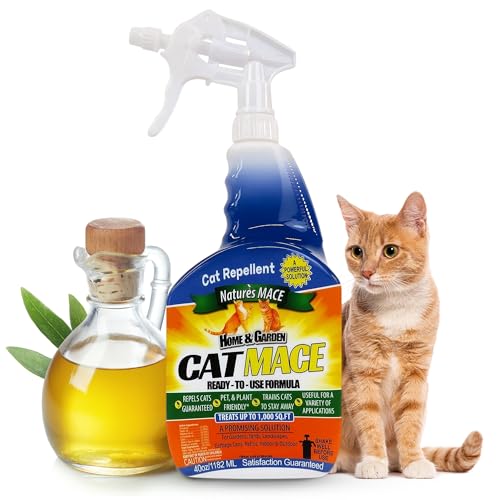
Nature's MACE Cat Repellent, 40 oz Spray
by Nature's MACE
A fully disclosed outdoor spray for beds and paths with a clear schedule, best kept to the garden because of its cinnamon and peppermint.
Pros
- Every active is listed with a percentage
- Maker quotes coverage of about 1,000 sq ft per bottle
- Spelled-out taper schedule: daily for 7-10 days, every other day the next week, then weekly
- Made for outdoor beds, decks, walkways and trash areas
Cons
- Its cinnamon and peppermint oils are both on the Pet Poison Helpline's list
- Strong cinnamon smell, and some owners say cats return quickly
- Needs reapplying after rain or mowing; one owner reports a stain
Colton’s Naturals Cat Repellent Outdoor/Indoor Spray
Colton’s Naturals is the spray I would try when the problem is a cat getting into a garage or sleeping in a car’s engine bay, places its label names along with crawl spaces, trash cans, the yard and the garden. The routine is easy: daily for a few days, then roughly monthly.
The label names citronella and peppermint but gives no percentages, and peppermint is on the Pet Poison Helpline’s list. Owner results are mixed, the smell is strong, and one owner had a bottle leak. Whatever you spray, knock on the hood before you start the car on a cold morning.
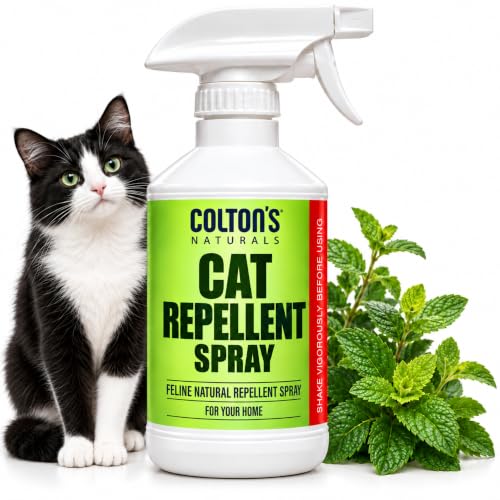
Colton's Naturals Cat Repellent Outdoor/Indoor Spray, 32 oz
by Colton's Naturals
The spray to try when a cat is getting into a garage or a car's engine bay, with a label that names its oils but not their strength.
Pros
- Names car engine bays, garages and crawl spaces among its uses
- Also labeled for the yard, garden and trash cans
- Simple routine: daily for a few days, then roughly monthly
- Sold as both an outdoor and an indoor spray
Cons
- Names citronella and peppermint but gives no percentages, and peppermint is on the Pet Poison Helpline's list
- Mixed owner results and a strong smell
- One owner reports a leaking bottle
Hoont Cobra Motion-Activated Sprinkler
The Hoont Cobra does the Orbit’s job on solar power, with water only, and the maker rates it at 0 to 30 feet and up to 1,000 square feet. It suits a smaller yard or a single bed where you want a deterrent with nothing chemical in it.
It still needs a hose. Owners report leaks at the fitting, which Teflon tape on the threads usually fixes, the instructions are thin, and one owner says theirs broke within a month. It is sold by a third-party seller and ships from Amazon. As with any sensor, move it now and then so cats do not learn its blind spot.

Hoont Cobra Solar Powered Motion-Activated Sprinkler
by Hoont
A solar, water-only sprinkler for a smaller yard or a single bed, with fittings that may need tape to stop leaks.
Pros
- Sprays only water
- Solar powered
- Maker rates it at 0-30 ft and up to 1,000 sq ft
- Suits a single bed or a smaller yard
Cons
- Owners report leaks at the hose fitting; Teflon tape on the threads helps
- One owner says it broke within a month, and the instructions are thin
- Sold by a third-party seller, though it ships from Amazon
PetSafe SSSCAT Automatic Spray Pet Deterrent
SSSCAT is the only motion-activated air spray on this page, and it fills a gap the scent sprays cannot. A sensor that reads movement within about 3 feet triggers a short burst of unscented compressed spray, so it works on kitchen counters, doorways, plants, trash cans and the Christmas tree, where you would not want a scented residue. The maker rates a can at about 120 sprays, and it takes 4 AAA batteries, not included.
I have to be honest about its record. Many owners report units that never worked. The owners whose units do work say it stopped counter surfing, and that fits what Cornell says about effective deterrents: consistent, immediate, and with no person attached for the cat to fear. Refill cans cost extra, the propellant is not named, and it is sold by a third-party seller. Test it the day it arrives, while you can still return it.

PetSafe SSSCAT Automatic Spray Pet Deterrent (2nd Generation)
by PetSafe
The one motion air-spray option here, useful for counters and trees when it works, with a real share of owners reporting units that never did.
Pros
- The only motion-activated air spray on this page
- Unscented compressed spray, so no scent residue on counters or plants
- Sensor reads movement within about 3 ft
- Owners whose units work say it stopped counter surfing
Cons
- Many owners report units that never worked
- Refill cans cost extra, and the 4 AAA batteries are not included
- Propellant is not named, and it is sold by a third-party seller
NaturVet Bitter Yuck! No Chew Spray
Bitter Yuck works by taste rather than smell, which makes it the right tool for a cat that chews cords, plants, furniture or drapes. The label is short: rosemary at 0.5% as the active, with water and sodium bicarbonate. It is labeled for dogs, cats and horses, and the directions say not to spray it near the eyes or nose.
Some cats keep chewing anyway, and the bitter taste transfers to your hands, so wash up after applying it. For cords, spraying is a backup: cover them or route them out of reach as well.
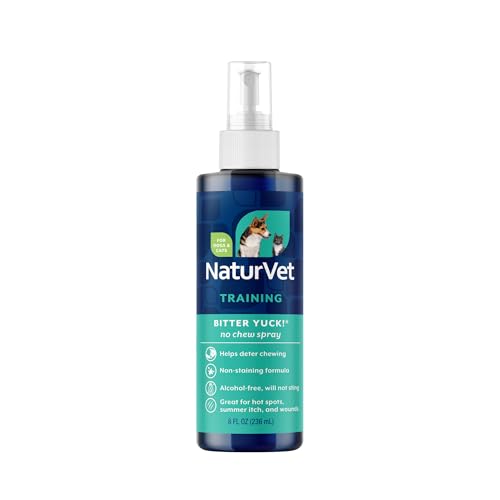
NaturVet Bitter Yuck! No Chew Spray, 8 oz
by NaturVet
A short-label bitter spray for cats that chew cords, plants and drapes, rather than a scent repellent.
Pros
- Single active, rosemary at 0.5%, with only water and sodium bicarbonate as inerts
- Works by bitter taste, the right mechanism for a cat that chews
- Labeled for cats, dogs and horses
- For cords, plants, furniture and drapes
Cons
- Some cats keep chewing anyway
- The bitter taste transfers to your hands, and it must not be sprayed near eyes or nose
Best Cat Repellent Spray for Furniture
A furniture spray has two jobs: put the cat off one surface, and leave that surface undamaged. Test every spray on a hidden spot first, or spray a cloth and lay it over the arm. Four Paws Keep Off has a straightforward label, with one disclosed active and no essential oils, though it can stain some fabrics. Stop the Scratch uses rosemary at 1% and is the one I would choose for a scratching habit. Pet Block is the low-commitment way to learn whether scent works on your cat at all. Whichever you use, spray the furniture, never the cat, and keep the cat out until it dries.
| Product | Price | Buy |
|---|---|---|
| Four Paws Keep Off Cat Repellent Spray, Outdoors and Indoors, 6 ozBest furniture spray with no essential oils One EPA-registered active; test fabric first | $11.24 | View on Amazon |
| Stop the Scratch Cat Scratch Spray Deterrent by Emmy's Best, 8 ozBest furniture spray for scratching Single active, rosemary oil at 1% | $18.95 | View on Amazon |
| Nature's Miracle Cat Pet Block Repellent Spray, 8 ozBest budget furniture spray Simple base with a named four-oil scent blend | $8.12 | View on Amazon |
Best Outdoor Cat Repellent Spray
Most outdoor cat problems are stray or neighbor cats using a garden bed as a litter box. Alley Cat Allies, which works with community cats, lists humane fixes: motion-activated sprinklers, chicken wire laid on the soil, and rough mulch or river rock in beds. A sprinkler is the gentlest option here because it sprays only water. The Orbit is the step-up pick, and the Hoont runs on solar. Nature’s MACE covers paths, decks and trash areas a sprinkler cannot reach, though its oils are a reason to keep it away from where cats rest. Cats can learn where a sensor sits, so move it now and then.
| Product | Price | Buy |
|---|---|---|
| Orbit Yard Enforcer Motion-Activated Sprinkler 62100Best outdoor deterrent overall Water only, up to 40 ft range by the maker's figure | $89.97 | View on Amazon |
| Nature's MACE Cat Repellent, 40 oz SprayBest outdoor spray for paths and trash Every active listed; reapply after rain or mowing | $19.97 | View on Amazon |
| Hoont Cobra Solar Powered Motion-Activated SprinklerBest solar sprinkler Water only and solar powered; still needs a hose | $47.97 | View on Amazon |
Best Cat Scratch Deterrent Spray
Scratching is normal. The AAFP describes it as claw care, stretching and marking, both visual and by scent from the paws, and Cornell notes that it is largely marking. So the goal is to redirect it. A scratch deterrent spray makes the sofa less appealing, and a sturdy post tall enough for a full stretch, placed right next to it, gives the cat the better choice. Without the post, expect the cat to move to the other arm. Our guide on how to stop a cat scratching furniture covers the full plan, and a solid cat tree doubles as a scratcher. The AAFP strongly opposes elective declawing, and the AVMA discourages it.
| Product | Price | Buy |
|---|---|---|
| Stop the Scratch Cat Scratch Spray Deterrent by Emmy's Best, 8 ozBest cat scratch deterrent spray Rosemary oil at 1%; taper as the habit fades | $18.95 | View on Amazon |
| Nature's Miracle Cat Scratch Deterrent Spray, 8 ozBest scratch spray with every percentage listed Every ingredient carries a percentage | $8.99 | View on Amazon |
| Four Paws Keep Off Cat Repellent Spray, Outdoors and Indoors, 6 ozBest scratch spray with no essential oils Single EPA-registered active; test fabric first | $11.24 | View on Amazon |
Best Cat Deterrent Spray for Peeing
Start with your vet, not a spray. The AAFP and ISFM house-soiling guidelines say to rule out medical causes first: urinary stones, kidney disease, urinary tract infection, diabetes, hyperthyroidism and arthritis, along with feline idiopathic cystitis. Marking is a diagnosis made only once those are excluded. Next, clean every spot with an enzyme cleaner so no odor is left to draw the cat back; our guide to the best cat urine enzyme cleaner covers the options. Only then is a deterrent worth trying, and the guidelines note it may push marking elsewhere and add stress. A spray supports that plan. It does not treat anything.
| Product | Price | Buy |
|---|---|---|
| Nature's Miracle Advanced Platinum No More Spraying Training Spray, 24 ozBest spray for urine-marking spots Label says clean first, then three sprays per square foot | $12.72 | View on Amazon |
| Nature's Miracle Cat Pet Block Repellent Spray, 8 ozBest budget spray for a cleaned spot General repellent with a simple base; reapply daily | $8.12 | View on Amazon |
Best Natural Cat Repellent Spray
Natural does not mean safe for cats. Essential oils are plant extracts, and several common ones are on the Pet Poison Helpline’s list of oils known to poison cats. The gentlest options are the ones with the least on the label. A motion sprinkler like the Orbit uses water only. Stop the Scratch lists a single active, rosemary at 1%, and Bitter Yuck lists rosemary at 0.5% with water and sodium bicarbonate. A short, single-ingredient, low-percentage label is easier to judge, though it is no proof of safety, so the same rules apply: spray the object, keep the cat away until it dries, and ventilate the room.
| Product | Price | Buy |
|---|---|---|
| Orbit Yard Enforcer Motion-Activated Sprinkler 62100Best chemical-free deterrent Water only, for yards and garden beds | $89.97 | View on Amazon |
| Stop the Scratch Cat Scratch Spray Deterrent by Emmy's Best, 8 ozBest single-ingredient scent spray Rosemary oil at 1% with fully listed inerts | $18.95 | View on Amazon |
| NaturVet Bitter Yuck! No Chew Spray, 8 ozBest single-ingredient bitter spray Rosemary at 0.5% in water and sodium bicarbonate | $14.72 | View on Amazon |
Best Cat Repellent Sprays by Use Case
A few more problems come up often enough to deserve a direct pick. Each product below is reviewed in full above.
| Product | Price | Buy |
|---|---|---|
| Colton's Naturals Cat Repellent Outdoor/Indoor Spray, 32 ozBest for cars and engine bays Label names engine bays, garages and crawl spaces | $19.95 | View on Amazon |
| PetSafe SSSCAT Automatic Spray Pet Deterrent (2nd Generation)Best air spray for counters and Christmas trees Motion sensor with unscented spray; test it on arrival | $59.95 | View on Amazon |
| NaturVet Bitter Yuck! No Chew Spray, 8 ozBest chew deterrent Bitter taste for cords, plants and drapes | $14.72 | View on Amazon |
| Four Paws Keep Off Cat Repellent Spray, Outdoors and Indoors, 6 ozBest for indoor use Single disclosed active and no essential oils | $11.24 | View on Amazon |
| Stop the Scratch Cat Scratch Spray Deterrent by Emmy's Best, 8 ozBest for plants Maker says safe on plants; rosemary oil at 1% | $18.95 | View on Amazon |
Do Cat Repellent Sprays Work? What the Evidence Shows
The evidence is thin. I know of no controlled study showing that scent sprays, bitter sprays or motion-activated air deterrents change cat behavior. What exists is owner reports and product testing, and the owner reports on every product here are mixed: some cats avoid a treated spot for a day, some for a few hours, and some ignore it entirely.
What behavior science does tell us is how a deterrent has to work if it is going to work at all. The Cornell Feline Health Center says effective deterrents are consistent and immediate. The unpleasant thing has to happen every time, at the moment the cat does the behavior, which is the case for a motion sensor over a person with a water bottle. Cornell also warns that punishment from you makes a cat fear you, which is the opposite of what you want.
The other half is an alternative. A deterrent works best when the cat has an acceptable place to do the same thing: a post next to the sofa, a litter box it likes, a perch by the window instead of the counter. Without one, a spray only moves the behavior somewhere else. Reapply as the label directs, and if the behavior has not changed after a fair trial, the spray is not the fix.
Are Cat Repellent Sprays Safe? Essential Oils and Cats
Most cat repellent sprays rely on essential oils, and that is the part of the label I look at hardest. The Merck Veterinary Manual explains that cats are more sensitive to essential oils because they are deficient in a liver enzyme, glucuronyl transferase, which leaves them with a limited ability to break these compounds down. The oils absorb through the skin, the gut and the lungs, and a cat that grooms a treated coat swallows what it licks off.
The Pet Poison Helpline lists essential oils known to poison cats, among them wintergreen, sweet birch, citrus oils (d-limonene), pine, ylang ylang, peppermint, cinnamon, pennyroyal, clove, eucalyptus and tea tree, and higher concentrations carry higher risk. The ASPCA notes that concentrated tea tree oil can cause problems with as little as seven or eight drops. Cinnamon appears on three labels in this guide and peppermint on two, which is why I flag them in each review.
Regulation does not settle the question for you. Four Paws’ active, methyl nonyl ketone, is an EPA-registered repellent. Many essential-oil repellents are instead sold under the EPA’s minimum-risk exemption, section 25(b) of the federal pesticide law. EPA does not review those products or their labels, although some states still require registration. So the exemption tells you nothing about how a given spray affects a cat.
The practical rules are simple:
- Spray the object, never the cat.
- Keep the cat out of the room until the spray dries, and ventilate.
- Never use a spray on bedding or anywhere your cat sleeps.
- If your cat drools, vomits, seems wobbly or has trouble breathing after exposure, call your veterinarian or ASPCA Animal Poison Control at 888-426-4435.
Spray, Scratcher or Vet Visit: What to Check First
Before you buy any spray, name what your cat is actually doing, because each problem has a different first step.
Scratching furniture is normal behavior in the wrong place. Put a sturdy, tall post beside the spot first, then add a spray to the furniture.
Urine outside the box is a vet visit before anything else, to rule out the medical causes above. After that, look at the box. A cat that dislikes its box or its location will go elsewhere, and our guides to the best cat litter box and where to put a litter box cover both. For bedding and clothes, see our guide to enzyme cleaner for cat urine on laundry.
Spraying is different from peeing. A spraying cat stands with its tail up and leaves small amounts on vertical surfaces. Cornell puts it at about 10 percent of neutered males and 5 percent of neutered females. It is still a vet visit first, and if your vet thinks stress is part of the picture, our guide to cat calming treats covers one option to discuss.
Counter surfing, chewing and garden digging are where a deterrent device or spray does its best work, paired with a perch, a chew-safe toy or a covered bed. Any sudden change in a cat’s habits is worth a call to your vet.
Buyer's Guide
A spray is one tool, not a fix on its own. These six factors decide whether one helps with your cat's particular problem.
Match the Spray to the Behavior
Scratching, chewing, counter surfing, garden digging and urine marking each need a different tool. A scent spray suits a surface you want avoided, a bitter spray suits chewing, a motion sensor suits counters and yards, and urine marking needs a vet visit and an enzyme cleaner before any deterrent.
Indoor vs Outdoor
Indoors, the cat lives with whatever you spray, so favor water-only devices, unscented sprays or short, low-percentage labels. Outdoors, motion sprinklers and physical barriers come first, with an outdoor spray for paths, decks and trash areas, reapplied after rain or mowing.
Read the Active Ingredients and Essential Oils
Look for a label that names every active and gives each a percentage. Be wary of cinnamon, peppermint, citrus, clove, eucalyptus and tea tree, all on the Pet Poison Helpline's list of oils known to poison cats. Many essential-oil repellents are sold under an EPA exemption, which means EPA does not review the product or its label.
Surface and Stain Testing
Several labels warn that the spray may stain or soften fabrics and plastics. Test a hidden spot first and let it dry, or spray a cloth and lay it over the arm of the sofa instead of spraying the upholstery itself.
Reapplication Schedule
Owners report most scent sprays fading within hours to a day, so the label's schedule matters. Expect daily application at first and a taper once the habit breaks. Consistency is what makes a deterrent work, so a spray you will not reapply is a spray that will not help.
Pair It With an Alternative
A deterrent tells a cat where not to go. It works far better when there is somewhere it should go: a sturdy, tall scratching post right beside the furniture, a clean litter box in a quiet spot, and enough play and climbing space to use up energy.
How to Choose the Best Cat Repellent Spray
Start with the behavior
Choose the tool for the problem. A scent spray for a surface, a bitter spray for chewing, a motion sensor for counters and yards, and a vet visit plus an enzyme cleaner for urine. A spray bought for the wrong problem is a common reason owners tell me none of them work.
Read the label before the reviews
Owner reviews tell you about results, and the label tells you about risk. Favor a label that names every active and gives each a percentage. If the essential oils are unnamed or have no percentages, assume you cannot judge them. Be wary of cinnamon, peppermint, citrus, clove, eucalyptus and tea tree.
Test the surface and the schedule
Spot-test fabric and plastic and let it dry, or spray a cloth instead. Then commit to the schedule on the label, usually daily at first. Inconsistency is what makes a deterrent fail.
Give the cat a yes
Every no needs a yes beside it: a scratcher by the sofa, a clean box in a quiet spot, a window perch instead of the counter, and enough daily play.
The Bottom Line
For most homes, Four Paws Keep Off is where I would start. It has one disclosed, EPA-registered active and no essential oils, and its owners describe modest results honestly. Nature’s Miracle Pet Block is the low-commitment way to test whether scent works on your cat. For the yard, the water-only Orbit Yard Enforcer is the upgrade I would choose, and Stop the Scratch is the runner-up for scratching.
Whichever you choose, spray objects and never the cat, keep it away until the spray dries, and pair the deterrent with something better to do. A post beside the sofa or a solid cat tree will do more for scratching than any bottle, and if the problem is urine, your veterinarian comes first.
Frequently Asked Questions
Do cat repellent sprays work?
Are cat repellent sprays safe for cats?
Are essential oils in cat deterrent sprays safe?
What is the best homemade cat repellent spray?
What cat deterrent spray works for peeing?
How do I keep stray cats out of my yard?
Is cayenne pepper safe to use as a cat repellent?
Related Articles
About the Reviewer

Dr. Priya Anand, DVM, ABVP (Feline)
DVM, Cornell University College of Veterinary Medicine
Dr. Priya Anand is a veterinarian board-certified by the ABVP in Feline Practice, with over a decade caring for cats in a feline-exclusive clinic. She has guided thousands of cat owners through nutrition, litter-box troubleshooting, enrichment, and senior-cat care. She founded House of Mittens in 2026 to cut through pet-aisle marketing and recommend the food, litter, and gear that actually keep cats healthy and happy — judged the way she'd advise her own patients.