10 Best Kitten Foods of 2026
Feline veterinarian Dr. Priya Anand, DVM ranks the 10 best kitten foods of 2026 -- overall, budget, premium, wet, dry, grain-free, high-protein, and sensitive-stomach picks judged on the AAFCO growth statement, animal protein, calorie density, DHA, and taurine for healthy kitten development.
Updated
Bringing home a kitten is exciting and a little overwhelming, and the food aisle does not make it easier: dozens of bags and cans, competing claims, and strong opinions from every corner of the internet. As a feline veterinarian, my job across the exam table is to cut through that noise, because the first year of a cat’s life is the single most important window for nutrition. A kitten is building an entire body — muscle, bone, brain, eyes — while burning energy at a furious pace, which is why it needs a food formulated for growth, not the adult-maintenance food a grown cat eats. Get that one distinction right, add a named animal protein, DHA, and taurine, and pay attention to hydration and portioning, and you have given your kitten the strongest possible start.
For this roundup I evaluated kitten foods on the factors that actually protect a growing cat’s health: the AAFCO growth statement and how it was substantiated, animal-protein quality and calorie density, DHA for brain and eye development, taurine, and moisture — then filtered everything through what I see in practice, from newly weaned bottle babies to picky eaters to fast-growing kittens with bottomless appetites. The ten picks below span every household and budget, from a research-backed everyday kibble and an affordable value bag to premium growth formulas, moisture-rich wet foods, and clean grain-free options. Once your kitten grows up, our general guide to the best cat food covers the adult transition, and because moisture matters so much in the first year, the companion guide to the best wet cat food is worth reading alongside this one.
Find the Best Kitten Food for Your Need
Jump straight to the kitten food that matches your situation:
- Best kitten foods overall
- Best wet kitten food
- Best dry kitten food
- Best kitten food for indoor cats
- Best kitten food for sensitive stomachs
- Best grain-free kitten food
- Best high-protein kitten food
How We Chose These Kitten Foods
Every food in this roundup was selected on a verified, active Amazon listing with real owner-review volume, and each was judged first on the things that protect a growing kitten’s health rather than the things that market well. I started with the AAFCO nutritional adequacy statement on every product — confirming it is complete and balanced for growth or all life stages, and, where the manufacturer discloses it, whether it is substantiated by feeding trials or by formulation on paper. From there I weighted a named animal protein at the top of the ingredient list, adequate calorie and protein density for the growth stage, confirmed DHA for brain and eye development, and confirmed added taurine. I read owner reviews for what matters clinically: palatability and whether kittens actually finished the food, stool quality, and how newly weaned or picky kittens responded. Then I filtered everything through what I see in practice — the picky eaters, the sensitive young guts, the bottomless-appetite growth spurts, and the hydration risk that dry-only feeding creates. The result is ten foods chosen to cover the real range of kittens and budgets, each with honest notes on its trade-offs. One practical note on cost as you compare them: the dry foods here range from a two-pound bag to a seven-pound one, so the number on the shelf tag tells you very little about what a food actually costs to feed. Divide by the bag weight before you decide anything is expensive. The single most expensive bag in this roundup is not the most expensive food per pound — it is simply the biggest — while the small premium bags cost more to feed than their modest shelf price suggests.
Best Kitten Foods Overall
These are the full reviews, starting with the kitten food I recommend most and working through the budget, premium, and specialty picks. Every food below is reviewed once here; the use-case sections that follow simply point you back to the right pick for your kitten.
Best Overall: Hill’s Science Diet Kitten Formula
Hill’s Science Diet Kitten is the food I name most often when a new-kitten owner wants one dependable recommendation, and it earns the top spot on substance rather than marketing. It is formulated specifically for growth and substantiated through Hill’s feeding trials — meaning it was actually fed to kittens and their health measured over time, rather than calculated on paper. In a food a cat eats during its single most important developmental year, that feeding-trial pedigree is the quality signal I weight most heavily.
The formulation matches the pedigree. Real chicken leads the recipe with the high-quality animal protein a growing kitten needs, and it includes the DHA that supports healthy brain and eye development along with a clinically tested antioxidant blend for the developing immune system. It was developed with Hill’s veterinary nutritionists, is among the most frequently vet-recommended kitten foods, and carries a 4.8-star average across more than eleven thousand reviews — which matters, because the healthiest food does nothing if a kitten walks away from the bowl. The kibble size is tailored to small mouths, so it works from weaning through the first birthday.
The honest caveats are narrow. It is priced above grocery kitten kibble, the trade-off for the clinical formulation, and like any dry food it runs low in moisture — so I would pair it with some wet food to build good hydration habits early. For the overwhelming majority of healthy kittens, though, this is the research-backed everyday growth food I would start with.

Hill's Science Diet Kitten Formula Chicken Recipe Dry Cat Food
by Hill's Science Diet
My top overall kitten pick -- a feeding-trial-substantiated, real-chicken growth formula with DHA and a clinical antioxidant blend, from the brand vets recommend most, palatable enough that kittens reliably finish the bowl.
Pros
- Formulated specifically for growth and substantiated through Hill's feeding trials rather than paper formulation -- the food was actually fed to kittens and their health measured, which is the quality signal I weight most heavily in a food a kitten eats during its single most important developmental year
- Real chicken leads the recipe with the high-quality animal protein a growing kitten needs, plus a clinically tested antioxidant blend and the DHA that supports healthy brain and eye development
- Developed with Hill's veterinary nutritionists and among the most frequently vet-recommended kitten foods, with a 4.8-star average across more than eleven thousand reviews reflecting consistent palatability
- Complete and balanced for growth with a kibble size tailored to small kitten mouths, so it works as a dependable everyday foundation from weaning through the first birthday
Cons
- Priced above grocery kitten kibble -- the trade-off for the feeding-trial pedigree and clinical formulation
- As a dry food it runs low in moisture, so I would pair it with some wet food to build good hydration habits early
Budget Pick: IAMS Proactive Health Healthy Kitten
IAMS Proactive Health Healthy Kitten is my budget recommendation because it proves you do not have to overspend to feed a kitten well. Real farm-raised chicken leads the ingredient list at a genuinely affordable price — an unusual pairing — and, crucially for a kitten, the low cost does not mean skipping the nutrients that actually matter during growth. It carries the Omega-3 DHA a kitten needs for brain and eye development and added taurine, so a tight budget still buys complete, growth-appropriate nutrition.
Kittens simply eat it, which is half the battle. A 4.8-star average across more than twenty thousand reviews reflects unusually consistent palatability, the tailored kibble is easy for small mouths to crunch, and it is complete and balanced for growth, widely stocked, and frequently vet-recommended. For the purpose that matters most — keeping a growing kitten on quality, affordable nutrition through the whole first year — it is the most cost-effective food on this list that still leads with real chicken and includes DHA.
I want to be honest about the trade-off. It contains corn and other grains, so the carbohydrate load is higher than a premium meat-forward kitten kibble, and like any dry food it is low in moisture, so it is best paired with wet food to support hydration. For a healthy kitten and a budget that has to stretch, though, it delivers real-chicken, DHA-fortified growth nutrition at a price you can sustain.

IAMS Proactive Health Healthy Kitten Chicken Dry Cat Food
by IAMS
The best value on this list -- a real-chicken-first growth kibble with DHA and taurine at a grocery-tier price, the food I recommend when quality and budget both have to work.
Pros
- Real farm-raised chicken is the first ingredient at a genuinely affordable price -- an unusual pairing that makes this the best-value complete kitten kibble I can point owners to
- Carries the Omega-3 DHA a kitten needs for brain and eye development plus added taurine, so the low price does not skip the nutrients that actually matter during growth
- A 4.8-star average across more than twenty thousand reviews reflects unusually consistent palatability, and the tailored kibble is easy for small mouths to crunch
- Complete and balanced for growth, widely stocked, and frequently vet-recommended -- the food I suggest when quality nutrition has to work on a real budget
Cons
- Contains corn and other grains, so the carbohydrate load is higher than a premium meat-forward kitten kibble
- Low moisture like any dry food, so it is best paired with wet food to support hydration
Best Wet Food: Purina Fancy Feast Kitten Classic Pate
Purina Fancy Feast Kitten is my best wet pick, and I recommend it as often as any food on this list, because it solves the single biggest barrier to feeding wet food: cost. Its per-can price is low enough that an owner can actually feed wet food consistently, which matters because moisture is wet food’s great advantage — canned food runs near 78 percent water, and building that hydration habit in the first year is one of the best things you can do for a cat’s lifelong urinary and kidney health.
It also delivers where it counts for a kitten. It is complete and balanced for growth with real poultry and fish, its soft pate texture is easy for tiny mouths and newly weaned kittens, and its near-universal palatability means even picky eaters reliably accept it — reflected in a 4.7-star average across nearly thirty thousand reviews and a spot among the best-selling kitten foods on Amazon. The variety pack keeps mealtime interesting, which helps prevent a kitten from fixating on one flavor, a common problem that makes adult cats hard to feed.
The trade-offs are the usual wet-food ones. It is substantiated by formulation rather than feeding trials, the norm at this price, and opened cans spoil quickly and cost more per calorie than kibble — which is exactly why many owners feed it as a moisture-rich foundation alongside a quality dry food. As the affordable, palatable wet food that makes hydration genuinely sustainable, it is the one I reach for first.

Purina Fancy Feast Kitten Classic Pate Wet Cat Food Variety Pack (24 Cans)
by Purina Fancy Feast
My best wet pick -- an affordable, moisture-rich, endlessly palatable growth pate that makes feeding wet food to a kitten genuinely sustainable, and builds the hydration habit that pays off for life.
Pros
- The moisture-rich wet food I most often recommend as a kitten's foundation, because canned food runs near 78 percent water and building that hydration habit early is one of the best things you can do for lifelong urinary and kidney health
- Complete and balanced for growth with real poultry and fish, at a per-can price low enough to actually feed wet food consistently -- the single biggest barrier for most owners
- Near-universal palatability that even picky, newly weaned kittens reliably accept, reflected in a 4.7-star average across nearly thirty thousand reviews and one of the best-selling kitten foods on Amazon
- The soft pate texture is easy for tiny mouths and transitioning kittens, and the variety pack keeps mealtime interesting so a kitten does not fixate on one flavor
Cons
- Substantiated by formulation rather than feeding trials, the norm for grocery-tier wet food
- Opened cans spoil quickly and cost more per calorie than kibble, so many owners feed it alongside a dry food
Upgrade Pick: Royal Canin Kitten
Royal Canin Kitten is the upgrade I point owners toward when they want a precisely engineered growth food and are willing to pay for it — and it is the kitten food I most often see recommended in exam rooms. It is built specifically for kittens up to twelve months, with a careful balance of protein, fat, and minerals calibrated to the growth stage, plus an antioxidant complex and vitamin E to support the developing immune system and highly digestible proteins and prebiotics that suit a young, still-maturing gut.
The details are where Royal Canin earns its reputation. The distinctive small, easy-to-grasp kibble shape is tailored to a kitten’s tiny jaw, which genuinely improves acceptance and encourages proper chewing, and the brand has a consistent track record of turning finicky or fragile kittens — the bottle babies, the shy rescues, the poor eaters — into steady eaters. A 4.8-star average from thousands of reviews backs that up.
The trade-offs are cost and label optics. It asks for the largest single outlay of anything in this roundup, though it is worth knowing that buys a seven-pound bag — on a per-pound basis it is actually cheaper than the smaller premium bags here, so the sticker overstates how expensive it is to feed. It also leads with chicken by-product meal rather than a whole named muscle meat. By-product meal is nutritious and highly digestible — it is not a red flag nutritionally — but it reads less cleanly than a deboned-chicken-first label to an ingredient-focused owner. For a kitten that needs coaxing into eating well, or an owner who wants a clinically engineered growth food, it is the premium pick worth the spend.

Royal Canin Feline Health Nutrition Kitten Dry Cat Food
by Royal Canin
The premium upgrade -- a precisely engineered, highly digestible growth formula with immune and gut support and a kitten-tailored kibble shape, the food most likely to settle a fragile or picky kitten into steady eating.
Pros
- Engineered specifically for kittens up to twelve months with a precise balance of protein, fat, and minerals for the growth stage -- the kitten food I most often see recommended in exam rooms for a reason
- Supports the developing immune system with an antioxidant complex and vitamin E, and includes highly digestible proteins and prebiotics that suit a young, still-maturing gut
- The distinctive small, easy-to-grasp kibble shape is tailored to a kitten's tiny jaw, which improves acceptance and encourages proper chewing
- A 4.8-star average from thousands of reviews and a consistent reputation for turning finicky or fragile kittens into steady eaters
Cons
- The largest single outlay in this roundup -- though that buys a seven-pound bag, so it actually costs less per pound than the smaller premium bags here
- Leads with chicken by-product meal rather than a whole named muscle meat, which is nutritious and digestible but reads less cleanly than a deboned-chicken-first label
High-Protein Pick: Purina ONE +Plus Healthy Kitten
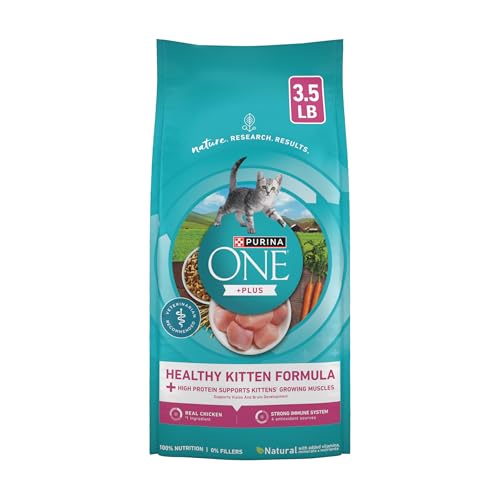
Purina ONE +Plus Healthy Kitten is my pick for the owner who wants elevated animal protein without stepping up in price. Real chicken leads a genuinely high-protein growth formula, which suits a kitten’s fast-building muscle and carnivore metabolism far better than a carbohydrate-heavy kibble. For a kitten in the middle of the fastest growth it will ever do, that protein density is doing real work.
Just as important, the affordable price does not cost you quality signals. It comes from Purina, which substantiates its foods through feeding trials, so it carries the gold-standard AAFCO backing, and it includes DHA for brain and eye development and added taurine. A 4.8-star average across roughly twenty-five thousand reviews reflects strong acceptance, and because it is widely stocked, you can reliably rebuy the same food — a high-protein everyday kibble at a grocery-tier price.
The honest notes are simple. It contains grains and plant proteins, so it is not a grain-free or ultra-low-carb option, and like any kibble it is low in moisture and best paired with some wet food. For a healthy, fast-growing kitten whose owner wants meat-forward protein on a budget, it is an excellent everyday choice.
Purina ONE +Plus Healthy Kitten High-Protein Dry Cat Food
by Purina ONE
The best high-protein everyday dry pick -- a real-chicken-first, feeding-trial-backed growth kibble with DHA and taurine at an affordable price, for the kitten building muscle fast.
Pros
- Real chicken first in a genuinely high-protein growth formula, which suits a kitten's fast-building muscle and carnivore metabolism better than a carb-heavy kibble
- Comes from Purina, which substantiates its foods through feeding trials, so the affordable price still carries the gold-standard AAFCO quality signal
- Includes DHA for brain and eye development and added taurine, with a 4.8-star average across roughly twenty-five thousand reviews reflecting strong acceptance
- Complete and balanced for growth and widely stocked, so you can reliably rebuy the same food -- a high-protein everyday kibble at a grocery-tier price
Cons
- Contains grains and plant proteins, so it is not a grain-free or ultra-low-carb option
- Low moisture like any kibble, best paired with some wet food for hydration
Best Grain-Free: Blue Buffalo Wilderness High-Protein Kitten
Blue Buffalo Wilderness Kitten is my pick for the owner who wants a clean, natural, grain-free growth food without paying boutique-brand prices. Deboned chicken leads a high-protein recipe inspired by the diet of a kitten’s wild ancestors, with no corn, wheat, or soy and — notably — no chicken by-product meal or artificial colors, flavors, or preservatives. Among the grain-free options here, it reads the most cleanly from top to bottom.
For a kitten specifically, it does not sacrifice growth nutrition for the clean label. It is fortified with the DHA and ARA a developing kitten needs for brain and eye development, and the signature LifeSource Bits add a separate, cold-formed blend of antioxidants, vitamins, and minerals selected with input from animal nutritionists. Combined with the meat-forward base, it makes a natural food that keeps animal protein up front while sitting well below the premium boutique tier on price — backed by a 4.8-star average across nearly nine thousand reviews.
The trade-offs are the usual grain-free ones. It is substantiated by formulation rather than feeding trials, the near-universal norm in this category, and it uses peas and potato as grain replacements, so while it is meaningfully carb-lighter than grocery kibble, it is not carb-free. For an owner who specifically wants a clean, high-protein, grain-free growth food at a reasonable price, it is the grain-free pick I would choose.

Blue Buffalo Wilderness High-Protein Grain-Free Chicken Kitten Dry Cat Food
by Blue Buffalo
The best grain-free kitten kibble -- deboned-chicken-first, high in protein, DHA-fortified, and free of corn, wheat, soy, and by-products, for owners who want a clean meat-forward label at a sensible price.
Pros
- Deboned chicken leads a high-protein, grain-free recipe inspired by the diet of a kitten's wild ancestors, with no corn, wheat, or soy -- the cleanest meat-forward label among the grain-free picks here
- Fortified with the DHA and ARA a growing kitten needs for brain and eye development, plus the signature antioxidant-rich LifeSource Bits selected with input from animal nutritionists
- No chicken by-product meal and no artificial colors, flavors, or preservatives, which makes it easy to recommend to a label-conscious owner
- A 4.8-star average across nearly nine thousand reviews and a natural, widely available grain-free option that sits below boutique brands on price
Cons
- Substantiated by formulation rather than feeding trials, the near-universal norm among grain-free brands
- Uses peas and potato as grain replacements, so it is meaningfully carb-lighter than grocery kibble but not carb-free
Best Natural Dry: Blue Buffalo Baby Blue Kitten
Blue Buffalo Baby Blue is the pick for an owner who wants a natural label but is not committed to going fully grain-free. Real chicken leads a natural growth recipe with the DHA a kitten needs for healthy development, and it does it at a genuinely accessible price for a natural-positioned food. It skips chicken by-product meal, corn, wheat, soy, and artificial colors, flavors, and preservatives, and adds the same antioxidant-rich LifeSource Bits found across the Blue Buffalo line — a clean label without the boutique price.
The difference from the grain-free Wilderness recipe is deliberate. Baby Blue includes wholesome brown rice, which provides gentle, digestible carbohydrate energy for a busy kitten and suits owners who see no need to avoid grains entirely. The small kibble is easy for little mouths, and it is a well-reviewed, widely available option that gives a health-minded owner a clean, real-chicken growth food without the premium spend.
The honest notes are short. It contains grains, so it is not the pick for an owner specifically seeking grain-free, and it is substantiated by formulation rather than feeding trials. For the owner who wants a natural, DHA-fortified, real-chicken kibble at a price a normal budget can sustain, it is a smart, uncomplicated choice.

Blue Buffalo Baby Blue Natural Kitten Chicken & Brown Rice Dry Cat Food
by Blue Buffalo
The best natural everyday dry pick -- a real-chicken-first, DHA-fortified growth kibble with a clean natural label and wholesome grains, at a price most budgets can sustain.
Pros
- Real chicken first in a natural growth recipe with the DHA a kitten needs for healthy development, at a genuinely accessible price for a natural-positioned food
- Includes the antioxidant-rich LifeSource Bits and skips chicken by-product meal, corn, wheat, soy, and artificial colors, flavors, and preservatives -- a clean label without the boutique price
- Wholesome brown rice provides gentle, digestible carbohydrate energy for a busy kitten, and the small kibble suits little mouths
- A well-reviewed, widely available option for the owner who wants a natural label but is not committed to going fully grain-free
Cons
- Contains grains, so it is not the pick for an owner specifically seeking grain-free
- Substantiated by formulation rather than feeding trials
Best for Picky Eaters: Weruva Kitten Fur Baby Favorites
Weruva Kitten Fur Baby Favorites is the wet food I reach for when the kitten in front of me is a genuinely picky eater — the fussy weanling, the shy rescue, the little one recovering from illness who turns up its nose at everything else. Tender shreds of real meat in a hydrating gravy are hard for a reluctant kitten to resist, and getting a fragile kitten to eat at all is sometimes the whole battle.
Underneath the appeal is real quality. It is high in animal protein and grain-free, built on named muscle meat rather than by-products or plant fillers — a meat-forward, carnivore-appropriate recipe for a growing kitten. And the broth-and-gravy format delivers excellent moisture, which is exactly what a kitten needs to build the hydration habit that protects an adult cat’s urinary and kidney health. It is a trusted premium brand with a loyal following and a strong 4.6-star average.
Two honest trade-offs. It is among the priciest foods per calorie here, the cost of the high-quality named meats and human-grade positioning, and the shreds-in-gravy texture is lower in calories per can than a dense pate, so a fast-growing kitten may need larger portions to hit its energy needs. For a picky or fragile eater, or an owner who prioritizes hydration and ingredient quality, it is the wet food most likely to get a difficult kitten eating well.

Weruva Kitten Fur Baby Favorites Variety Pack Wet Cat Food (12 Cans)
by Weruva
The best pick for a picky eater -- a high-protein, grain-free, gravy-rich wet food with real meat shreds that fussy or newly weaned kittens reliably accept, with excellent hydration built in.
Pros
- Tender shreds of real meat in a hydrating gravy that fussy, newly weaned, or convalescing kittens accept when little else works -- the wet food I reach for with a genuinely picky eater
- High animal protein and grain-free, with named muscle meat rather than by-products or plant fillers -- a meat-forward, carnivore-appropriate recipe for a growing kitten
- The extra moisture from the broth-and-gravy format is excellent for hydration, which matters most in the first year when good habits form
- A trusted premium brand with a loyal following and a strong 4.6-star average, formulated to support kittens through their growth stage
Cons
- Among the priciest foods per calorie here -- the cost of the high-quality named meats and human-grade positioning
- The shreds-in-gravy texture is lower in calories per can than a dense pate, so a fast-growing kitten may need larger portions
Best Grain-Free Wet: Wellness Complete Health Kitten Pate
Wellness Complete Health Kitten Pate is my pick for the owner who wants a grain-free wet food with a genuinely clean, protein-rich label. It leads with real whitefish and chicken in a meat-forward, carbohydrate-light pate that suits a kitten’s carnivore biology, and it is made without meat by-products, wheat, corn, soy, or artificial additives — a recipe that reads cleanly for a health-focused owner.
For a growing kitten it covers the essentials well. It is fortified with DHA for brain and eye development, its moisture-rich pate supports the hydration that matters so much in the first year, and the smooth, consistent texture is easy for small mouths — working equally well as a kitten’s primary food or as a wet complement to a quality kibble. Wellness is a respected natural brand, and most kittens take to the pate readily.
The trade-offs are straightforward. It is priced above grocery wet food, the cost of the grain-free, by-product-free formulation, and it is substantiated by formulation rather than feeding trials. For an owner who specifically wants a clean, grain-free, protein-rich wet food for a growing kitten, it is the one I would choose.

Wellness Complete Health Kitten Pate Grain-Free Wet Cat Food Variety Pack (12 Cans)
by Wellness
The best grain-free wet pick -- a protein-rich, DHA-fortified pate with real fish and chicken and a clean, by-product-free label, moisture-rich and easy for a growing kitten to eat.
Pros
- A protein-rich, grain-free growth pate with real whitefish and chicken as the first ingredients -- a meat-forward, carbohydrate-light wet recipe that suits a kitten's carnivore biology
- Fortified with DHA for brain and eye development and made without meat by-products, wheat, corn, soy, or artificial additives, so the label reads cleanly for a health-focused owner
- The moisture-rich pate supports hydration and is easy for small mouths, working well as a growing kitten's primary food or a wet complement to kibble
- A respected natural brand with a smooth, consistent pate texture that most kittens take to readily
Cons
- Priced above grocery wet food, the trade-off for the grain-free, by-product-free formulation
- Substantiated by formulation rather than feeding trials
Best Wet for Digestion: Royal Canin Kitten Thin Slices in Gravy
Royal Canin Kitten Thin Slices in Gravy is my gentle wet pick — the one I suggest for a kitten with a young, still-maturing or slightly sensitive digestive system. It is formulated specifically for growing kittens with a precise nutrient balance and highly digestible ingredients, and the tender thin slices in a savory gravy add the moisture that supports both hydration and a settled gut. It is designed to pair naturally with Royal Canin’s dry kitten food for a mixed-feeding routine.
Where it shines is tolerability and acceptance. The soft, sliced-in-gravy texture is easy for tiny mouths and appealing to transitioning kittens, and Royal Canin’s clinical reputation for digestibility is exactly why it is a common exam-room recommendation for young or fragile kittens. A 4.7-star average across thousands of reviews reflects consistent results.
The trade-offs are cost and substantiation. It is more expensive per calorie than grocery wet food, the price of the tailored formulation, and it is substantiated by formulation rather than feeding trials. For a kitten whose gut needs a gentle, highly digestible, moisture-rich food — or an owner already feeding Royal Canin kibble who wants a matched wet complement — it is a thoughtful, well-targeted choice.

Royal Canin Feline Health Nutrition Kitten Thin Slices in Gravy Wet Cat Food (12 Cans)
by Royal Canin
The best gentle wet pick -- a highly digestible, moisture-rich thin-slices-in-gravy formula engineered for the kitten growth stage, ideal for a maturing or slightly sensitive gut and easy for small mouths.
Pros
- Tender thin slices in a savory gravy designed to pair with Royal Canin's dry kitten food, with the extra moisture that makes it easy to recommend for hydration and for a young, developing digestive system
- Formulated specifically for growing kittens with a precise nutrient balance and highly digestible ingredients -- a gentle, well-tolerated wet option for a sensitive or maturing gut
- The soft, sliced-in-gravy texture is easy for tiny mouths and appealing to transitioning kittens, and pairs naturally with a dry ration for a mixed-feeding routine
- A 4.7-star average across thousands of reviews and the clinical reputation that makes Royal Canin a common exam-room recommendation for kittens
Cons
- More expensive per calorie than grocery wet food, the trade-off for the tailored formulation
- Substantiated by formulation rather than feeding trials
Best Wet Kitten Food
Wet food should be part of nearly every kitten’s routine, because its moisture — near 78 percent water versus roughly 10 percent for kibble — builds the hydration habit that protects an adult cat’s urinary and kidney health, and its soft texture and strong palatability suit newly weaned and picky kittens. The best wet kitten foods are complete and balanced for growth, lead with real animal protein, and are affordable enough to feed consistently.
| Product | Price | Buy |
|---|---|---|
| Purina Fancy Feast Kitten Classic Pate Wet Cat Food Variety Pack (24 Cans)Best value wet An affordable, moisture-rich, endlessly palatable growth pate that makes feeding wet food to a kitten genuinely sustainable | $22.86 | View on Amazon |
| Weruva Kitten Fur Baby Favorites Variety Pack Wet Cat Food (12 Cans)Best for picky eaters High-protein, grain-free shreds in a hydrating gravy that fussy or newly weaned kittens reliably accept | $22.99 | View on Amazon |
| Wellness Complete Health Kitten Pate Grain-Free Wet Cat Food Variety Pack (12 Cans)Best grain-free wet A protein-rich, DHA-fortified grain-free pate with real fish and chicken and a clean, by-product-free label | $20.89 | View on Amazon |
Best Dry Kitten Food
Dry kitten food is affordable, convenient, easy to measure, and practical to leave out for a growing kitten that eats little and often. The best dry kitten foods are complete and balanced for growth, lead with a named animal protein, include DHA and taurine, and come in a kibble sized for small mouths — and they are best paired with some wet food to cover moisture.
| Product | Price | Buy |
|---|---|---|
| Hill's Science Diet Kitten Formula Chicken Recipe Dry Cat FoodBest overall dry A feeding-trial-substantiated, real-chicken growth kibble with DHA and a clinical antioxidant blend from the brand vets recommend most | $22.99 | View on Amazon |
| IAMS Proactive Health Healthy Kitten Chicken Dry Cat FoodBest budget dry A real-chicken-first growth kibble with DHA and taurine at a grocery-tier price -- the best value that still leads with meat | $9.89 | View on Amazon |
| Purina ONE +Plus Healthy Kitten High-Protein Dry Cat FoodBest high-protein dry A high-protein, feeding-trial-backed growth kibble with DHA and taurine at an affordable price, for the kitten building muscle fast | $10.28 | View on Amazon |
Best Kitten Food for Indoor Cats
An indoor kitten still needs full growth nutrition — do not reach for a calorie-restricted adult indoor food during the first year. What an indoor kitten does need is a complete growth formula fed in measured meals, because a lower-activity indoor kitten is the easiest to accidentally overfeed. These growth foods are highly digestible, portion-friendly, and easy to keep a house cat lean on with a measured ration.
| Product | Price | Buy |
|---|---|---|
| Hill's Science Diet Kitten Formula Chicken Recipe Dry Cat FoodBest overall for indoor kittens A research-backed, real-chicken growth kibble that is easy to portion and keep an indoor kitten lean on | $22.99 | View on Amazon |
| Royal Canin Feline Health Nutrition Kitten Dry Cat FoodBest premium for indoor kittens A precisely engineered, highly digestible growth formula with a kitten-tailored kibble, ideal for a fussy indoor kitten | $41.99 | View on Amazon |
| IAMS Proactive Health Healthy Kitten Chicken Dry Cat FoodBest budget for indoor kittens An affordable, real-chicken growth kibble with DHA that keeps quality high while you control portions | $9.89 | View on Amazon |
Best Kitten Food for Sensitive Stomachs
A kitten with a young, still-maturing gut can have mild loose stool or occasional vomiting, and the answer is usually a highly digestible growth food with a clean, consistent recipe — introduced gradually over seven to ten days. If problems are frequent, severe, or come with lethargy or poor growth, that is a veterinary visit, not another bag. These are the gentlest, most digestible growth foods here.
| Product | Price | Buy |
|---|---|---|
| Royal Canin Feline Health Nutrition Kitten Dry Cat FoodBest digestible premium A precisely engineered growth formula with highly digestible proteins and prebiotics that suit a young, maturing gut | $41.99 | View on Amazon |
| Royal Canin Feline Health Nutrition Kitten Thin Slices in Gravy Wet Cat Food (12 Cans)Best gentle wet A highly digestible, moisture-rich thin-slices-in-gravy formula that is gentle on a sensitive or maturing kitten stomach | $27.48 | View on Amazon |
| Hill's Science Diet Kitten Formula Chicken Recipe Dry Cat FoodBest digestible everyday A feeding-trial-backed, real-chicken growth kibble with a clinical antioxidant blend and consistent, well-tolerated recipe | $22.99 | View on Amazon |
Best Grain-Free Kitten Food
Grain-free is a preference rather than a medical necessity for most kittens, and the canine grain-free heart-disease discussion centered on dogs, not cats — every complete cat food adds taurine regardless of grain. If you want grain-free for your kitten, choose one that still leads with real animal protein and includes the DHA growth requires. These do.
| Product | Price | Buy |
|---|---|---|
| Blue Buffalo Wilderness High-Protein Grain-Free Chicken Kitten Dry Cat FoodBest grain-free dry Deboned-chicken-first, high-protein, DHA-fortified, and free of corn, wheat, soy, and by-products at a sensible price | $29.98 | View on Amazon |
| Wellness Complete Health Kitten Pate Grain-Free Wet Cat Food Variety Pack (12 Cans)Best grain-free wet A protein-rich, DHA-fortified grain-free pate with real fish and chicken and a clean, by-product-free label | $20.89 | View on Amazon |
| Weruva Kitten Fur Baby Favorites Variety Pack Wet Cat Food (12 Cans)Best grain-free for picky eaters High-protein grain-free shreds in a hydrating gravy that fussy or newly weaned kittens reliably accept | $22.99 | View on Amazon |
Best High-Protein Kitten Food
A growing kitten thrives on elevated animal protein — it fuels the fast muscle and organ development of the first year far better than the carbohydrate kibble tends to carry. These deliver the most animal protein per bite, from a grain-free whole-prey-style kibble to a protein-rich grain-free wet pate.
| Product | Price | Buy |
|---|---|---|
| Purina ONE +Plus Healthy Kitten High-Protein Dry Cat FoodBest high-protein value A real-chicken-first, feeding-trial-backed high-protein growth kibble with DHA and taurine at an affordable price | $10.28 | View on Amazon |
| Blue Buffalo Wilderness High-Protein Grain-Free Chicken Kitten Dry Cat FoodBest grain-free high-protein Deboned-chicken-first and grain-free with high animal protein and a clean, by-product-free natural label | $29.98 | View on Amazon |
| Wellness Complete Health Kitten Pate Grain-Free Wet Cat Food Variety Pack (12 Cans)Best high-protein wet A protein-rich, grain-free wet pate with real fish and chicken and the moisture a kitten needs for hydration | $20.89 | View on Amazon |
Buyer's Guide
After years in feline practice fielding new-kitten questions across the exam table, these are the factors I actually walk owners through when they ask what to feed a kitten -- ordered by how much they affect a growing kitten's health, and written for the specific demands of the first year of life.
The AAFCO Statement: It Must Say 'Growth,' Not 'Maintenance'
Before anything else, find the AAFCO nutritional adequacy statement on the package -- it is the single most useful line on the label, and almost no competitor explains what it really tells you for a kitten. It confirms which life stage the food is complete and balanced for, and for a kitten that word must be 'growth' or 'all life stages,' never 'adult maintenance.' The two are genuinely different nutrient profiles: a growth food carries the extra protein, fat, calories, calcium, and DHA a kitten needs to build a whole body, and a maintenance food simply does not. There is a second layer worth understanding: how the completeness was substantiated. 'Animal feeding tests using AAFCO procedures' means the food was actually fed to kittens and their health measured -- the gold standard -- while 'formulated to meet the AAFCO nutrient profiles' means the recipe was calculated on paper without a live trial. Both can be good foods, but a feeding trial is a higher bar, and the major research brands run them. When two kitten foods look otherwise similar, the growth statement plus a feeding-trial substantiation is the tiebreaker I use.
Named Animal Protein and Calorie Density for Growth
Kittens are obligate carnivores in the most demanding phase of their lives, so read the first few ingredients and look for a named animal protein -- chicken, turkey, salmon -- at the very top, not a grain or a vague 'meat meal.' Just as important for a kitten specifically is calorie and protein density: a growing kitten needs roughly two to three times the calories per pound of body weight that an adult does, because it is building muscle, bone, and organs while burning energy at a furious pace. That is exactly why a kitten needs a growth formula and not a calorie-controlled adult food. Higher animal protein supports that fast muscle development far better than the carbohydrate that kibble tends to carry. You cannot get a dry food to zero carbs, but you can choose one that leads with real meat -- which is why high-protein and grain-free growth kibbles sit near the top for ingredient quality on this list, and why the goal is always meat first, adequate calories, and enough of both to fuel the fastest growth your kitten will ever do.
DHA for Brain and Eye Development
DHA is the nutrient that makes kitten food genuinely different from adult food, and it is the one I most want owners to confirm on the label. DHA is an omega-3 fatty acid critical to the development of a kitten's brain, nervous system, and retinas during the first months of life -- the window when that wiring is actually being built. Kittens naturally get DHA from their mother's milk, so once weaned onto solid food, a growth formula fortified with DHA carries that development forward. Not all omega-3 is equal here: DHA from a marine source such as fish oil is directly usable, whereas the ALA in plant oils like flaxseed converts to DHA very inefficiently in cats, so a food listing fish oil or a named DHA source is preferable to one relying on plant omega-3 alone. Every quality kitten food on this list includes DHA, and it is a checkable point of difference -- a food that does not name DHA is one I would set aside for a kitten no matter how good the rest of the label looks.
Taurine: The Non-Negotiable Amino Acid
Taurine is the amino acid that makes cat food fundamentally different from dog food, and it matters from the very first meals. Cats cannot synthesize taurine in adequate amounts, so it must come from the diet, and a deficiency causes two devastating, often irreversible conditions: dilated cardiomyopathy, a weakening of the heart muscle, and retinal degeneration leading to blindness. Any food carrying a complete-and-balanced AAFCO statement for growth or all life stages contains added taurine -- you will usually see it spelled out near the end of the ingredient list, and its presence is one quick confirmation that a food was formulated for cats specifically rather than repurposed. This is also the reason you must never feed a kitten dog food, even briefly: dog formulas are not required to supplement taurine, and a growing kitten is especially vulnerable. On any kitten food you are considering, confirm taurine appears on the label; on every complete-and-balanced food in this roundup, it does.
Wet, Dry, or Both -- and the Hydration Habit
How you split wet and dry food matters less than making sure a kitten gets enough moisture and enough calories, but it is worth being deliberate about early. Wet food's real advantage is water: canned food runs near 78 percent moisture against roughly 10 percent for kibble, and because cats evolved from desert predators with a weak thirst drive, a kitten that learns to eat moisture-rich food is far better protected against the urinary and kidney problems I treat constantly in adult cats. Dry food's advantages are cost, convenience, easy measuring, and the practicality of leaving food out for a growing kitten that eats little and often. In practice, the routine I recommend for most kittens is a foundation of measured wet-food meals for hydration and palatability, complemented by a quality kitten kibble -- which also means a kitten that accepts both textures grows into an adult you can feed flexibly. Whatever the split, keep fresh water available, and consider that the hydration habits you build in the first year tend to last a lifetime.
Feeding Frequency, Portioning, and Not Overfeeding
A kitten's stomach is tiny and its energy needs are enormous, so young kittens do best on frequent small meals -- roughly four a day under three months, tapering to three and then two meals as they approach adulthood -- rather than one or two large ones. It is tempting to assume a kitten cannot be overfed because it is growing, but that is a myth worth correcting: kittens absolutely can be overfed, and starting a cat's life overweight sets up patterns that are hard to reverse. Use the feeding guide on the package as a starting point, then adjust to your kitten's body condition -- you should be able to feel the ribs easily under a light covering and see a slight waist. Free-feeding kibble around the clock is convenient but the most common route to an overweight kitten, so measure the daily ration and offer it in meals. As growth slows toward the first birthday -- and especially after spay or neuter surgery, which lowers calorie needs -- reassess the portion downward with your veterinarian rather than simply keeping the bowl full.
The Bottom Line on Kitten Food
Feeding a kitten well is simpler than the crowded food aisle makes it look, because the decision rests on a few things that genuinely matter. Choose a food complete and balanced for growth or all life stages — ideally feeding-trial substantiated — that leads with a named animal protein and includes DHA for brain and eye development and taurine for heart and vision. For most kittens, my top recommendation is Hill’s Science Diet Kitten: research-backed, real-chicken-first, and formulated for growth. If budget is the priority, IAMS Proactive Health Healthy Kitten delivers real-chicken, DHA-fortified nutrition at a grocery-tier price, and to build the hydration habits that protect an adult cat for life, a moisture-rich wet food like Purina Fancy Feast Kitten belongs in the routine too.
Whatever you choose, hold on to the principles that outrank any brand: an AAFCO growth statement you have actually read, a named animal protein among the first ingredients, DHA and taurine on the label, and enough calories fed in measured meals to fuel the fastest growth your cat will ever do — without tipping into overfeeding. If you do not know how old your kitten is — the usual situation when one simply arrives — our kitten age chart estimates it from the teeth, eyes, ears and weight, which is the number every recommendation below depends on. Our kitten feeding schedule calculator by age turns your kitten’s age and weight into the right food, meals per day, and exact amount for its stage; our cat diet calculator does the same portion math once your kitten is grown; our kitten weight chart by week shows what a kitten should weigh at every age from birth to twelve months — day by day for the first eight weeks — and grades the daily gain once you log a second weigh-in; the cat weight chart by age and breed picks up the same question for grown cats; and our guide on how much to feed a cat by weight walks through adjusting as your kitten grows. Around the first birthday, transition gradually to a quality adult cat food and reassess portions with your veterinarian. And because a kitten’s appetite, energy, and growth are among the clearest early signals of health, keep up those first-year wellness visits — our kitten vaccination schedule turns your kitten’s birthday into the actual dates of every shot it needs, which is the same four months this food has to carry it through. Getting nutrition right now is one of the best investments you will ever make in a long, healthy life together.
Frequently Asked Questions
What should I look for in a kitten food?
Is wet or dry food better for kittens?
When should I switch my kitten to adult cat food?
Can kittens eat adult cat food, and can adult cats eat kitten food?
What is the healthiest kitten food?
Related Articles
About the Reviewer

Dr. Priya Anand, DVM, ABVP (Feline)
DVM, Cornell University College of Veterinary Medicine
Dr. Priya Anand is a veterinarian board-certified by the ABVP in Feline Practice, with over a decade caring for cats in a feline-exclusive clinic. She has guided thousands of cat owners through nutrition, litter-box troubleshooting, enrichment, and senior-cat care. She founded House of Mittens in 2026 to cut through pet-aisle marketing and recommend the food, litter, and gear that actually keep cats healthy and happy — judged the way she'd advise her own patients.