How Much Wet Food to Feed a Cat: A Vet's Feeding Guide
Feline veterinarian Dr. Priya Anand, DVM explains exactly how much wet food to feed a cat — a weight-based feeding chart, the calorie math, the spay/neuter adjustment most owners miss, and how to read the label so you feed the right amount.
Updated
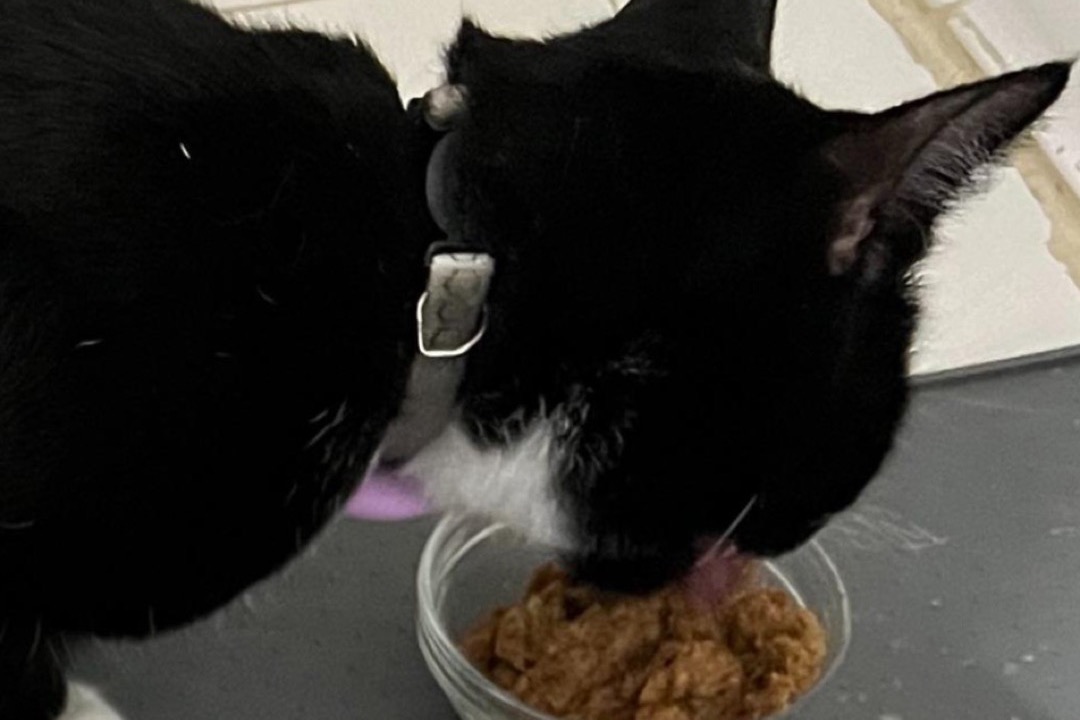
“How much wet food should I feed my cat?” is one of the most common questions I answer in my feline practice, and the honest first answer — “it depends” — is true but useless. So let me give you the version that actually helps. The cats I see carrying extra weight, and they make up well over half of my appointments, almost never belong to careless owners. They belong to thoughtful people who fed the amount on the can, or the amount the last cat ate, or simply the amount that made the meowing stop. The number on the can is a starting point set by a manufacturer who has never met your cat. This guide gives you the real math — by weight, by life stage, and adjusted for the one factor that trips up nearly everyone.
The Quick Answer — Wet Food by Cat Weight
Most healthy, spayed or neutered adult indoor cats need roughly 20 calories per pound of body weight per day. A standard 3-ounce (85g) pouch or can of wet food usually contains somewhere between 70 and 100 calories, and a 5.5-ounce can runs about 130 to 160 calories. Put those together and you get a practical starting chart:
| Cat weight | Daily calorie target | 3-oz cans/day | 5.5-oz cans/day |
|---|---|---|---|
| 6 lbs | ~120–150 kcal | 1.5–2 | 1 |
| 8 lbs | ~160–200 kcal | 2–2.5 | 1–1.5 |
| 10 lbs | ~200–260 kcal | 2.5–3 | 1.5–2 |
| 12 lbs | ~240–300 kcal | 3–3.5 | 2–2.5 |
| 15 lbs | ~300–375 kcal | 3.5–4 | 2–3 |
Read this table as a place to begin, not a prescription. It assumes a neutered, moderately active indoor adult and an average-calorie food. The single most useful thing you can do next is stop trusting my averages and read your own can’s label — which is exactly what the next section is about. Divide whatever total you land on across at least two meals a day.
How to Find Your Cat’s Actual Calorie Needs
Every complete cat food sold in the US is legally required to print a calorie statement — written as “kcal/kg” and “kcal per can” (or per cup for dry) — usually in fine print near the guaranteed analysis panel. Almost no one looks at it, and it is the most important number on the package. Two 3-ounce cans that look identical on the shelf can differ by 40 calories, which over a year is the difference between a trim cat and an overweight one.
To dial in your cat’s target, start with the 20-calories-per-pound rule for a neutered adult, then adjust for reality: a lean, playful young cat may need closer to 25 or 30 per pound, while a sedentary senior or a cat already carrying weight needs less. Multiply the target by your cat’s weight, find the kcal-per-can figure on your specific food, and divide. That is your starting daily portion in actual cans — far more accurate than any generic chart, mine included. If you’d rather not do the arithmetic, our free cat diet calculator does exactly this — enter your cat’s weight, life stage, and the food’s calories per can, and it returns the daily calorie target and the number of cans (with a weight-loss mode for overweight cats). When you are choosing which food to measure out in the first place, my breakdown of the best wet cat foods flags the calorie density of each pick so you are not guessing.
Kitten, Adult, and Senior — How Life Stage Changes Everything
Life stage is the biggest lever on how much your cat should eat, and the rules genuinely flip from one end to the other.
Kittens (under 1 year) are building an entire body and burn energy at a staggering rate. A growing kitten needs roughly two to three times the calories per pound that an adult does, split across three or four small meals a day, and the food must be labeled for growth or “all life stages” — adult maintenance formulas do not carry enough protein, fat, or specific nutrients like taurine and the right calcium-to-phosphorus ratio. A four-month-old typically works through three to four small 3-ounce pouches daily. Around twelve months you can taper to an adult portion and two to three meals. (If you are still in the early days, my kitten litter-training guide covers the other half of bringing a young cat home.)
Adults (1 to 7 years) settle into the maintenance numbers in the table above, fed across two meals minimum. This is the long, stable middle where most overfeeding quietly accumulates — half a can too much per day is barely visible week to week but adds up to a meaningfully heavier cat over a year.
Seniors (7 years and older) are where you have to watch in both directions. Many older cats need slightly fewer calories — around 180 to 220 a day for a 10-pound cat — and do best on two or three smaller, softer-textured meals that are easy on aging teeth. But unexplained weight loss in a senior is a red flag, not a goal: hyperthyroidism, kidney disease, and diabetes all show up first as a cat who is eating but shrinking. If your older cat is dropping weight despite a normal appetite, that is a vet visit, not a reason to add food.
Spayed and Neutered Cats Need Fewer Calories Than You Think
Here is the adjustment almost every owner misses, and it is the single biggest driver of feline obesity I see. Spaying or neutering lowers a cat’s resting energy needs by roughly 25 to 30 percent — and at the same time it tends to increase appetite by dialing down the body’s satiety signals. So your cat wants more food precisely when it needs less. Left on its pre-surgery ration, a newly neutered cat will gain weight almost like clockwork.
In concrete terms: if an intact cat’s daily target was 250 calories, the post-neuter target is closer to 175 to 190. That is a real cut of a quarter or more, and your cat will lobby hard against it with the convincing performance of a starving animal. Hold the line. A neutered cat fed for its actual metabolism, not its enthusiasm, stays lean for life.
Wet-Only vs Mixed Feeding — How to Calculate Both
Wet-only feeding is nutritionally complete as long as the food meets AAFCO standards, and I genuinely like it for one big reason: cats evolved from desert animals with a weak thirst drive, and they get much of their water from prey. Wet food is roughly 75 percent moisture, so it does the hydrating that a cat on dry-only often skips — which matters for urinary and kidney health. If you feed wet only, just use the table above and split it across two or more meals.
Mixed feeding (some wet, some dry) is perfectly fine, but you have to do the math by calories, not by volume — and this is where the popular “two-thirds wet, one-third dry” shortcut fails. Dry food is far more calorie-dense than wet, so equal-looking scoops are nowhere near equal calories. Do it properly in four steps:
- Calculate the total daily calorie target (say, 200 kcal for a 10-pound neutered cat).
- Decide your split — for example, 50/50, which is 100 kcal from each.
- Read the wet food label and portion out 100 kcal worth of cans.
- Read the dry food label (kcal per cup) and measure 100 kcal worth of kibble with an actual measuring cup, not a coffee mug.
It takes two minutes once and then becomes routine. Skipping the calorie check and eyeballing volume is one of the quietest ways cats drift overweight.
How to Tell If You’re Feeding the Right Amount
The scale matters, but your hands are a better day-to-day tool. Veterinarians use a 9-point body condition score, and you can run the home version in ten seconds. Rest your thumbs on your cat’s spine and run your fingers along the rib cage. On an ideal cat you should feel the ribs easily, with just a thin layer of cover — like feeling the back of your hand through a sweater. Look down from above: you should see a visible waist behind the ribs. Look from the side: there should be a slight upward tuck of the belly.
If you have to press to find ribs and there is no waist, your cat is over-conditioned — reduce daily calories by about 10 percent and reassess in four weeks. If ribs, spine, and hip bones are sharply visible, your cat is underweight and needs a vet’s eye. The score, not the can’s suggestion, is your real feedback loop.
One critical rule that follows from this: feed for your cat’s ideal weight, not its current weight. If your cat weighs 14 pounds but should weigh 10, you calculate the portion for a 10-pound cat. Feeding to maintain the current number just locks in the obesity. Drop weight slowly, though — never cut more than 20 percent of calories at once, because rapid starvation in cats can trigger hepatic lipidosis, a serious and sometimes fatal liver condition. Weight loss in cats is a marathon measured in months.
How Often Should You Feed Your Cat Wet Food?
Cats are built to eat small, frequent meals — a wild cat hunts and eats the equivalent of eight to ten mice a day. You do not need to match that, but you should beat the once-a-day bowl. Kittens want three to four meals; adults do well on two as a minimum and better on three or four smaller ones, which curbs the begging and the overnight hunger that has many of us woken at 5 a.m.
What does not work for wet food is free-feeding — leaving it out all day. It spoils, it draws bacteria, and it makes intake impossible to track, which defeats the whole point of measured portions. If your schedule fights a two- or three-meal routine, a timed automatic feeder with sealed wet-food compartments and an ice pack solves it cleanly.
Wet Food Storage and Food Safety
Treat open wet food like the perishable meat it is. The rules are simple:
- Out at room temperature: two hours maximum. Bacteria multiply quickly past that, especially in a warm kitchen. Toss what your cat hasn’t finished.
- Opened cans in the fridge: up to three days, covered. A plastic pet-can lid or a small airtight container keeps it from drying out and from perfuming your leftovers.
- Serve at room temperature or slightly warm. Cats strongly prefer food near body temperature, around 98 to 100°F — closer to fresh prey than cold-from-the-fridge. Take the chill off, stir, and always test it on your wrist so it is warm, never hot.
- Never leave wet food in direct sun or a hot car, even briefly.
Cleaner feeding also means a cleaner box, since what goes in shapes what comes out — and if litter-box odor or output ever changes sharply alongside a diet switch, that is worth noting. My best cat litter guide covers the odor and tracking side of that equation.
When Wet Food Portions Need to Change — Medical Conditions to Know
Several common feline conditions change the feeding math, and wet food is often part of the treatment. These are vet-supervised adjustments — I include them so you know when the standard chart no longer applies:
- Chronic kidney disease (CKD): wet food’s high moisture is a genuine therapeutic asset for hydration, and protein and phosphorus targets shift to a therapeutic diet your vet prescribes. Portions are calculated case by case.
- Diabetes: consistent, carbohydrate-controlled meals on a fixed schedule that lines up with insulin. Many diabetic cats do well on canned diets, but timing and amount become medical decisions.
- Hyperthyroidism: these cats burn calories fast and may need more food despite looking thin — until the underlying disease is treated.
- Obesity: a structured reduction to the ideal-weight target, often with more frequent small meals to take the edge off hunger.
The common thread: if your cat has a diagnosed condition, your vet calculates the portion with you. Don’t freelance it from a chart.
Switching from Dry to Wet Food (or Changing Brands)
Cats are creatures of habit with sensitive stomachs, so never flip foods overnight. Use a ten-day transition: days 1–3 at 25 percent new food mixed into 75 percent old, days 4–6 at 50/50, days 7–9 at 75 percent new, and day 10 at 100 percent. A gradual change lets the gut bacteria adjust and gives a picky cat time to accept a new texture. Watch for vomiting, diarrhea, or outright refusal — if any show up, slow the transition down further or step back to the last ratio your cat tolerated. A patient switch beats a fast one that ends with a hunger strike.
Frequently Asked Questions
How many cans of wet food should I feed my cat a day?
For an average 10-pound neutered adult cat, roughly 2 to 2.5 cans of a standard 3-ounce (85g) wet food per day, divided across two meals. Calorie density varies a lot by brand, so confirm with the kcal-per-can figure printed near the guaranteed analysis on your specific food rather than relying on the can count alone.
Can I feed my cat only wet food?
Yes. A wet-only diet is nutritionally complete as long as the food meets AAFCO standards, and it has a real advantage for hydration, which supports urinary and kidney health. Just divide the daily amount across at least two meals and discard anything left out longer than two hours.
How do I know if I’m overfeeding my cat?
Use the body condition check: you should be able to feel the ribs easily under a thin layer of fat, see a waist when you look down from above, and see a slight belly tuck from the side. If you have to press hard to find ribs and there’s no visible waist, reduce daily calories by about 10 percent and reassess in four weeks.
How much wet food should a kitten eat?
Kittens need two to three times the calories per pound that adults do, split across three to four meals a day. A four-month-old typically eats three to four small 3-ounce pouches daily. Always use a food labeled for growth or “all life stages” until about twelve months of age.
Should I leave wet food out all day?
No. Wet food shouldn’t sit out longer than two hours — bacteria multiply quickly at room temperature, and free-feeding makes it impossible to track how much your cat actually eats. If your cat grazes slowly, offer smaller portions more often instead of one large serving.
How much wet food does a senior cat need?
Most cats 7 and older need slightly fewer calories — around 180 to 220 a day for a 10-pound cat — fed as two or three smaller, softer meals. Watch for weight loss rather than gain, though: if a senior is eating normally but shrinking, see your vet, because hyperthyroidism, kidney disease, and diabetes are common culprits.
How do I adjust portions if my cat is overweight?
Feed for your cat’s ideal weight, not its current weight. If your cat is 14 pounds but should be 10, calculate the portion for a 10-pound cat. Reduce slowly — never cut more than 20 percent of calories at once, because crash dieting in cats can trigger hepatic lipidosis, a serious liver condition. Weight loss should take months, not weeks.
Related Articles
About the Reviewer

Dr. Priya Anand, DVM, ABVP (Feline)
DVM, Cornell University College of Veterinary Medicine
Dr. Priya Anand is a veterinarian board-certified by the ABVP in Feline Practice, with over a decade caring for cats in a feline-exclusive clinic. She has guided thousands of cat owners through nutrition, litter-box troubleshooting, enrichment, and senior-cat care. She founded House of Mittens in 2026 to cut through pet-aisle marketing and recommend the food, litter, and gear that actually keep cats healthy and happy — judged the way she'd advise her own patients.