How Much to Feed a Cat by Weight: A Vet's Feeding Chart
Feline veterinarian Dr. Priya Anand, DVM gives you one unified feeding chart by weight — dry, wet, and mixed — plus the real calorie math (RER and MER), the spay/neuter adjustment, and how to read the bag so you feed the right amount.
Updated
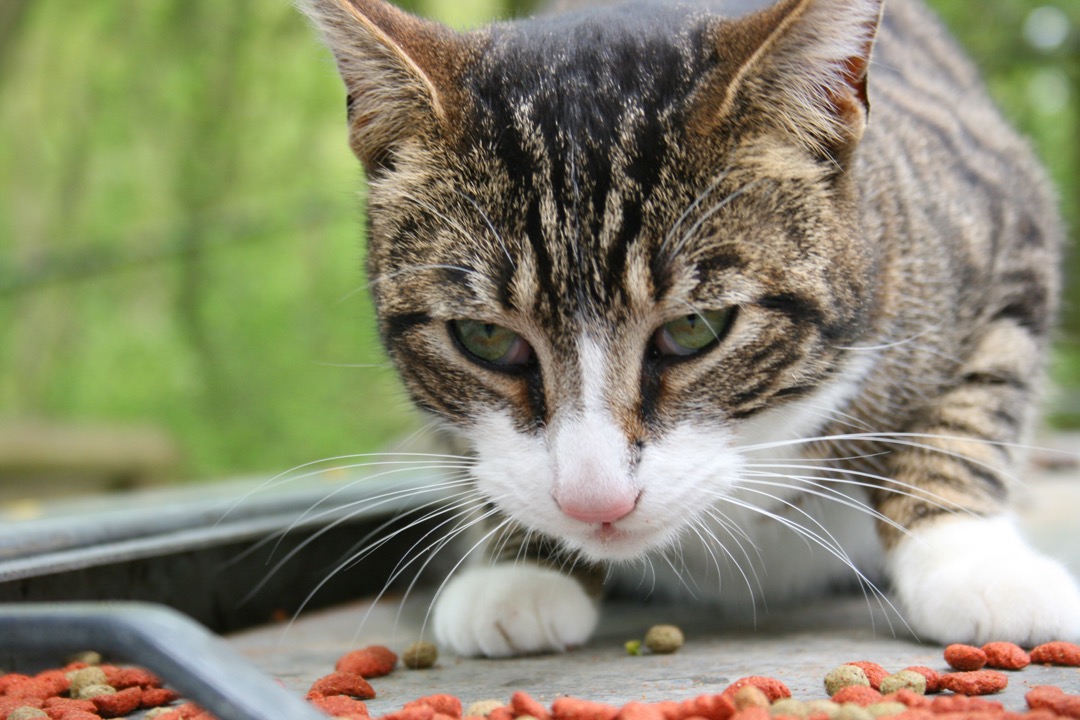
“How much should I feed my cat?” sounds like it should have a simple answer, and every day in my feline practice I watch that question quietly wreck a cat’s waistline. The owner is doing everything right by their own lights — they feed the amount printed on the bag, or the amount the last cat ate, or the amount that finally silences the 6 a.m. yowling — and their cat is a pound and a half heavier than it should be. More than half the cats I examine are overweight, and almost none belong to careless people. They belong to thoughtful owners who were never given the actual number.
So here is the actual number, or rather the actual method. This guide answers the general feeding question the way I answer it in an exam room: with a chart you can use in ten seconds, and then the real math underneath it so you understand why the chart says what it does and when to stray from it. We’ll cover dry food (where “half a cup” means almost nothing until you read your specific bag), wet food, mixed feeding without accidentally double-feeding, life stages, the spay/neuter adjustment nearly everyone misses, treats, and how to feed toward the cat your cat should be rather than the cat it currently is.
The Quick Answer — Feeding Chart by Weight
Most healthy, spayed or neutered indoor adult cats need roughly 20 calories per pound of body weight per day. That makes a 10-pound cat’s target about 200 calories — the anchor number worth memorizing. From there, the practical question is how many cups of kibble or cans of wet food that translates to, so here is the unified chart I wish every bag printed on the front:
| Cat weight | Daily kcal target | Dry only (cups/day) | Wet only (3-oz cans/day) | 50/50 mixed |
|---|---|---|---|---|
| 6 lbs | ~120 kcal | ~1/4–1/2 cup | 1.5–2 cans | ~1/8–1/4 cup + ~1 can |
| 8 lbs | ~160 kcal | ~1/3–2/3 cup | 2–2.5 cans | ~1/4 cup + ~1 can |
| 10 lbs | ~200 kcal | ~1/2–3/4 cup | 2.5–3 cans | ~1/4–1/3 cup + ~1.5 cans |
| 12 lbs | ~240 kcal | ~2/3–1 cup | 3–3.5 cans | ~1/3 cup + ~1.5–2 cans |
| 15 lbs | ~300 kcal | ~3/4–1.25 cups | 3.5–4 cans | ~1/2 cup + ~2 cans |
Read the assumptions before you trust a single row. This chart assumes a neutered, moderately active indoor adult cat at a healthy weight, eating an average-calorie food. The dry-food column is a range on purpose — kibble runs anywhere from about 300 to 600 calories per cup depending on the formula, so the same 200-calorie target can be two-thirds of a cup of one bag or barely a third of a cup of another. The wet column assumes a 3-ounce can at roughly 70–100 calories. And crucially: you feed to the cat’s ideal weight, not its current weight — a 14-pound cat that should weigh 10 uses the 10-pound row. Divide whatever total you land on across at least two meals a day.
That table gets you moving. The next section is the part no ranking article bothers to explain: where the numbers actually come from, and when the tidy “20 calories a pound” rule stops being accurate.
How Cats’ Calorie Needs Actually Work
The “20 calories per pound” shortcut is a linear approximation of something that isn’t linear, and knowing the real formula tells you exactly when the shortcut lies to you.
A cat’s true starting point is its Resting Energy Requirement (RER) — the calories it would burn doing nothing but staying alive. The equation veterinary nutritionists use is:
RER = 70 × (body weight in kg)^0.75
That ^0.75 exponent is the important bit. Metabolism scales to body weight raised to the three-quarter power, not to weight itself, which is why a cat twice as heavy does not need twice the calories. Run a 10-pound cat (4.5 kg) through it: 4.5^0.75 ≈ 3.09, times 70 ≈ 216 kcal at rest.
RER is just the floor. To get the Maintenance Energy Requirement (MER) — what the cat actually needs to live its life — you multiply RER by a factor for its situation:
| Life situation | MER multiplier |
|---|---|
| Neutered adult, indoor | ~1.2 × RER |
| Intact adult | ~1.4 × RER |
| Weight loss (overweight cat) | ~0.8 × RER (of ideal weight) |
| Active / lean young adult | ~1.4–1.6 × RER |
| Kitten (up to ~4 months) | ~2.5–3 × RER |
| Kitten (4 months to adult) | ~2 × RER |
For our 10-pound neutered indoor cat: 216 × 1.2 ≈ 260 kcal. Notice that’s a bit higher than the 200 the linear rule gave. Both are defensible starting points — the truth is a range, and individual metabolism varies enough that any formula is a hypothesis you test against the cat’s body over the following month.
Where the linear shortcut breaks down is at the extremes, because of that three-quarter-power curve. For a very small cat — a 5-pound senior — “20 per pound” says 100 calories, but RER math lands meaningfully higher; small cats need more per pound than the rule suggests. For a very large cat — an 18- or 20-pound Maine Coon — “20 per pound” over-feeds, because per-pound needs drop as size climbs. For an average 8-to-12-pound housecat, the shortcut and the formula agree closely enough that the chart above works. Outside that band, do the RER math (or let our calculator do it). This is the single biggest reason two owners with “the same size cat” can both be right about very different portions.
Dry Food: Why “Half a Cup” Means Nothing Until You Read the Bag
If you take one thing from this whole guide, take this: a cup of cat food is not a unit of calories. It’s a unit of volume, and the calories packed into that volume swing enormously by formula. Across the dry foods on the market, energy density runs from roughly 300 calories per cup at the low end to 600 or more at the high end. That is a two-fold difference hiding inside identical-looking scoops.
Here’s what that does to a real portion. Say your 10-pound cat’s target is 200 calories from dry food:
| Kibble type | Approx. calories/cup | Cups to hit 200 kcal |
|---|---|---|
| Weight-management / high-fiber formula | ~300 kcal/cup | ~2/3 cup |
| Typical adult maintenance formula | ~400 kcal/cup | ~1/2 cup |
| Energy-dense kitten or performance formula | ~550–600 kcal/cup | ~1/3 cup |
Same cat, same 200-calorie goal, and the correct scoop ranges from a third of a cup to two-thirds of a cup depending purely on which bag you bought. If you “just feed half a cup” the way a neighbor or an old habit taught you, you’re overfeeding by 50% on a dense formula and underfeeding on a light one — and you’d never know, because the scoop looks the same.
The number that ends the guesswork is the calorie statement every complete cat food is legally required to print: for dry food it reads as “kcal/cup” (and “kcal/kg”), usually in fine print near the guaranteed analysis panel. Find it, divide your cat’s target by it, and you have your actual scoop. Then measure with a real measuring cup, not a coffee mug or the scoop that came in the bag — eyeballing kibble is where quiet overfeeding lives.
When you’re choosing which dry food to measure out, calorie density is worth weighing alongside protein quality and ingredients. My roundup of the best dry cat food flags the calorie density of every pick precisely so you can match it to your cat — a high-energy formula is a gift for a hard-to-keep-weight-on senior and a trap for a mellow indoor adult. And if you’re deciding between food types entirely, my broader best cat food guide compares wet, dry, and hybrid options with the same calorie-first lens.
Wet Food, Fast
Wet food math follows the exact same calorie logic, just with different numbers: a 3-ounce (85g) can runs about 70–100 calories and a 5.5-ounce can about 130–160, so a 10-pound cat on an all-wet diet eats roughly 2.5 to 3 of the small cans a day, split across meals. Wet food’s high moisture content (around 75%) is a genuine asset for urinary and kidney health, since cats are desert-descended animals with a weak thirst drive.
That’s the consensus in three sentences — and I’m going to hand you off rather than repeat myself, because I’ve written a full guide on exactly this. For the complete wet-food breakdown, including the label-reading walkthrough and the storage and food-safety rules, see how much wet food to feed a cat. If you want help picking a can in the first place, the best wet cat food roundup does the shopping legwork.
Mixed Feeding Without Overfeeding
Feeding some wet and some dry is a perfectly good plan — many of my patients thrive on it, getting the hydration of wet meals and the convenience (and dental-chewing) of dry. But mixed feeding is also where the most accidental overfeeding happens, for one reason: you have to split by calories, not by volume, and dry food is far more calorie-dense than wet. Two “equal” scoops are nowhere near equal calories.
The popular rule of thumb — “two-thirds wet, one-third dry by volume” — is a fallacy for this exact reason. A third of a cup of kibble can carry more calories than the two-thirds of a cup of wet it’s paired with, so a split that looks balanced on the plate is lopsided in the bowl of your cat’s metabolism. Do it by calories instead, in four steps:
- Set the total target. For our 10-pound neutered cat, call it 200 kcal/day.
- Choose the split by calories. A 50/50 plan means 100 kcal from wet and 100 kcal from dry — not half a can and half a scoop.
- Portion the wet. Read the can’s kcal figure. If a 3-oz can is 90 kcal, 100 calories is a little over one can — say one full can plus a spoonful.
- Portion the dry. Read the bag’s kcal/cup. If it’s 400 kcal/cup, 100 calories is a quarter cup, measured properly.
So that 10-pound cat’s real 50/50 day is roughly one 3-oz can plus a quarter cup of a 400-kcal kibble — which is exactly what the “50/50 mixed” column of the chart at the top estimated. Notice how small the dry portion is; that’s the whole lesson. It takes two minutes once, and then it’s routine. The failure mode is always the same: eyeball the volumes, feel like you split it fairly, and slowly grow a heavier cat.
Kitten, Adult, and Senior — How Life Stage Changes Everything
Life stage is the single biggest lever on how much a cat should eat, and the rules genuinely invert from one end of life to the other.
Kittens (under 1 year) are constructing an entire body and burn energy at a rate that would be alarming in an adult. A growing kitten needs roughly two to three times the calories per pound an adult does, split across three or four small meals, and the food must be labeled for growth or “all life stages” — adult maintenance formulas don’t carry the protein, fat, taurine, and calcium-to-phosphorus balance a kitten needs. I’m keeping this section deliberately light because kitten feeding deserves its own detailed schedule and I’d rather point you to a dedicated guide than cram it here; for now, the headline is: feed generously, feed a growth formula, feed often, and don’t try to slim a kitten down.
Adults (1 to 7 years) settle into the maintenance numbers in the chart above, fed across two meals minimum. This is the long, quiet middle where overfeeding accumulates invisibly — half a can or an extra tablespoon of kibble a day is imperceptible week to week and becomes a genuinely heavier cat over a year. This is the stage to be most disciplined about measuring, precisely because nothing looks wrong.
Seniors (7 years and older) demand attention in both directions. Many older cats need slightly fewer calories — around 180 to 220 a day for a 10-pound cat — and do best on two or three smaller, softer meals that are kind to aging teeth. But unexplained weight loss in a senior is a red flag, never a goal. Hyperthyroidism, chronic kidney disease, and diabetes all announce themselves first as a cat who is eating normally but shrinking. If your older cat is losing weight with a healthy appetite, that’s a vet visit, not a cue to feel good about a “trim” cat. I’d rather see a senior a hair over ideal than mysteriously melting away.
Spayed and Neutered: The Adjustment Almost Everyone Misses
Here is the correction I make most often in the exam room, and it’s the single biggest driver of feline obesity I see. Spaying or neutering lowers a cat’s resting energy needs by roughly 25 to 30 percent — and at the same time it tends to increase appetite by turning down the body’s satiety signaling. So your cat wants noticeably more food at the exact moment it needs less. A cat left on its pre-surgery ration after neutering gains weight almost on a schedule.
In concrete numbers: if an intact cat’s target was 250 calories a day, the post-neuter target is closer to 175 to 190 — a real cut of a quarter or more. And your cat will campaign against that cut with the full theatrical performance of a starving animal: the pacing, the plaintive meow, the sitting pointedly by the bowl. Hold the line. Split the smaller ration into more frequent meals if the begging is hard to live with, but don’t feed to the enthusiasm. A neutered cat fed for its actual metabolism stays lean for life; a neutered cat fed for its appetite becomes one of my overweight patients within a year.
Treats Count — The 10% Rule
Treats are not free calories, even though we hand them out as though they were. The veterinary guideline is that treats should make up no more than 10% of a cat’s daily calories, with the other 90% coming from a complete, balanced diet — because treats are rarely nutritionally complete, and calories that go to treats crowd out balanced nutrition (and, just as often, simply add up on top of a full ration).
Do the worked example for our 10-pound cat on 200 calories a day. Ten percent is 20 calories — and that’s smaller than it sounds. Twenty calories is only a few small commercial cat treats, or a couple of the freeze-dried single-ingredient ones, or a thin sliver of cooked plain chicken. A single dental treat can be 10–15 calories on its own. The mistake I see constantly: the owner feeds a full 200-calorie ration and then the treats on top, turning a 200-calorie cat into a 240-calorie cat without touching the “real food.” If you treat daily, subtract those 20 calories from the meal portion so the day still totals 200. Treats belong inside the budget, not bolted onto it.
Feed to Ideal Weight, Not Current Weight
Every calculation in this guide runs on the weight your cat should be, not the weight it currently is. If your cat weighs 14 pounds but its healthy weight is 10, you portion for a 10-pound cat. Feeding to maintain 14 pounds just cements the obesity in place. The trick, then, is knowing your cat’s ideal weight — start with our free average & ideal cat weight checker, which gives a healthy range for your cat’s breed and flags whether they’re over or under it, or look it up on our cat weight chart by age and breed — then confirm with your hands, which are better at this than the scale. If the cat in question is still a kitten, the target moves every week, so use the kitten weight chart by week instead: it gives the healthy range for each age from birth to twelve months and tells you whether the daily gain is keeping pace.
Veterinarians use a 9-point body condition score, and you can run the home version in ten seconds — or let our free cat body condition score tool walk you through the four checks and convert the result into your cat’s ideal weight in pounds. Rest your thumbs on either side of the spine and run your fingers along the rib cage: on an ideal cat you should feel the ribs easily under a thin layer of cover, like feeling the back of your hand through a light sweater. Look down from above — you should see a visible waist behind the ribs. Look from the side — there should be a slight upward tuck of the belly. If you have to press to find ribs and there’s no waist, your cat is over-conditioned; if ribs, spine, and hips are sharply visible, it’s underweight and needs a vet’s eye.
If your cat needs to lose weight, go slowly and never cut more than 20 percent of calories at once. Rapid calorie restriction in cats can trigger hepatic lipidosis — fatty liver disease — which is serious and sometimes fatal. Feline weight loss is a marathon measured in months, not a crash diet measured in weeks. Because the target-weight math and the safe-deficit math are fiddly, this is exactly what our free cat diet calculator is built for: enter your cat’s weight, life stage, and (optionally) an ideal-weight goal, and it returns the daily calorie target and portion, including a weight-loss mode that applies a safe deficit off the ideal weight rather than the current one. It does the RER-and-MER arithmetic from earlier so you don’t have to.
How Often Should You Feed Your Cat?
Cats are built to eat small, frequent meals — a wild cat hunts and consumes the equivalent of eight to ten mice across a day. You don’t have to match that, but you should beat the once-a-day bowl. Kittens want three to four meals; adults do fine on two as a minimum and better on three or four smaller ones, which blunts the begging and the pre-dawn hunger that has so many of us awake at 5 a.m.
There are two workable models. Meal feeding — measured portions at set times — is my default recommendation because it lets you track intake exactly, which is the entire point of measuring. Free-feeding (leaving food out) is only viable with dry food, never wet, and it has a real cost: it makes intake impossible to track and is strongly associated with the overweight cats I see. If you free-feed dry, at least measure the day’s full ration into the bowl once each morning rather than topping it up, so the amount is capped.
Multi-cat homes add a logistics wrinkle: cats freely share a communal bowl, so the assertive eater fattens while the timid one goes hungry, and you can’t tell who ate what. Feed multiple cats in separate bowls, ideally in separate spots or at separate times, and if one cat needs a diet food or a different portion, physical separation at mealtime is the only reliable way to enforce it.
Signs You’re Feeding the Wrong Amount
Your cat’s body is the feedback loop, and it’s more honest than any chart. Watch for these:
- Overfeeding: no palpable waist, ribs you have to dig for, a rounding belly or a swaying “primordial pouch” that’s clearly fat rather than the normal loose flap, growing lethargy, and reluctance to jump or play. Reduce daily calories by about 10 percent and reassess the body condition in four weeks.
- Underfeeding: sharply visible ribs, spine, and hip bones, persistent food-seeking and bowl-guarding, low energy, or a dull, poorly-groomed coat. In a young or adult cat this may simply mean a bigger portion; but sudden weight loss at any age warrants a vet check first.
- Ambiguous cases: constant begging on a correct ration is usually behavioral (boredom, habit, the reward of your attention) rather than true hunger — try more frequent smaller meals and play sessions before adding food. Conversely, a good appetite paired with weight loss is a medical flag, not a feeding one.
The rule that ties it together: trust the body condition score over the bowl. If the cat looks and feels right on less than the chart says, the cat is right. If it’s drifting heavy on the “correct” amount, the amount is wrong for that individual — adjust by about 10 percent and recheck in a month.
Frequently Asked Questions
Is 1 cup of food a day enough for a cat?
For most cats, a full cup of dry food a day is actually too much, not too little. A typical 10-pound indoor cat needs around 200 calories, and an average kibble packs roughly 400 calories per cup — so about half a cup a day covers it, less if the formula is calorie-dense. A full cup would deliver roughly double what an average housecat needs. Always divide your cat’s calorie target by your specific bag’s kcal-per-cup figure rather than defaulting to “a cup.”
How much should an indoor cat eat?
An indoor cat is less active than an outdoor one, so it needs fewer calories — plan on roughly 20 calories per pound of ideal body weight for a neutered indoor adult, or about 200 calories for a 10-pound cat. In food terms that’s around half a cup of average dry food, or 2.5–3 small cans of wet, split across two or more meals. Lean, young, or especially playful indoor cats may need a bit more (closer to 25 per pound); overweight or sedentary ones need less.
Is 2 meals a day enough for a cat?
Two meals a day is a perfectly acceptable minimum for an adult cat and much better than one large daily feeding. That said, cats are natural grazers, and three or four smaller meals often reduce begging, curb overnight hunger, and suit their metabolism a little better. Kittens genuinely need more — three to four meals a day — because of how fast they burn energy. The total daily amount matters more than the exact number of meals, as long as you’re not down to a single feeding. To turn “two meals” into actual clock times built around your wake-up and bedtime — with automatic-feeder flags for the hours you’re out — use our free cat feeding schedule generator.
What is the 3-3-3 rule for cats?
The 3-3-3 rule is about adjustment to a new home, not about feeding amounts — it’s worth correcting because people sometimes assume it’s a portion formula. It describes a rough timeline for a newly adopted cat: about 3 days to decompress and feel safe, 3 weeks to settle into a routine and start showing personality, and 3 months to feel fully at home and bonded. It has nothing to do with how many calories or meals to give. For feeding, use the weight-based calorie math in this guide instead.
How do I know if my cat is still hungry versus actually underfed?
Judge the body, not the meowing. If you can easily feel the ribs under a thin layer of fat, see a waist from above, and see a slight belly tuck from the side, your cat is at a healthy weight and the begging is behavioral — boredom, habit, or the fact that meowing has reliably produced food before. Respond with play, attention, or a small scheduled meal rather than more food. A cat is genuinely underfed when ribs, spine, and hips are sharply visible or when it’s losing weight; sudden weight loss with a normal appetite is a medical red flag and warrants a vet visit, not just a bigger bowl.
Do treats count toward daily calories?
Absolutely, and forgetting this is a leading cause of the sneaky weight gain I see. Treats should be capped at 10% of daily calories — about 20 calories for a 10-pound cat, which is only a few small treats. Crucially, subtract those treat calories from the meal portion rather than adding them on top; otherwise a perfectly measured 200-calorie ration quietly becomes 240. Table scraps and “just a little” of your dinner count too, and they add up faster than owners expect.
Related Articles
About the Reviewer

Dr. Priya Anand, DVM, ABVP (Feline)
DVM, Cornell University College of Veterinary Medicine
Dr. Priya Anand is a veterinarian board-certified by the ABVP in Feline Practice, with over a decade caring for cats in a feline-exclusive clinic. She has guided thousands of cat owners through nutrition, litter-box troubleshooting, enrichment, and senior-cat care. She founded House of Mittens in 2026 to cut through pet-aisle marketing and recommend the food, litter, and gear that actually keep cats healthy and happy — judged the way she'd advise her own patients.