10 Best Cat Trees of 2026
Feline veterinarian Dr. Priya Anand, DVM ranks the 10 best cat trees of 2026 by stability, sisal quality, height, and weight rating -- with picks for large cats, small spaces, multiple cats, kittens, and seniors.
Updated
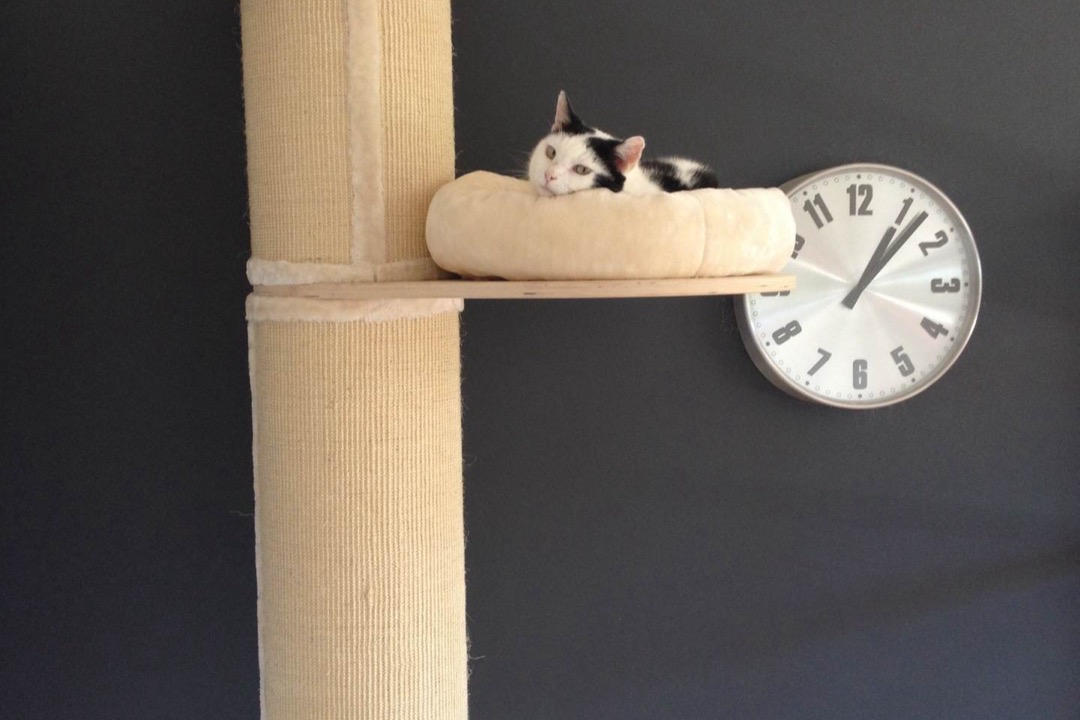
10 Best Cat Trees of 2026
In more than a decade of feline practice, few purchases change a cat’s daily life as much as the right cat tree. Cats are not floor animals — they are climbers and perchers by instinct, and vertical territory is a genuine biological need, not a luxury. A cat that can climb high feels safe, surveys its domain, and de-stresses; a cat with nowhere to go up is more anxious, more prone to conflict with other cats, and far more likely to take its scratching instinct out on your furniture. That last point is why I bring up cat trees in nearly every consultation about destructive scratching: a tall, sisal-wrapped tree is the single most effective way to redirect a cat away from the sofa, and if scratching is your main frustration, our guide to how to stop cat scratching furniture pairs directly with the right tree. The best cat trees give a cat the height, the scratching surface, and the hideaways it craves — while staying stable enough to be safe and looking like something you can live with.
For this guide I evaluated ten cat trees against the criteria that matter clinically and practically: stability and base width, because an unstable tree is a safety hazard and one a cautious cat will abandon; the scratching material, since sisal redirects destructive scratching far better than carpet; height and platform size against the space you have; and weight rating against your cat’s breed and build. The lineup runs from a twenty-dollar sisal scratching post to an 81-inch tower and a furniture-grade designer cabinet, and it is built to cover every household — a single apartment cat, a 20-pound Maine Coon, an arthritic senior, a busy five-cat home. Whichever you choose, the tree is only half the picture: environmental enrichment works best when climbing space is paired with daily interactive play and enough resources to go around.
| Product | Price | Buy |
|---|---|---|
| Feandrea Cat Tree, 59.5-Inch Tall Cat TowerBest Overall | $52.99 | View on Amazon |
| Yaheetech 54in Cat Tree Tower, 2 Caves & Scratching PostsBudget Pick | $39.98 | View on Amazon |
| Vesper Cat Tree, High Base, WalnutPremium Pick | $124.99 | View on Amazon |
| Globlazer Heavy Duty 72in Maine Coon Cat Tree for Large Cats 20 lbs+Runner-Up | $94.99 | View on Amazon |
| Feandrea Cat Tree, 81.1-Inch Large Cat TowerRunner-Up | $79.99 | View on Amazon |
| Cat Tree 32in Small Cat Tower with Large Hammock & Self GroomerRunner-Up | $42.99 | View on Amazon |
| Globlazer Big Cat Tower 80in XXL for Multiple Adult CatsRunner-Up | $109.99 | View on Amazon |
| Senior-Friendly Cat Tower with Wide Shelves & Low StepRunner-Up | $109.99 | View on Amazon |
| Amazon Basics Cat Tree Tower, Large (45.9in)Runner-Up | $67.71 | View on Amazon |
| ANWA 32in Tall Cat Scratching Post, 3-in-1 VerticalRunner-Up | $19.99 | View on Amazon |
Find the Best Cat Tree for Your Need
Jump straight to the pick that fits your cat and your home:
- Overall best cat trees
- Best for large cats
- Best tall cat trees
- Best for small spaces
- Best for multiple cats
- Best for senior and arthritic cats
- Best for kittens
- Best modern cat trees
- More use cases
How We Chose These Cat Trees
Every tree in this roundup sits on a verified, currently active Amazon listing with real owner-review volume, and each ASIN was checked live and in stock before publishing. I weighted the factors that protect a cat and your home first: stability and base width, because a tipping tree is the one genuinely dangerous failure mode; the scratching material, since natural sisal is what actually redirects a cat away from your furniture; and height and platform size matched to real households rather than a spec sheet. From there I assessed weight rating against breed and build, the number of separated hideaways for multi-cat peace, footprint for small-space owners, and value across a wide price range. I read owner reviews for the failure modes that matter — wobble after assembly, plush that mats within a year, condos too small for a big cat, cheap posts that fray fast — and chose ten trees to cover every common situation, from a giant-breed tower to a senior-friendly low step, rather than ranking ten near-identical mid-height towers.
Best Cat Trees Overall
These are the full reviews, starting with the tree I recommend most and working through the budget, upgrade, and specialty picks. Every tree below is reviewed once here; the use-case sections that follow simply point you back to the right one for your situation.
Best Overall: Feandrea 59.5-Inch Cat Tree
The Feandrea 59.5-inch tower is the tree I name first for most cats, because it gets the fundamentals right at a height that fits real homes. At just under five feet it gives an adult cat genuine vertical territory and a commanding top perch, but it sidesteps the ceiling-clearance and tip-risk headaches of the 80-inch towers — which makes it the natural default for the average one- or two-cat household. Crucially, it is wrapped in five full sisal posts, and sisal is the material that decides whether a tree actually saves your furniture. Its coarse vertical fibers let a cat get the full stretch-and-drag scratch it craves, so the cat is far more likely to strop here than on your sofa arm.
Beyond height and scratching, it is thoughtfully laid out for feline behavior. Two cushioned caves and a top hammock give a cat — or two cats — separated resting spots at different levels, and that separation is not decorative: cats manage their relationships by controlling vertical distance from one another, so stacked, enclosed hideaways let a nervous cat retreat without a confrontation. That makes this tree quietly excellent in a two-cat home as well as a single-cat one, and it dovetails with plenty of shared interactive play and enrichment as the other half of a low-stress environment.
The honest caveats are minor and shared across the category. The plush covering mats and sheds over time and is only spot-cleanable, so a long-haired cat’s tree will look worn sooner; the per-platform tolerance suits cats up to about 11 pounds, so a 15-pound-plus cat will find the perches less secure; and the sisal posts must be torqued down firmly during assembly or the tree develops a wobble. Anchor it with the included strap, tighten it properly, and for most cats and most homes this is where I would start.

Feandrea Cat Tree, 59.5-Inch Tall Cat Tower
by Feandrea
The most balanced cat tree on Amazon -- the right height for most homes, five real sisal posts, separated hideaways, and an anti-tip strap, backed by the largest review base in its class. The one I recommend first for the average household.
Pros
- At just under 60 inches it hits the height sweet spot most homes need -- tall enough to give an adult cat genuine vertical territory and a commanding perch, without the tip risk or ceiling-clearance headaches of the 80-inch towers, which is why I recommend it as a default for the average one- or two-cat household
- The frame is wrapped in five full sisal-covered posts, and sisal is the single most important material choice for redirecting destructive scratching -- its coarse vertical fibers satisfy the stretch-and-drag instinct far better than the carpet many trees use, so a cat is more likely to strop here instead of on your sofa
- Two cushioned caves plus a top hammock give a multi-cat home the separated resting spots that actually reduce inter-cat tension -- cats de-stress by controlling vertical distance from one another, and stacked, enclosed hideaways let a nervous cat retreat without confrontation
- It ships with a wall anti-tip strap and a wide, weighted base, and it carries the largest credible review base of any mid-height tree I evaluated at more than twelve thousand ratings -- the closest thing to a proven safe default in a category full of unproven imports
Cons
- The plush covering mats and sheds over time and is only spot-cleanable, so a heavy-shedding or long-haired cat's tree will look worn sooner than a smooth-fabric model
- The per-platform weight tolerance suits cats up to about 11 pounds comfortably; a 15-pound-plus cat will find the perches and hammock less secure
- Assembly takes patience -- the sisal posts must be torqued down firmly or the tree develops a wobble that undermines the stability an anxious cat needs
Best Budget: Yaheetech 54-Inch Cat Tree Tower
The Yaheetech 54-inch tower is my budget pick because it answers the hesitation I hear most: “I don’t want to spend a lot to find out whether my cat will even use a tree.” At well under fifty dollars, backed by more than forty thousand ratings, it is the lowest-risk way to try — and that review volume is not a vanity number. It is the most reliable durability signal in the category, because tens of thousands of cats have already put this exact frame through years of daily use, and the pattern of what holds up is unusually clear.
In use it delivers far more than its price suggests. Its multi-level layout packs seven platforms, two enclosed condos, and three perches into a compact 19.5-inch-square footprint, which gives a cat abundant vertical territory without eating a room — a genuine advantage in an apartment or small home. The sisal posts hit the material that matters for scratching redirection, so even at this price it does the one job a tree most needs to do, and the manufacturer rates the whole structure to a generous combined load, so it truly supports a multi-cat household spread across its levels.
The trade-offs are the honest budget ones. The plush is thin and the particleboard platforms are lighter-gauge than the premium trees, so expect visible wear within a year or two of hard use. The compact footprint that makes it space-efficient also makes it less stable for a large, bounding cat, so a wall anchor is strongly advised and, in my view, non-negotiable over about 12 pounds. And the condos are sized for small-to-average cats, so a broad-chested adult will find them tight. Anchor it and it is an excellent, proven first tree.
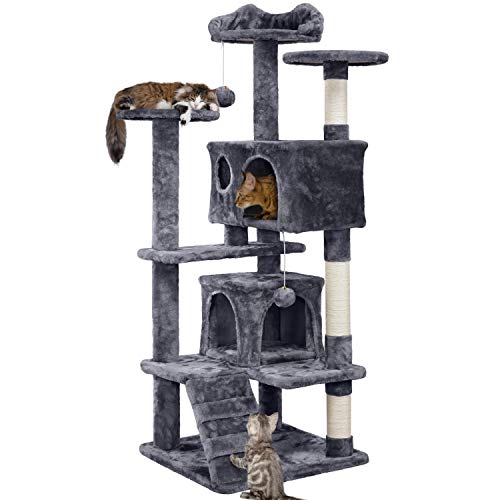
Yaheetech 54in Cat Tree Tower, 2 Caves & Scratching Posts
by Yaheetech
The category's proven budget workhorse -- more reviews than any competitor, a genuinely space-efficient multi-level layout, and real sisal posts for well under fifty dollars. Anchor it to the wall and it is an excellent first tree.
Pros
- At well under fifty dollars with more than forty thousand ratings, it is the lowest-risk way to find out whether your cat will use a tree at all -- and that review volume is the most reliable durability signal you can get, because tens of thousands of cats have already put this exact frame through years of use
- Its multi-level layout packs seven platforms, two enclosed condos, and three perches into a compact 19.5-inch-square footprint, which gives a cat abundant vertical territory without demanding much floor space -- ideal for an apartment or a small room
- The sisal posts hit the material that matters for scratching redirection, so even at a budget price it does the one job a tree most needs to do to save your furniture
- The manufacturer rates the whole structure to a generous combined load, so it genuinely supports a five- or six-cat household spread across its levels rather than buckling like many cheap towers
Cons
- The plush is thin and the particleboard platforms are lighter-gauge than the premium trees, so expect visible wear within a year or two of hard use
- The compact footprint that makes it space-efficient also makes it less stable for a large, bounding cat -- a wall anchor is strongly advised and, in my view, non-negotiable for cats over about 12 pounds
- The condos are sized for small-to-average cats; a broad-chested or long adult will find them a tight squeeze
Best Upgrade: Vesper Walnut Cat Tree
The Vesper Walnut is the upgrade I point owners to when the tree has to live in the living room. Its walnut-finish wood-look cabinet reads as intentional furniture rather than a carpeted gadget, and that matters more than aesthetics alone: in practice it means the tree goes in the main room where the family spends time, which is exactly where a social cat wants its high perch to be. A tree a cat will actually use in the center of household life beats a taller one banished to a spare bedroom.
It also handles feline comfort intelligently. The resting surfaces are backed by dense memory-foam cushions, and an enclosed cube gives a cat the den-like hideaway it instinctively seeks to feel safe — something few designer trees bother to include. Sisal-wrapped posts are built into the structure, so despite the furniture look it still offers a legitimate scratching surface rather than trading function for style. And the heavy, low cabinet base makes it one of the most inherently stable designs here, drawing its steadiness from mass and a low center of gravity rather than a wall strap, which is ideal for a home where drilling into a wall is not an option.
The caveats are real. It is the most expensive tree in this roundup by a wide margin, and at just under 48 inches it is shorter than the dedicated tall towers, so a cat that craves the highest possible vantage point will not get it here. One buying note: because the listing pools several color and configuration variants, the displayed review count is shared across versions, so read the reviews for the specific finish you are buying rather than trusting the aggregate. For design-conscious owners who want a tree that belongs in the room, nothing else here competes.
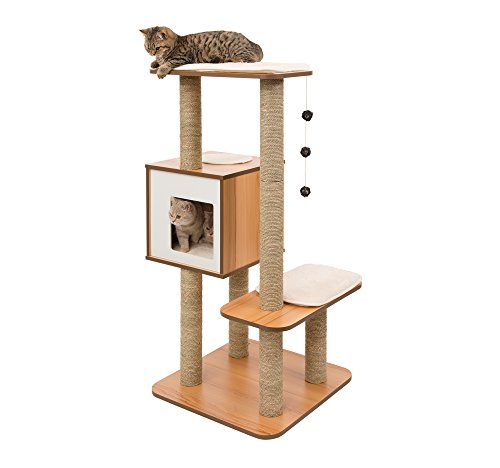
Vesper Cat Tree, High Base, Walnut
by Vesper (Catit)
The best furniture-grade cat tree -- a walnut-finish cabinet with memory-foam cushions and an enclosed cube that earns a place in your living room, for owners willing to pay a premium for a tree that does not look like one.
Pros
- This is the tree for owners who have refused to put a carpeted tower in the living room -- its walnut-finish wood-look cabinet reads as intentional furniture, which in practice means it goes in the main room where your cat actually wants to be near you rather than exiled to a spare bedroom
- The resting surfaces are backed by dense memory-foam cushions and an enclosed cube hideaway, giving a cat a genuinely comfortable, den-like retreat -- enclosure is what a cat instinctively seeks to feel safe, and few designer trees deliver it
- Sisal-wrapped posts are integrated into the structure, so despite the furniture aesthetic it still provides a legitimate scratching surface rather than sacrificing function for looks
- The heavy, low cabinet base makes it one of the most inherently stable designs here -- its stability comes from mass and a low center of gravity rather than a wall strap, which suits homes where drilling into a wall is not an option
Cons
- It is the most expensive tree in this roundup by a wide margin, and you are paying a real premium for the design and materials
- At just under 48 inches it is shorter than the dedicated tall towers, so a cat that craves the highest possible vantage point will not get it here
- Because the listing pools several color and configuration variants, the displayed review count is shared across versions -- read the reviews for the specific finish you are buying rather than trusting the aggregate number
Globlazer 72-Inch Heavy-Duty Tree: Best for Large Cats
The Globlazer 72-inch heavy-duty tree is the one I reach for when the cat is simply too big for an ordinary tower. It is engineered specifically for the large and giant breeds — Maine Coons, Ragdolls, Bengals, Savannahs — that overwhelm standard trees, with a stated tolerance for cats of 20 pounds and up and an oversized top platform a big cat can lie on fully stretched rather than perched precariously on an edge. For an owner whose cat has already flattened a flimsy tower, that engineering is the whole point.
The details follow the same heavy-duty logic. Six thick sisal posts of a heavier gauge than standard trees give a powerful cat something substantial to sink its claws into and stretch against — and a big cat genuinely needs a taller, sturdier surface to get the full spinal stretch that keeps its back and shoulders healthy. The feature that matters most, though, is the wide, triangular-braced base: it resists the lateral force a 20-pound animal generates when it launches onto a perch, which is exactly the load that tips undersized trees. Two caves and a hammock round it out with separated, load-rated resting spots.
Its drawbacks are the flip side of its strength. At 72 inches and built heavy, it is a genuinely large, imposing piece of furniture that dominates a small room, and the heavier components make assembly more physical and time-consuming than a lightweight tree. With fewer than two thousand reviews its track record is shorter than the mass-market towers, though the feedback it does have is strong. For a large or giant breed, it is the tree I would trust.

Globlazer Heavy Duty 72in Maine Coon Cat Tree for Large Cats 20 lbs+
by Globlazer
The best cat tree for large and giant breeds -- a 20-pound-plus weight rating, heavy-gauge sisal posts, an oversized platform, and a wide braced base built to take the force a big cat generates.
Pros
- This tree is engineered specifically for the large and giant breeds -- Maine Coons, Ragdolls, Bengals, Savannahs -- that overwhelm ordinary towers, with a stated tolerance for cats of 20 pounds and up and an oversized top platform a big cat can actually lie on fully stretched out rather than perched precariously
- Six thick sisal posts of a heavier gauge than standard trees give a powerful large cat something substantial to sink its claws into and stretch against -- a big cat needs a taller, sturdier scratching surface to get the full spinal stretch that keeps its back and shoulders healthy
- The wide, triangular-braced base is the feature that matters most for a heavy cat: it resists the lateral force a 20-pound animal generates when it launches onto a perch, which is exactly the load that tips undersized trees
- Two caves plus a hammock provide the separated, load-rated resting spots a large-cat household needs, and at a mid-range price it substantially undercuts most heavy-duty specialty towers
Cons
- At 72 inches and built heavy, it is a genuinely large, imposing piece of furniture that dominates a small room
- The heavier components make assembly more physical and time-consuming than a lightweight tree
- With fewer than two thousand reviews it has a shorter track record than the mass-market towers, though the feedback it does have is strong
Feandrea 81-Inch Tower: The Tallest Pick
The Feandrea 81-inch tower is the tree for cats that want to be at the very top of the room. At just over 81 inches it is the tallest well-reviewed tower here, and that height is not indulgence — vertical space is territory to a cat, and the higher it can climb, the more secure and in control it feels. Giving an anxious or territorial cat the highest perch in the house is one of the most effective environmental interventions I recommend, and this tower delivers it.
It is also built for busy households. Thirteen scratching zones spread across its height mean competing cats are not forced to share a single post, removing a common flashpoint, and its two caves, basket, hammock, and two perches let several cats occupy the tree at different levels at once — vertical separation is precisely how cats time-share the same space peacefully. Critically, it ships with an anti-tip wall strap and a reinforced base, which at this height are essential rather than optional: an 81-inch tower is only as safe as its wall anchor, and Feandrea includes the hardware to do it right.
The caveats are dictated by its size. At over six and a half feet it demands real ceiling clearance and must be wall-anchored, so it is not a freestanding-anywhere tree — a home with low ceilings or no drillable wall nearby should size down. The plush is spot-clean only and will show wear on a heavily used tall tree, and the tall, multi-part assembly is best handled by two people. For a cat that craves altitude or a multi-cat home that needs vertical separation, it is the standout.

Feandrea Cat Tree, 81.1-Inch Large Cat Tower
by Feandrea
The tallest well-reviewed tower here -- 81 inches of vertical territory with 13 scratch zones, multiple hideaways, and an included wall strap, built for cats that crave the highest vantage point and for multi-cat homes that need vertical separation.
Pros
- At just over 81 inches it is the tallest well-reviewed tower here, and vertical height is not a luxury for cats -- it is territory; the higher a cat can climb, the more secure and in control it feels, which is one of the most effective environmental fixes for anxiety and inter-cat friction I recommend
- It packs 13 scratching zones across its height, so a multi-cat home gets multiple simultaneous strop surfaces -- enough that competing cats are not forced to share a single post, a common flashpoint
- Two caves, a basket, a hammock, and two perches spread resting spots across its full height, letting several cats occupy the tree at different levels at once -- vertical separation is how cats time-share space peacefully
- It ships with an anti-tip wall strap and a reinforced base, which are essential rather than optional at this height -- an 81-inch tower is only as safe as its wall anchor, and Feandrea includes the hardware
Cons
- At over six and a half feet it demands real ceiling clearance and must be wall-anchored -- it is not a freestanding-anywhere tree, and a home with low ceilings or no drillable wall nearby should size down
- The plush covering is spot-clean only and will show wear on a heavily used tall tree over time
- The tall, multi-part assembly is involved and best done by two people to keep the upper sections aligned
Pawfessor 32-Inch Small Cat Tower: Best for Small Spaces
The pawfessor 32-inch tower proves that living in a small apartment does not mean skipping a cat tree. At 32 inches with a genuinely compact footprint, it is built for the studio, the tight corner, or the crowded room where a full tower simply will not fit, yet it still delivers the vertical element and hideaway a cat needs. For a small-space owner who assumed the choice was between a giant tower and nothing, this is the middle path.
What makes it more than a token gesture is the thoughtful use of limited space. The oversized 15.7-inch hammock is unusually generous for a tree this size and is the feature owners praise most, giving even a compact tree a genuinely comfortable elevated resting spot. A built-in self-groomer brush lets a cat rub and de-shed on its own terms — a small enrichment touch cats use readily that also cuts loose hair — and sisal posts plus an included anti-tip strap mean it still does the two things that matter most: redirect scratching and stay upright.
The limits are inherent to its size. The low height gives an adult cat far less vertical territory than a full tower, so it works as a supplement in a small home rather than a commanding perch, and the single condo and four tiers suit one cat or a bonded pair rather than a busy multi-cat household. With under a thousand reviews it is also a newer entrant with a shorter durability record. For a small space, though, it is the compact tree I would choose.

Cat Tree 32in Small Cat Tower with Large Hammock & Self Groomer
by pawfessor
The best cat tree for small spaces -- a genuinely compact footprint with an oversized hammock, a self-groomer, and an anti-tip strap, for the apartment or tight corner where a full tower will not fit.
Pros
- At 32 inches with a compact footprint it is purpose-built for the apartment, studio, or tight corner where a full tower simply will not fit, yet it still delivers the vertical element and hideaway a cat needs -- proof that small-space owners do not have to skip a tree entirely
- The oversized 15.7-inch hammock is unusually generous for a tree this size and is the feature owners praise most, giving even a compact tree a genuinely comfortable elevated resting spot
- A built-in self-groomer brush lets a cat rub and de-shed on its own terms -- a small enrichment touch that also cuts down on loose hair, and something cats use readily
- Sisal posts and an included anti-tip strap mean it still does the two things that matter most -- redirect scratching and stay upright -- despite its small stature
Cons
- The low height gives an adult cat far less vertical territory than a full tower, so it is a supplement in a small home rather than the commanding perch a taller tree provides
- The single condo and four tiers suit one cat or a bonded pair; it is not enough real estate for a busy multi-cat household
- With under a thousand reviews it is a newer entrant with a shorter durability track record
Globlazer 80-Inch XXL Tower: Best for Multiple Cats
The Globlazer 80-inch XXL is the tree I point multi-cat homes toward when the goal is parallel occupancy — several cats using the tree at once without being forced into contact. With three perches, two condos, two baskets, and a hammock spread across 80 inches, it lets cats rest, hide, and climb simultaneously at different levels, and that separation is the single most effective way to lower inter-cat tension in a crowded home. A crowded tree that cats have to queue for creates conflict; a spacious one that lets them spread out defuses it.
The design reinforces that logic throughout. Nine sisal posts mean multiple cats can scratch at the same time rather than competing for one surface, which removes a common source of friction and better protects your furniture across a busy household. The generous count of enclosed condos and baskets gives shy or lower-ranking cats their own defensible retreats — and a cat that can escape vertically and hide is a cat that stays out of fights. A reinforced wide base carries the constant traffic of several adults climbing and launching at once, the load that collapses lighter towers.
The trade-offs come with the scale. It is a large, tall structure that needs both floor space and ceiling clearance, and a wall anchor is mandatory at this height and traffic level. At 4.3 stars its rating sits a touch below the best trees here, with a minority of owners citing plush and platform wear under heavy multi-cat use, and the many-part assembly is lengthy. For a genuinely multi-cat home, its capacity is worth the effort — and it pairs well with the calmer dynamics that come from a careful introduction between cats.
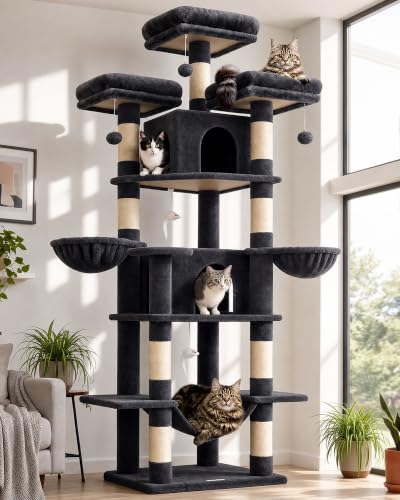
Globlazer Big Cat Tower 80in XXL for Multiple Adult Cats
by Globlazer
The best cat tree for multiple cats -- 80 inches of parallel-occupancy real estate with three perches, two condos, two baskets, nine sisal posts, and a reinforced base, built so several cats can share the tree without sharing space.
Pros
- This is the tree I point multi-cat homes toward when parallel occupancy is the goal -- with three perches, two condos, two baskets, and a hammock spread across 80 inches, several cats can rest, hide, and climb at once without being forced into contact, which is the single most effective way to lower inter-cat tension in a crowded home
- Nine sisal posts mean multiple cats can scratch simultaneously rather than queuing for one surface, removing a common source of friction and better protecting your furniture across a busy household
- The generous number of enclosed condos and baskets gives shy or lower-ranking cats their own defensible retreats -- a cat that can escape vertically and hide is a cat that stays out of fights
- A reinforced wide base supports the constant traffic of several adult cats climbing and launching at once, the load that collapses lighter towers
Cons
- It is a large, tall structure that needs both floor space and ceiling clearance, and a wall anchor is mandatory at this height and traffic level
- At 4.3 stars its rating sits a touch below the best trees here, with a minority of owners citing plush and platform wear under heavy multi-cat use
- The many-part assembly is lengthy and best tackled by two people
PETTIFUL Senior-Friendly Cat Tower: Best for Kittens and Seniors
The PETTIFUL senior-friendly tower is designed around a problem I see constantly in older cats: the arthritis that makes the big jumps of a tall tree painful or impossible. At 37.4 inches with wide shelves and a deliberately low first step, it lets an arthritic or senior cat — and a small kitten — reach an elevated perch by climbing in manageable increments rather than leaping. That matters because vertical access is just as important to an old cat’s quality of life as to a young one; the goal is to keep an aging cat engaged and perching, not to force it to give up the high spots it loves.
The accommodations are genuinely clinical. The posts are wrapped in soft cotton rather than coarse sisal, which is gentler on the sensitive paws of seniors and kittens while still offering a scratchable surface, and the broad, generously sized shelves give an unsteady older cat a stable landing rather than a narrow perch it has to balance on — a meaningful reduction in fall risk. An ultra-wide anti-tilt base gives it exceptional stability, which is critical for a cat with compromised balance that may lean or stumble against the structure, and it carries the highest rating in this entire roundup at 4.7 stars.
The limits are the flip side of its accessible design. The low height that makes it reachable also means limited vertical territory for a healthy, athletic adult that wants to climb high, and with only about 150 reviews it is the least-established product here. The soft cotton posts also will not withstand a powerful younger cat’s aggressive scratching as long as dense sisal would. For a kitten, a senior, or a recovering cat, though, it is exactly the right design.

Senior-Friendly Cat Tower with Wide Shelves & Low Step
by PETTIFUL
The best cat tree for kittens and senior or arthritic cats -- low steps, wide stable shelves, soft cotton posts, and an ultra-wide anti-tilt base that keep elevated resting within reach of cats that can no longer make big jumps.
Pros
- This tower is designed around the mobility problem I see constantly in older cats: at 37.4 inches with wide shelves and a deliberately low first step, it lets an arthritic or senior cat -- and a small kitten -- reach an elevated perch without the big vertical jumps that painful joints cannot manage, preserving the vertical access that keeps an aging cat engaged
- The posts are wrapped in soft cotton rather than coarse sisal, which is gentler on the sensitive paws of seniors and kittens while still offering a scratchable surface -- a thoughtful accommodation for cats that find rough sisal uncomfortable
- Broad, generously sized shelves give an unsteady older cat a stable, roomy landing surface rather than a narrow perch it has to balance on, which meaningfully reduces the risk of a fall
- An ultra-wide anti-tilt base gives it exceptional stability -- critical for a cat with compromised balance that may lean or stumble against the structure -- and it carries the highest rating in this entire roundup at 4.7 stars
Cons
- The low height that makes it accessible also means it offers limited vertical territory for a healthy, athletic adult cat that wants to climb high
- With only about 150 reviews it is the least-established product here, so its long-term durability is less proven than the mass-market towers
- The soft cotton posts will not withstand the aggressive scratching of a powerful younger cat as long as dense sisal would
Amazon Basics Cat Tree Tower: Trusted-Brand Value
The Amazon Basics tower is the tree I suggest to owners who want a known quantity rather than an anonymous import. The Amazon Basics name brings predictable quality control and easy returns, and it is backed by nearly twenty thousand reviews — a reassuringly deep track record at a mid-range price. For a first-time buyer nervous about ordering a large item sight unseen, that combination of a familiar name and heavy review volume is worth a lot.
It also covers the fundamentals competently. Its seven jute-wrapped posts give a cat plentiful vertical scratching surfaces, and jute, like sisal, is a coarse natural fiber that satisfies the scratching instinct far better than carpet alone. At 45.9 inches it is a practical mid-height that suits most rooms and most cats without demanding ceiling clearance or a large footprint, and its square, corner-friendly base tucks neatly against a wall. The straightforward, cushioned bed-top design is simple to assemble and stable in daily use.
The trade-offs are worth knowing. It leans on a carpeted, bed-top layout without an enclosed condo, so a cat that prefers a covered hideaway to feel secure will not get one here. The per-platform tolerance is modest at around 7.7 pounds, so it suits small-to-average cats better than large breeds, and the carpet-and-jute surfaces attract and hold shed hair, requiring regular vacuuming. For a straightforward, well-supported mid-height tree from a name you already trust, it is an easy recommendation.

Amazon Basics Cat Tree Tower, Large (45.9in)
by Amazon Basics
The best trusted-brand value tree -- a practical mid-height design with seven jute scratching posts and a corner-friendly base, backed by the Amazon Basics name and nearly twenty thousand reviews.
Pros
- For an owner who wants a known quantity rather than an anonymous import, the Amazon Basics name brings predictable quality control and easy returns, backed by nearly twenty thousand reviews -- a reassuringly deep track record at a mid-range price
- Its seven jute-wrapped posts give a cat plentiful vertical scratching surfaces, and jute, like sisal, is a coarse natural fiber that satisfies the scratching instinct far better than carpet alone
- At 45.9 inches it is a practical mid-height that suits most rooms and most cats without demanding ceiling clearance or a large footprint, and its square, corner-friendly base tucks neatly against a wall
- The straightforward design with a cushioned bed-top platform is simple to assemble and stable in daily use, making it a fuss-free choice for a first-time buyer
Cons
- It leans on a carpeted, bed-top layout without an enclosed condo, so a cat that prefers a covered hideaway to feel secure will not get one here
- The per-platform weight tolerance is modest at around 7.7 pounds, so it suits small-to-average cats better than large breeds
- The carpet-and-jute surfaces attract and hold shed hair, requiring regular vacuuming to keep tidy
ANWA 32-Inch Scratching Post: The Ultra-Budget Scratcher
The ANWA 32-inch post is not a climbing tree, and that is exactly why it earns a place here: at under twenty dollars it is the most affordable way to give a cat a legitimate vertical scratching surface, and redirecting scratching to a proper post is the proven first step in stopping a cat from shredding your furniture — a point I make in every consultation on the subject. If your budget or your space rules out a full tree right now, a good post is the single most cost-effective intervention you can make.
Its quality lies in the material and the height. It is wrapped in 100 percent natural sisal rope, the single best scratching material there is, whose coarse, durable fibers let a cat get the full downward drag and claw-shedding it needs — something flimsier carpet-covered posts cannot deliver. And at 32 inches it is genuinely tall enough for an adult cat to stretch fully upright while scratching, which matters more than buyers expect: a post shorter than a cat’s full reach gets ignored in favor of the sofa arm. A slim base tucks into any corner, and three attached toys add a little play value.
The caveats are straightforward. It is a scratching post, not a climbing tree — the small top perch is a resting spot, not real vertical territory, so it complements a tree rather than replacing one. The narrow base, while space-saving, makes it less stable for a large or enthusiastic cat, so a wall or corner placement is wise, and the natural sisal will fray with heavy use and eventually need replacing, though at this price that is an easy trade. As a first, low-commitment step against furniture scratching, it is hard to beat.

ANWA 32in Tall Cat Scratching Post, 3-in-1 Vertical
by ANWA
The best ultra-budget scratcher -- a full-height, all-natural-sisal post tall enough for a real stretch, at under twenty dollars, the low-commitment way to redirect a cat away from your furniture.
Pros
- At under twenty dollars this is the most affordable way to give a cat a legitimate vertical scratching surface, and redirecting scratching to a proper post is the proven first step in stopping a cat from shredding furniture -- a point I make in every consultation about destructive scratching
- It is wrapped in 100 percent natural sisal rope, the single best scratching material there is: its coarse, durable fibers let a cat get the full downward drag and claw-shedding it needs, which flimsier carpet-covered posts cannot deliver
- At 32 inches it is genuinely tall enough for an adult cat to stretch fully upright while scratching -- height matters, because a post shorter than a cat's full reach will be ignored in favor of the sofa arm
- A slim 15.7-inch-square base tucks into any corner, and the three attached toys add a bit of play value, making it an easy, low-commitment addition to a room that already has a tree
Cons
- It is a scratching post, not a climbing tree -- the small top perch is a resting spot, not real vertical territory, so it complements a tree rather than replacing one
- The narrow base, while space-saving, makes it less stable for a large or enthusiastic cat, so placing it against a wall or corner is wise
- The natural sisal will fray with heavy use and eventually need replacing, though at this price that is an easy trade
Best Cat Tree for Large Cats
Large and giant breeds — Maine Coons, Ragdolls, Bengals, Savannahs, and any cat over about 15 pounds — overwhelm ordinary towers, which wobble, sag, and eventually tip under the force a big cat generates when it launches onto a perch. For these cats the deciding factors are weight rating, platform size, and a wide braced base, not height alone; a big cat needs an oversized platform it can lie on fully stretched and posts sturdy enough to take a powerful stretch. All three trees below appear in the full reviews above; this is the fastest route to the one built for a heavy cat.
| Product | Price | Buy |
|---|---|---|
| Globlazer Heavy Duty 72in Maine Coon Cat Tree for Large Cats 20 lbs+Best for Maine Coons & large breeds Rated to 20 lb+ with heavy-gauge sisal posts and an oversized platform on a wide braced base | $94.99 | View on Amazon |
| Globlazer Big Cat Tower 80in XXL for Multiple Adult CatsBest XXL for big multi-cat homes 80 inches of parallel-occupancy space with a reinforced base for several big adults at once | $109.99 | View on Amazon |
| Feandrea Cat Tree, 81.1-Inch Large Cat TowerBest tall pick with a higher weight rating The tallest tower here, rated to 15.4 lb per cat, for a large cat that also wants height | $79.99 | View on Amazon |
Best Tall Cat Tree
When a cat craves altitude — and many confident, territorial, or multi-cat-home cats do — height is the point. Vertical space is territory to a cat, so the highest perch in the room is the most valued one, and a tall tower gives an anxious cat the sense of control that lowers stress and defuses friction. At this height, though, stability is non-negotiable: every tall tree must be wall-anchored with its included strap, and you need real ceiling clearance. These three, all reviewed above, are the tallest well-supported towers here.
| Product | Price | Buy |
|---|---|---|
| Feandrea Cat Tree, 81.1-Inch Large Cat TowerTallest well-reviewed tower (81in) 81 inches with 13 scratch zones and multiple hideaways, plus an included anti-tip strap | $79.99 | View on Amazon |
| Globlazer Big Cat Tower 80in XXL for Multiple Adult CatsBest 80in XXL for multiple cats 80 inches packed with three perches, two condos, and two baskets for a busy household | $109.99 | View on Amazon |
| Globlazer Heavy Duty 72in Maine Coon Cat Tree for Large Cats 20 lbs+Best 72in heavy-duty 72 inches built heavy for large breeds, with a wide triangular-braced base | $94.99 | View on Amazon |
Best Cat Tree for Small Spaces
A small apartment does not mean skipping a tree — it means choosing one that delivers vertical space and a hideaway in a minimal footprint. Look for a compact base under 20 inches square, a slim profile that tucks into a corner, and a design that still includes at least one perch or hammock and a real scratching surface. Measure your spot before ordering and remember to leave room for the cat to land and turn around. All three below are reviewed above.
| Product | Price | Buy |
|---|---|---|
| Cat Tree 32in Small Cat Tower with Large Hammock & Self GroomerBest compact tree with hammock A genuinely compact 32in tower with an oversized hammock, condo, and self-groomer | $42.99 | View on Amazon |
| ANWA 32in Tall Cat Scratching Post, 3-in-1 VerticalBest ultra-slim scratcher A slim 15.7in-square sisal post that fits any corner for under twenty dollars | $19.99 | View on Amazon |
| Senior-Friendly Cat Tower with Wide Shelves & Low StepBest low-profile for tight corners A low, wide-shelf tower that tucks against a wall and suits kittens and seniors too | $109.99 | View on Amazon |
Best Cat Tree for Multiple Cats
A multi-cat home asks for volume and, above all, separated spaces — the veterinary rule of thumb is one climbing or perching station per cat plus one, spread around the home. In practice, one large tower with enough perches, condos, and hideaways can function as several stations if cats can occupy different levels without contact, which is what keeps the peace. Prioritize the number of separated resting and hiding spots and multiple scratching posts over any single feature. These three, all reviewed above, are the multi-cat standouts.
| Product | Price | Buy |
|---|---|---|
| Globlazer Big Cat Tower 80in XXL for Multiple Adult CatsBest parallel-occupancy capacity Three perches, two condos, two baskets, and nine sisal posts so cats spread out, not compete | $109.99 | View on Amazon |
| Feandrea Cat Tree, 81.1-Inch Large Cat TowerBest tall multi-cat tower 81 inches with 13 scratch zones and multiple hideaways for vertical separation | $79.99 | View on Amazon |
| Yaheetech 54in Cat Tree Tower, 2 Caves & Scratching PostsBest budget multi-cat pick Seven levels and two condos in a compact footprint, rated for five to six cats on a budget | $39.98 | View on Amazon |
Best Cat Tree for Senior and Arthritic Cats
Older and arthritic cats still want to perch, but the big jumps of a tall tower become painful or impossible, so the right senior tree is lower, with wide, stable shelves and a low first step or gently staggered levels the cat can climb rather than leap. Soft cotton-wrapped posts are kinder to sensitive older paws than coarse sisal, and an ultra-wide, tip-resistant base is essential for a cat with reduced balance. If an older cat has stopped using a tall tree it once loved, a low-access model often brings it right back. Both trees below are reviewed above.
| Product | Price | Buy |
|---|---|---|
| Senior-Friendly Cat Tower with Wide Shelves & Low StepBest low-step, wide-shelf design A 37.4in tower with a low first step, wide shelves, soft cotton posts, and an ultra-wide anti-tilt base | $109.99 | View on Amazon |
| Cat Tree 32in Small Cat Tower with Large Hammock & Self GroomerBest compact low-height alternative A low 32in tower with an oversized hammock that gives easy elevated resting in a small space | $42.99 | View on Amazon |
Best Cat Tree for Kittens
Kittens need a tree they can climb safely as they grow — one with low, easy-access levels and a stable base for their still-developing coordination, ideally one they will not outgrow immediately. A low-step design suits a small kitten’s short jumps, a tall tree offers years of room to grow into once it is confident, and an inexpensive sisal post starts the good scratching habits early before bad ones form. Match the base stability to a kitten’s clumsy landings, and always anchor a tall tree. All three below are reviewed above.
| Product | Price | Buy |
|---|---|---|
| Senior-Friendly Cat Tower with Wide Shelves & Low StepBest low, easy-access first tree A low tower with a low first step and soft cotton posts, ideal for a small kitten's short jumps | $109.99 | View on Amazon |
| Yaheetech 54in Cat Tree Tower, 2 Caves & Scratching PostsBest tall tree to grow into A 54in multi-level tower a kitten grows into, with condos and perches for years of use | $39.98 | View on Amazon |
| ANWA 32in Tall Cat Scratching Post, 3-in-1 VerticalBest cheap starter scratcher A full-height sisal post that starts good scratching habits early for under twenty dollars | $19.99 | View on Amazon |
Best Modern Cat Tree
For owners who want the tree in the living room without a carpeted-tower eyesore, a modern, furniture-grade design is the answer — and the good news is that the best of them do not sacrifice function for looks. Prioritize a wood-look or neutral finish that fits your room, real sisal posts built into the structure, and an enclosed hideaway for the cat, plus a stable, weighted base. Both options below, reviewed in full above, keep the cat happy while earning their place in a well-kept room.
| Product | Price | Buy |
|---|---|---|
| Vesper Cat Tree, High Base, WalnutBest furniture-grade design A walnut-finish cabinet with memory-foam cushions and an enclosed cube, stable from mass alone | $124.99 | View on Amazon |
| Senior-Friendly Cat Tower with Wide Shelves & Low StepBest low-profile modern look A clean, low-profile tower with wide shelves and a wide base that stays unobtrusive in a room | $109.99 | View on Amazon |
Best Cat Trees by Use Case
A few more common situations deserve a direct pick. Each tree below appears in its full review above; this is simply the fastest route to the right one.
| Product | Price | Buy |
|---|---|---|
| Feandrea Cat Tree, 59.5-Inch Tall Cat TowerBest for a single cat or two The balanced 59.5in tower with sisal posts and separated hideaways -- my default recommendation | $52.99 | View on Amazon |
| Amazon Basics Cat Tree Tower, Large (45.9in)Best trusted-brand name A practical mid-height design from the Amazon Basics name, backed by nearly twenty thousand reviews | $67.71 | View on Amazon |
| ANWA 32in Tall Cat Scratching Post, 3-in-1 VerticalBest absolute budget A full-height natural-sisal scratching post for under twenty dollars, the low-commitment starting point | $19.99 | View on Amazon |
Buyer's Guide
A cat tree is a genuine piece of furniture and a real safety consideration, not a toy -- a poorly chosen one wobbles, gets ignored, and ends up on the curb, while the right one becomes the center of your cat's world for years. After years of advising owners on environmental enrichment and fielding the injuries that come from cheap, unstable towers, here are the six factors I walk people through, ordered by how much they decide whether the tree protects your cat and your furniture or becomes an expensive mistake.
Size, Height and Ceiling Clearance
Height is territory to a cat -- the higher it can perch, the safer and more in control it feels -- but taller is not automatically better. Measure your ceiling and the space before you buy: an 80-inch tower needs real clearance and a wall it can be anchored to, while a mid-height four-to-five-foot tree suits most homes and most cats without those constraints. Also size the platforms themselves, not just the overall height; a perch a cat can lie on fully stretched will be used, a narrow one it has to balance on will not. Match the tree's scale to both your room and your cat's ambitions.
Stability and Base Width: Anti-Tip and Wall Anchoring
This is the safety factor, and it is the one cheap trees fail. A tree tips when a cat's launching force overcomes its base, so the base should be wider and heavier than the height suggests, and any tree over roughly four feet should be wall-anchored with the included strap -- I treat that strap as required hardware, not an accessory. Heavy, low-cabinet designs gain stability from mass and a low center of gravity, which is useful when you cannot drill into a wall. Before buying, check that the base is genuinely wide and weighted, and after assembly, push the tree firmly at the top: any meaningful wobble means it needs anchoring before a cat touches it.
Material: Solid Wood vs. Particleboard, and Sisal vs. Carpet vs. Jute
Structure and scratching surface are two separate material decisions. For the frame, solid-wood and heavier-gauge cores outlast the thin particleboard of budget towers, which is what you are paying for in the premium trees. For the scratching surface, natural sisal is the gold standard -- its coarse, durable fibers satisfy the stretch-and-drag scratching instinct far better than carpet, so a cat is far more likely to strop on the post instead of your sofa. Jute is a good sisal alternative; soft cotton wrap suits seniors and kittens but wears faster under a strong scratcher. Carpet-only posts are the weakest choice, because a cat that learns to scratch carpet on the tree may generalize that to your carpeted floor.
Weight Capacity vs. Your Cat's Breed and Build
Every platform and hammock has a weight tolerance, and matching it to your cat is a stability and safety issue, not a formality. A tree rated to 11 pounds per perch is fine for an average domestic shorthair but will feel insecure to a 16-pound Maine Coon, and an under-rated hammock can sag or fail under a large cat. For big and giant breeds, buy a heavy-duty tree explicitly rated to 20 pounds and up, with oversized platforms and reinforced joints. When a manufacturer states a per-cat or total capacity, believe it and leave headroom -- a cat that has one perch collapse or shift under it may never trust the tree again.
Footprint vs. Your Room
Floor space is often the real constraint, and the good news is you do not have to skip a tree in a small home. Compact towers pack multiple levels, condos, and perches into a footprint under 20 inches square, giving vertical territory without eating the room, and slim scratching posts tuck into any corner. Measure the spot you have in mind and check the listed base dimensions before ordering, remembering to leave room for the cat to land and turn around at each level. In a large home, spread the floor budget across more than one tree in different rooms rather than a single giant tower, since distributed stations serve cats -- especially multiple cats -- better than one concentrated one.
Features: Condos, Hammocks, Perches and Self-Groomers
Beyond height and scratching, the extras shape how a cat actually uses the tree. Enclosed condos and cubes give a cat the covered hideaway it instinctively seeks to feel safe, which matters most for shy cats and multi-cat homes where retreats defuse tension. Hammocks and cushioned perches provide comfortable elevated napping, and cats strongly favor a soft high spot over a bare platform. Self-groomer brushes add low-effort enrichment and cut shed hair. In a multi-cat household, prioritize the number of separated resting and hiding spots over any single flashy feature -- more places to be apart is what keeps the peace, and it pairs well with plenty of interactive play from a good set of cat toys.
How to Choose the Best Cat Tree
Start with Stability
Before comparing perches and hideaways, decide on stability, because it is the safety decision and the one cheap trees fail. A tree tips when a cat’s launching force overcomes its base, so look for a base wider and heavier than the height implies, and treat the included anti-tip wall strap as required hardware on any tree over about four feet — not an optional accessory. Heavy, low-cabinet designs gain steadiness from mass, which helps when you cannot drill into a wall. After assembly, push the top firmly: any real wobble means it needs anchoring before your cat ever touches it.
Match Height and Weight to Your Cat
For an average adult cat, a four-to-five-foot tree gives real vertical territory without ceiling-clearance headaches. Large and giant breeds need a heavy-duty tower rated to 20 pounds and up, with oversized platforms and reinforced joints, while kittens and arthritic seniors need the opposite — a low tree with wide shelves and small steps they can climb without painful jumps. Always choose a stated weight rating that comfortably exceeds your cat’s weight, because a perch that shifts or sags once may cost you the cat’s trust in the whole tree.
Choose the Right Scratching Surface
The scratching material decides whether the tree protects your furniture. Natural sisal is the gold standard — its coarse fibers satisfy the stretch-and-drag instinct far better than carpet — with jute a good alternative and soft cotton a gentler option for seniors and kittens. Avoid carpet-only posts, because a cat that learns to scratch carpet on the tree may generalize that habit to your floor. Make sure at least one post is tall enough for your cat to stretch fully upright, since a short post gets ignored in favor of the sofa.
Fit It to Your Space
Measure the spot before you order and check the listed base dimensions, leaving room for the cat to land and turn around at each level. In a small home, a compact tower under 20 inches square delivers vertical space without eating the room; in a large or multi-cat home, spread the budget across more than one tree in different rooms rather than buying a single giant tower, since distributed stations serve cats far better than one concentrated one.
Where to Place a Cat Tree in Your Home
Placement often decides whether a tree gets used at all. The best spot is beside a window with an outdoor view, in a room where the family actually spends time — cats are social and want their high perch to overlook the action, not sit in an unused spare room. Keep the tree away from the food bowls and litter box, since cats prefer to separate those zones. Wedging the tree into a corner or against a wall makes it more stable and lets a cat survey the room with its back protected, which most cats prefer. For a nervous or newly introduced cat, choose a somewhat quieter corner with a clear escape route; for a confident cat, put it right in the middle of household life. In a multi-cat home, place trees in more than one room so every cat can claim its own high ground rather than competing for a single tower.
Cat Tree Safety: Stability, Sisal, and Assembly
A cat tree is one of the few pieces of furniture your cat will actively throw its full weight against, so a few safety habits matter. Anchor any tree over about four feet to the wall with its strap — tip-over is the one genuinely dangerous failure mode, and it happens when a cat launches onto an upper perch of an unanchored tower. Assemble the tree carefully and torque the sisal posts down firmly, because a wobble that develops from loose bolts both unsettles a cautious cat and worsens over time; re-tighten every few months, since posts loosen with use. Inspect sisal occasionally for long loose threads a claw could snag, and trim any that appear. Finally, keep the tree away from anything a falling or startled cat could strike, and give it enough surrounding floor space for safe landings. Done once at setup and checked periodically, these steps keep the tree both safe and appealing for years.
The Bottom Line on Cat Trees
The right cat tree gives your cat the vertical territory and scratching surface it instinctively needs, stays stable enough to be safe, and fits both your space and your cat’s build — and in doing so it protects your furniture and lowers household stress at the same time. For most cats and most homes, my recommendation is the Feandrea 59.5-inch tower: a well-judged height, five real sisal posts, separated hideaways, an included anti-tip strap, and the largest review base in its class. If you are testing the waters on a budget, the Yaheetech 54-inch tower is a proven, space-efficient on-ramp; if the tree must look like furniture, the Vesper Walnut earns its place in a living room; for a large breed, the Globlazer 72-inch is built to take the load; and for a kitten or an arthritic senior, the low-step PETTIFUL tower keeps elevated resting within reach.
Whichever you choose, remember that a tree works best as one part of a well-enriched home. Anchor it properly, place it near a window where your cat wants to be, pair it with daily interactive play and enough resources to go around, and in a multi-cat household support it with a patient introduction process and trees in more than one room. The tree provides the climbing and scratching outlet; the judgment about what your individual cat needs — and, when something about its behavior or mobility suddenly changes, a call to your veterinarian — still rests with you.
Frequently Asked Questions
How big a cat tree should I get for my cat's size and breed?
Are cat trees safe for senior or arthritic cats?
Can a cat tree hurt my cat? What are the sisal and tip-over risks?
How many cat trees do I need for a multi-cat household?
Where should I place a cat tree in my home?
Related Articles
About the Reviewer

Dr. Priya Anand, DVM, ABVP (Feline)
DVM, Cornell University College of Veterinary Medicine
Dr. Priya Anand is a veterinarian board-certified by the ABVP in Feline Practice, with over a decade caring for cats in a feline-exclusive clinic. She has guided thousands of cat owners through nutrition, litter-box troubleshooting, enrichment, and senior-cat care. She founded House of Mittens in 2026 to cut through pet-aisle marketing and recommend the food, litter, and gear that actually keep cats healthy and happy — judged the way she'd advise her own patients.