10 Best Cat Training Treats of 2026, Vet-Reviewed
Feline vet Dr. Priya Anand ranks the best cat training treats of 2026 by calories per piece, because a cat's 20 to 25 kcal treat budget is what limits your reps.
Updated
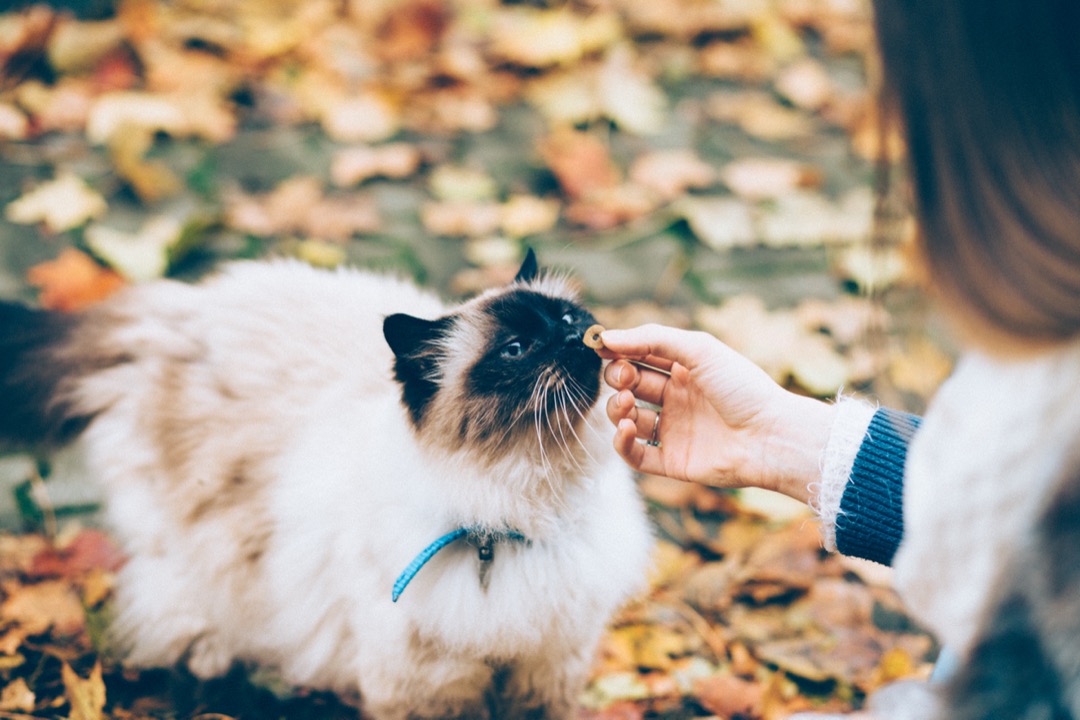
Every other treat page asks whether a product is nutritious, whether it cleans teeth, or whether it settles a stomach. A training treat is judged on one thing none of those pages measure: how many repetitions it buys you inside a fixed calorie budget. That is the whole category, and once you see it that way the shopping decision becomes arithmetic rather than taste.
Here is the arithmetic. A typical indoor adult cat eats somewhere in the region of 200 to 250 calories a day, and treats of any kind should stay under ten percent of that, which leaves a ceiling of roughly 20 to 25 treat calories. At 1 calorie a piece, that ceiling funds twenty or more rewards, which is a genuine training session with room to repeat a hard step until the cat gets it. At 2 calories a piece it funds ten to twelve. At 15 calories a piece, and there are products openly sold as bite-size training treats that carry exactly that figure, the day’s entire budget is spent on about a piece and a half. One reward, and the session is over before the cat has learned anything. The calorie figure is not a nutrition footnote in this category. It is the specification that decides whether the product works at all.
Owners ask me what training treats vets recommend, and the honest version of my answer is that I recommend a number before I recommend a brand. I look for a published calorie figure per piece, a piece small enough to be swallowed without a chewing pause, and a panel short enough to fit inside a diet trial if the cat is on one. That points overwhelmingly to single-ingredient freeze-dried treats, which is why they dominate the list below. For the ten products on this page in 2026 I recorded the calorie figure only where the manufacturer actually publishes one, which meant writing “not published” twice rather than inventing a number, and I noted where a review base is thin instead of quietly rounding it up.
If you are also sorting out the rest of the treat drawer, our guides to the best cat treats and lickable cat treats cover the everyday and the purée side of the aisle in more detail, and the cat diet calculator will give you the daily calorie target that everything below has to fit inside. Get that number first. It changes which of these products is right for your cat more than any other factor on this page.
Find the Best Cat Training Treat for Your Situation
Jump straight to the section that matches what you are training:
- Best cat training treats overall
- Best kitten training treats
- Best clicker training treats for cats
- Best high value treats for cats
- Best low calorie cat treats for training
- Best healthy cat treats for training
- Best freeze dried cat treats for training
- More cat training treats by need
How We Chose These Cat Training Treats
Calorie figures were recorded only where the manufacturer publishes one, and where nothing is published I have written “not published” rather than estimating. Two products on this page fall into that category, both of them otherwise strong picks, and I would rather flag the gap than manufacture a number that an owner then uses to budget a daily habit. Two products, the Vital Essentials chicken breast bites and the Tiki Cat soft treats, publish figures backed by a real Guaranteed Analysis panel rather than a line of marketing copy, and I have said so where it applies. Two more publish only a qualitative claim of “under two calories” or “less than two calories” with no exact figure behind it.
Piece counts are the other number this category almost never discloses. Exactly one product here, the PureBites chicken bag, publishes how many treats are in the bag, which is genuinely useful and genuinely rare. Because the rest do not, cost per repetition cannot be calculated for them, so I used cost per ounce instead as the closest workable comparison and named which picks are expensive on that basis rather than implying it.
Review depth was weighted heavily, because in a category full of newer entrants a record accumulated over years tells you more than a well-designed label does. Where a review pool is thin, I have named the actual figure in the product’s own section rather than burying it. The Tiki Cat soft treats carry 410 ratings and the Stella & Chewy’s Meowfulls carry 790, which are meaningfully thinner bases than the 73,035 and 8,358 behind the two deepest-tested products here, and that difference should change how much confidence you place in each. The top pick sits between those poles at 2,773, which is a real record rather than a deep one, and I have weighted it accordingly. For the Temptations tub, the 73,035 figure is what the listing itself shows; I have not verified whether Amazon pools it across the pouch and larger tub variants, so treat it as the listing’s number rather than a claim about that specific 16 ounce SKU.
Best Cat Training Treats Overall
These are the full reviews in order, starting with the treat I would hand most owners on day one and working through the budget option, the premium formulation, and the picks that solve one specific training problem each.
Best Overall: Vital Essentials Chicken Breast
This is where I start most owners, and the reason is a number you can actually check. The panel reads chicken breast and stops. One ingredient. And the calorie figure behind it, 2 kcal per piece, is not a line of marketing copy on the front of the bag: it comes from a CALORIE CONTENT heading in the Product Description, listing metabolisable energy at 3648 kcal/kg alongside a Guaranteed Analysis of minimum 75% crude protein and maximum 8% moisture. On a page where the calorie figure decides how many repetitions you get, a verifiable number beats a claimed one, and only two products here have one.
Two calories a piece is the tier that makes training arithmetic work. A 10 lb cat on a 20 to 25 calorie treat ceiling gets ten to twelve whole rewards from it, and because freeze-dried pieces snap under thumb pressure, halving or quartering them turns that into a genuine twenty-to-forty-rep session. That combination, a one-line panel and a piece that breaks, is what makes it usable for the cats whose owners most need a training reward and have the fewest options: a diabetic cat, a cat mid-elimination-trial, a cat on a weight-management plan where every calorie is spoken for. There is nothing in it to reconcile against a restricted diet except the chicken.
The process claim is worth a sentence because reviewers respond to it. The protein is frozen within 45 minutes of harvest before freeze-drying, and owners consistently credit that with a fresher taste than other freeze-dried treats. What comes with it is an authentically raw aroma, and that is genuinely polarizing in a household. The other honest caveats: reviewers disagree sharply on durability, with some bags lasting a month intact and others breaking apart immediately, and a subset report their cat refuses it outright, which is the ordinary risk of any single-ingredient product with no flavour coating to fall back on. It also publishes no piece count, so unlike the PureBites bag further down you cannot calculate cost per repetition exactly. Its review base, 2,773 ratings, is real but a good deal thinner than the two best-sellers here, and that is worth weighting.
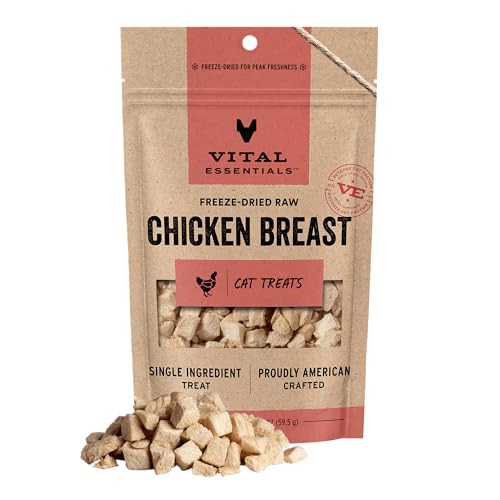
Vital Essentials Freeze Dried Cat Treats, Chicken Breast, 2.1 oz Bag
by Vital Essentials
The treat I would put in front of most owners starting clicker work: one ingredient, 2 calories a piece, and a calorie figure that comes from a real Guaranteed Analysis panel rather than a claim printed on the front of a bag.
Pros
- One ingredient, chicken breast, which makes it usable for a diabetic cat, an allergic cat, or a cat on a diet where every calorie and every protein has to be accounted for
- One of only two products here whose calorie figure is backed by an actual Guaranteed Analysis panel (3648 kcal/kg ME, 2 kcal per piece) rather than a marketing line on the front
- At 2 calories a piece it sits in the tier that funds a genuine 20 to 40 rep session inside a 20 to 25 calorie daily ceiling, and the pieces break down further
- The protein is frozen within 45 minutes of harvest, and reviewers credit that process for a fresher taste than other freeze-dried treats
Cons
- Reviewers disagree sharply on durability, with some bags lasting a month and others breaking apart immediately
- The aroma is authentically raw and genuinely polarizing in a household
- A subset of reviewers report their cat refuses it outright
- No piece count is published, so cost per repetition cannot be calculated the way it can for the PureBites bag
Best Budget: Temptations Classic
Training is a numbers game, and the number that quietly kills most training habits is cost. If a session costs enough that you hesitate before starting one, you will start fewer of them, and a behaviour that needs forty repetitions across a week will never get them. This is the cheapest per ounce of anything on this page by a wide margin, and that single fact is what makes a genuinely daily, high-repetition habit affordable rather than aspirational.
It also has the deepest evidence base here by an enormous distance: 73,035 ratings and the number one Best Sellers Rank in Crunchy Cat Treats. In a category where several products are working from a few hundred reviews, that depth means the failure modes are thoroughly documented rather than hypothetical. And the thing owners report over and over is that cats are obsessed with it. Palatability is not a soft criterion in a training treat. A reward the cat does not want is not a reward, and no amount of clean-label virtue compensates for a cat that walks away on repetition four. The dual texture, a crunchy shell over a soft centre, is part of why: it is fast to eat and it delivers both a crunch and a soft payoff.
Now read the panel, because it matters for some households and not for others. It leads with chicken by-product meal, followed by ground corn, animal fat, wheat flour and brewers rice. That is a grain-inclusive, meal-first formula, so this is out entirely if you are shopping grain-free, running a limited-ingredient trial, or working through a suspected food allergy with your vet. For a healthy adult cat with no dietary restrictions, it is a perfectly reasonable everyday reward and I would use it without hesitation. The recurring practical complaint is hardware rather than food: a meaningful share of reviewers say the flip-top lid cracks with daily use, and some report treats going stale in the tub before it is finished, which is a real risk with a container this size. Decant a week’s worth into something smaller and keep the tub sealed.
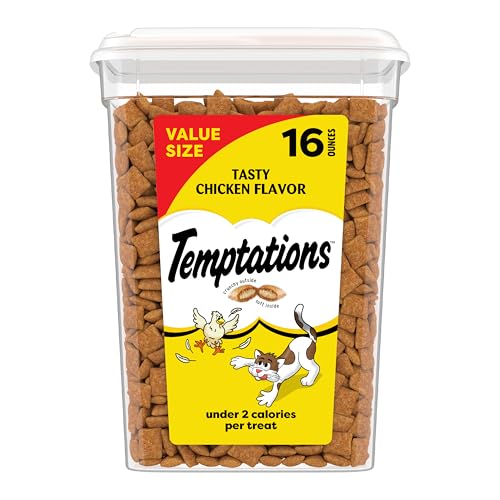
Temptations Classic Crunchy and Soft Cat Treats, Tasty Chicken, 16 oz
by Temptations
The most-tested and cheapest-per-ounce option here, which is exactly what a daily high-repetition habit needs, as long as you have read the panel and accepted that it leads with by-product meal, corn and wheat.
Pros
- 73,035 ratings and the number one Best Sellers Rank in Crunchy Cat Treats make this the most-tested budget option on the page by a very wide margin
- The cheapest per ounce here by a wide margin, which is the thing that actually makes a daily high-repetition habit affordable rather than aspirational
- Reviewers describe cats as obsessed with it, and palatability matters more in a training reward than any figure on the panel
- The resealable tub is the right shape to keep by the carrier or the training spot, which is half of whether a routine survives the first week
Cons
- The panel leads with chicken by-product meal, ground corn and wheat flour, so it is out for anyone shopping grain-free or limited-ingredient
- A meaningful share of reviewers say the flip-top lid cracks with daily use
- Some owners report treats going stale in the tub before the tub is finished
Best Value Per Calorie: ORIJEN Original Freeze Dried
I am calling this the upgrade pick on cost per ounce and on formulation, not on sticker price, and I want to be explicit about that because the bag itself is small and inexpensive to buy. What you are paying a premium for is the ounce, not the transaction. At 1.25 ounces this is roughly twelve times the price per ounce of the budget pick, and the small bag is the real catch: it empties faster than owners expect and a household running daily sessions will reorder often. Buy it understanding that, and it is an excellent product. Buy it expecting a month of high-repetition training from one bag, and it will disappoint you.
What you get for that per-ounce premium is genuine. At 1 calorie each it ties for the lowest figure on this page, which means a long session barely touches the daily budget: forty repetitions is 40 calories only if you use whole pieces, and broken into halves it is twenty. For a cat already at the top of its calorie allowance, or one on a weight-loss plan, that headroom is the difference between training and not training. The formulation is 99% animal ingredients spread across multiple muscle meats and organs, chicken, turkey, giblets and flounder, which is the WholePrey approach Champion Petfoods uses in its foods rather than a single muscle meat pressed into a shape. For owners already feeding ORIJEN or ACANA, that continuity is worth something real, and the grain-free, filler-free panel sits alongside most elimination protocols without complicating them.
Two limitations deserve to be stated plainly. The listing’s own review summary flags that some cats vomit after eating these, which is a digestibility concern rather than a taste complaint and is worth watching for in the first week. And reviewers report the pieces disintegrating in the bag over time, so what starts as clean chunks becomes fragments, which is fine for training and less fine if you wanted to control the fragment size yourself.

ORIJEN Freeze Dried Cat Treats Grain Free Original, 1.25 oz
by ORIJEN
The upgrade on formulation and cost per ounce rather than on sticker price: 1 calorie a piece and 99% animal ingredients, in a 1.25 oz bag that empties faster than you expect.
Pros
- 1 calorie each ties for the lowest figure on this page, so even a long session barely touches a cat's daily treat budget
- 99% animal ingredients across multiple muscle meats and organs rather than a single muscle meat, which is a genuinely different formulation approach in this aisle
- The Champion Petfoods name carries real weight for owners already feeding ORIJEN or ACANA, and the treat is built on the same WholePrey idea as the food
- Grain-free and filler-free enough to sit alongside most elimination protocols without complicating them
Cons
- The listing's own review summary flags that some cats vomit after eating these, which is a genuine digestibility concern rather than a taste complaint
- Reviewers report the pieces disintegrate in the bag over time, leaving fragments rather than whole chunks
- Among the priciest per ounce here, and several reviewers say so directly
Best Published Piece Count: PureBites Chicken Freeze Dried Treats
It is 2 calories a piece, one ingredient, and 430 pieces per bag, which is the only published piece count in this entire category. That last number matters more than it looks: without it you cannot calculate cost per repetition, and cost per repetition is what determines whether you can afford a real session of twenty to forty rewards rather than a token five. If you want to plan a training block with actual arithmetic rather than an estimate, this is still the only bag that lets you.
Run that arithmetic and it is the cheapest repetition on this page among the freeze-dried treats, comfortably below the single-ingredient bites that lead the guide. The catch is the shape of the spend: this is much the largest bag here, so it carries the highest sticker price on the page even while costing the least per treat. That is why the Vital Essentials chicken breast bites still lead. They are the same single ingredient and the same 2 calorie tier in a small bag, which is the lower-risk way to find out whether your cat will work for a freeze-dried treat at all. Once you know they will, this is the bag that makes a daily habit affordable.
The rest of the picture is unchanged. The panel reads chicken breast and stops, which makes it as easy as the top pick to fit into a diabetic cat’s day or an elimination trial. Reviewers consistently describe it as high-value enough to hold a cat’s attention through a whole session rather than the first three repetitions, which is the hardest quality to find in a training treat and the one no spec sheet can tell you. The freeze-dried format snaps into fragments cleanly, so one treat funds three or four repetitions. Breakability is also where reviewers split: a real share of bags arrive as mostly crumbs, which is annoying when you wanted control over fragment size. A vocal minority find it steep per ounce next to crunchy kibble-style rivals, and odor feedback is inconsistent in both directions.

PureBites Chicken Single Ingredient Freeze Dried Cat Treats, 5.5 oz
by PureBites
The only bag in this category that publishes a piece count, at 430, which is what makes cost per repetition calculable -- and it works out to the cheapest repetition of any freeze-dried treat here.
Pros
- 430 pieces per bag is the only piece count published anywhere in this category, and it is what makes cost per repetition calculable at all -- it works out to the lowest cost per treat of any freeze-dried option here
- One ingredient, chicken breast, which makes it usable for a diabetic cat, an allergic cat, or a cat on a diet where every calorie and every protein has to be accounted for
- Reviewers describe it as high-value enough to hold a cat's attention through a whole session rather than just the first few reps, which is the single hardest thing to find in a training treat
- The freeze-dried format snaps into smaller fragments cleanly, so one treat can fund several repetitions instead of one
Cons
- The largest bag here by some distance, so the sticker price is the highest on this page even though the cost per treat is the lowest
- Reviewers split sharply on breakability, and a real share of bags arrive as mostly crumbs
- A vocal minority call it steep per ounce against crunchy kibble-style rivals
- Odor feedback is inconsistent, with some owners finding the smell strong and others finding it faint
Best for Cooperative Care: INABA Churu Tuna Variety
This is the most palatable product on this page and it is the wrong tool for clicker training, and both of those things are worth understanding together. A tube cannot be broken into discrete pieces. There is no way to deliver twenty fast, separate repetitions from a purée, so if what you are doing is marking a behaviour and rewarding it twenty times in five minutes, this product physically cannot do the job no matter how much your cat loves it.
What it does instead is the job nothing else here can do. Cooperative care, which covers nail trims, pilling, ear drops, grooming, carrier loading and being handled at the vet, does not want speed. It wants duration: something that occupies the cat continuously for thirty seconds or more while you do the thing the cat would rather you did not do. A tube held out while a nail is clipped, or smeared on a plate at the back of a carrier, buys you a genuinely different kind of time than a crunchy treat, which is gone in a second and leaves the cat free to notice what your other hand is doing. Reviewers use it specifically to disguise medication, which makes it a real pilling tool rather than a snack that happens to be tasty. It is also the strongest palatability record on this page: number one Best Seller in Treat Pastes with 11,273 ratings on this listing, and those counts are per SKU in this line rather than pooled, since the smaller four-tube pack carries its own separate count.
At 6 calories a tube it adds a negligible load if you are using one, and at roughly 91% moisture it also contributes real fluid, which is a genuine secondary benefit in a species that habitually under-drinks. The panel for the tuna recipe is water, tuna, tapioca starch, natural flavors and guar gum, with no grains, no artificial colours and no carrageenan. The practical caveats are mess and cost: it ends up on hands, fur and furniture, and a portion of reviewers find it pricey per tube. For the wider lickable category, including the other formats and flavours and how they compare on ingredients, our lickable cat treats guide covers that ground properly. Here it earns its place for one job only.

INABA Churu Cat Treats, Lickable, Squeezable Creamy Purée Cat Treat with Green Tea Extract & Taurine, 0.5 Ounces Each Tube, 20 Tubes, Tuna Variety Box
by INABA
The most palatable product on this page and the wrong tool for clicker reps: a lickable tube is what you want for nail trims, pilling and carrier work, where duration matters more than speed.
Pros
- Number one Best Seller in Treat Pastes with 11,273 ratings on this listing, which is the strongest palatability record anywhere on this page
- Reviewers specifically use it to disguise medication, which makes it a genuine cooperative-care and pilling tool rather than only a snack
- 6 calories a tube at roughly 91% moisture adds negligible calorie load and real fluid intake at the same time
- No grains, no artificial colours and no carrageenan, and owners consistently report cats do not tire of it the way they tire of dry treats
Cons
- A tube cannot be broken into discrete pieces, so it cannot deliver the 20 to 40 fast repetitions a clicker session needs
- Messier to dispense than a crunchy treat, and it ends up on hands, fur and furniture
- A portion of reviewers find it pricey per tube for what is essentially a small amount of purée
Lowest Calorie With a Probiotic: Stella & Chewy’s Meowfulls
At 1 calorie per treat this ties ORIJEN for the lowest verified figure on this page, and for a weight-managed cat in daily training that is the number that matters more than anything else on the label. A cat on a restricted diet has the smallest treat budget and often the greatest need for enrichment, which is an uncomfortable combination, and a 1 calorie reward is what resolves it. Forty repetitions at 1 calorie is 40 calories, still too many for most cats, but halved it is 20 and that is a real session inside a real budget.
The genuinely distinctive thing here is the probiotic. This is the only product on the page that builds a dried Bacillus coagulans fermentation product into a training treat, which means the treats a cat receives every day during a training block are also delivering something functional rather than just calories. Salmon oil adds omega-3s for skin and coat as a second secondary benefit. Neither of these is a reason to buy a training treat on its own, and I would not want to oversell them, but if you are giving something daily anyway then getting a probiotic along with it is a real, if modest, bonus. The panel is chicken, chicken liver, sweet potato, natural vegetable flavor and salmon oil, and the chicken liver is worth noting: organ meat raises palatability meaningfully over plain muscle meat. Reviewers praise the piece size and the soft-but-freeze-dried texture as quick for a cat to clear between repetitions, which is exactly the property a clicker session needs.
The caveat is the evidence base, and I will not soften it. There are 790 ratings behind this product, which puts it among the thinner-tested picks here and a long way behind the 73,035 and 8,358 supporting the two deepest-tested products on the page. That does not make it worse, it makes it less proven, and you should weight it accordingly. Taste is polarizing and a real share of cats refuse it, with odor and value both drawing mixed feedback. This is a product I would buy in the small bag first.

Stella & Chewy's Meowfulls Freeze Dried Cat Treats - Chicken & Chicken Liver Recipe, 1.5 oz
by Stella & Chewy's
One calorie a piece with a probiotic and salmon oil built in, which is a combination nothing else here offers, on a review base of 790 that is thinner than the leaders and worth knowing about before you buy.
Pros
- 1 calorie per treat ties ORIJEN for the lowest verified figure here, which is what matters most for a weight-managed cat in daily training
- The only product on this page that builds a probiotic into a training treat, in the form of a dried Bacillus coagulans fermentation product
- Salmon oil adds omega-3s for skin and coat, which is a real secondary benefit rather than a label flourish
- Reviewers praise the piece size and the soft-but-freeze-dried texture as quick for a cat to eat between repetitions
Cons
- Under 800 ratings makes this one of the thinner-tested products on the page
- Taste is polarizing and a real share of cats refuse it
- Odor and value both draw mixed feedback from reviewers
Best for Kittens: Greenies Feline Smartbites Kitten
The socialisation window in kittens runs to roughly nine weeks with a broader period of adaptability continuing for some months after, and what happens during it shapes how the adult cat handles being touched, carried, restrained and transported. That makes early training less about tricks and more about future veterinary care. A kitten taught during that window that a harness, a carrier and having its paws held all predict food becomes an adult cat you can actually take to an appointment. A kitten that learns none of it becomes a cat that has to be extracted from under a bed twice a year.
Two things make this the right treat for that work. The first is that it is a genuine kitten formula rather than an adult treat relabelled kitten-safe, with DHA for brain and vision development and a formulation aimed at kittens from 8 weeks to 1 year. The second is piece size, and it is the more important one. Reviewers note the pieces genuinely suit a small kitten mouth, which means the kitten takes it, clears it in one bite and looks back up, rather than pausing to work on something built for an adult cat. That chewing pause is what breaks the rhythm of a training session, and it is the specific reason I do not recommend the rabbit or duck liver bites for kittens: owners of smaller and younger cats report both running too large. The clean-label option is the wrong reach here.
The listing’s own review summary explicitly cites owners using it for enrichment and harness training, which is a rare piece of evidence that maps directly onto the job. It is also among the cheapest per ounce on this page, which matters when you want to run several short sessions a day through the whole socialisation period. The honest limits: the panel leads with chicken meal, brewers rice, animal fat, wheat flour and animal plasma, so it is not grain-free and not the pick for a limited-ingredient household, and the scent is polarizing enough that some owners dislike opening the bag. If you are still working out the rest of a kitten’s diet, our kitten food guide covers the food side and the kitten feeding schedule calculator will give you the daily amounts these treats have to fit inside.

Greenies Feline Smartbites Kitten Treats, Chicken Flavor, 2.1 oz
by Greenies
A genuine kitten formula with DHA and a piece size a small mouth can clear in one bite, which is exactly what early harness, carrier and handling work needs.
Pros
- The listing's own review summary explicitly cites owners using it for enrichment and harness training, which maps directly onto early leash and carrier work
- Formulated for kittens 8 weeks to 1 year with DHA for brain and vision development, rather than an adult formula relabelled as kitten-safe
- Reviewers note the piece size genuinely suits a small kitten mouth, which avoids the chewing pause a larger treat forces between repetitions
- Among the cheapest per ounce here, which makes daily use through the whole socialisation window easy to justify
Cons
- The panel leads with chicken meal, brewers rice and wheat flour, so it is not a grain-free option
- The scent is polarizing and some owners find it unpleasant straight from the bag
- It is formulated for kittens, so it is not the treat to standardise on once the cat is an adult
Best for Senior or Dental-Compromised Cats: Tiki Cat Soft & Chewy
Training does not stop when a cat gets old, and it becomes more useful rather than less: an elderly cat needs more handling, more medication and more trips to the clinic than it did at three. What changes is the mouth. A cat with active dental disease, resorptive lesions, or several extractions cannot generate the bite force a hard freeze-dried piece requires, and asking it to teaches the cat that treats hurt. That is a genuinely bad outcome, because it costs you one of the few tools you had for managing a cat that now needs more managing.
A soft, no-crunch treat solves that, and the reason this one is on the page rather than any other soft treat is the calorie figure. Three calories a piece is genuinely low for the soft sub-category, where products marketed for training routinely run to fifteen, which would consume a whole daily budget in one and a half pieces. Three calories gives a cat on a 20 to 25 calorie ceiling six or seven repetitions, which is a short but real session, and it is a workable number for a senior cat that may also be on a weight-management or renal-support plan where every calorie is spoken for. Tuna leads the panel, followed by peas, potatoes, chickpeas and vegetable glycerin, and it is grain-free and formulated for all life stages, so a single pouch serves an ageing cat and a younger housemate without buying two products.
The evidence base is the thinnest on this page and I want that stated plainly rather than implied: 410 ratings, against 73,035 for the budget pick and 2,773 for the overall pick. That is a small pool, and the sentiment inside it is more mixed than most, with odor complaints skewing negative and a meaningful share of reviewers reporting digestive upset or refusal. Buy it because your cat’s mouth needs soft, not because the reviews are strong, and introduce it a few pieces at a time. If dental disease is the reason you are here, our cat dental treats guide goes through what does and does not help a mouth that is already compromised.

Tiki Cat Soft & Chewy Treats, Tuna Flavor, 6 oz Pouch
by Tiki Cat
The soft option for a mouth that cannot chew, at 3 calories a piece rather than the fifteen that some soft training treats carry, on the thinnest review base here.
Pros
- 3 calories a piece is genuinely low for a soft treat, in a sub-category where some products marketed for training run to fifteen
- The soft, no-crunch texture needs minimal bite force, which is what a senior cat, a cat with dental disease, or a cat with extractions actually requires
- Tuna leads the panel, and reviewers credit it with winning over cats that reject other soft treats
- Grain-free and formulated for all life stages, so one pouch serves an ageing cat and a younger housemate
Cons
- 410 ratings is the thinnest review record of any pick on this page
- Odor complaints skew more negative here than for most of the other picks
- A meaningful share of reviewers report digestive upset or outright refusal
Best Novel Protein: Vital Essentials Rabbit Bites
A novel protein is one the cat’s immune system has never met, and it is the foundation of an elimination diet trial. If your vet has you working through a suspected food allergy, everything entering the cat has to be a protein it has not previously eaten, and that rule does not pause for training. This is the practical problem the category usually ignores: an owner running a strict eight-week trial is told to stop all treats, which effectively means stop all training, at exactly the moment a cat’s routine is already being disrupted.
Rabbit is genuinely novel for most cats, and the panel here is effectively rabbit plus mixed tocopherols as a preservative. There is nothing on it that needs explaining away, which is exactly what a diet trial requires. What separates it from the rest of the novel-protein shelf is the review record: 1,777 ratings from an established brand, against the razor-thin counts typical of the micro-brands that dominate novel-protein treats. That difference in evidence depth is worth a lot when you are choosing something to feed daily for two months. Reviewers also credit the 45-minute freeze-lock process with a fresher taste, which is the same process behind the chicken breast bites from the same brand.
The gap is the calorie figure, and it is a real one on a page where that number decides everything. Nothing on this listing publishes calories per piece, anywhere, and I am not going to estimate one for you. If you need to budget precisely, either weigh out a portion and work from the metabolisable energy figure if your vet can source it, or use one of the picks that does disclose. The other caveats are physical: reviewers split on texture with some calling the pieces hard as rocks, and owners of smaller or younger cats report the pieces running too large, which is why this is not the kitten answer despite the clean panel. Always run an elimination trial under veterinary supervision rather than assembling one yourself, because an incomplete trial produces an ambiguous result and eight wasted weeks.
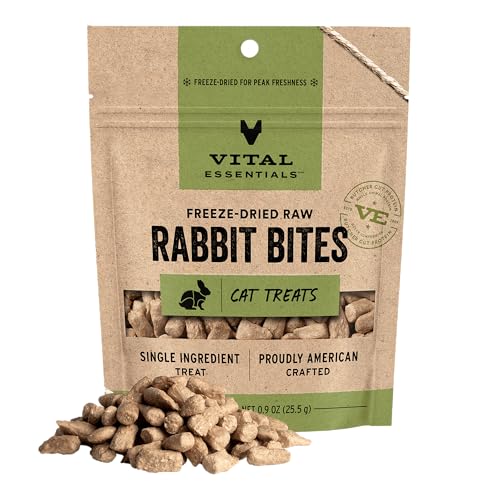
Vital Essentials Freeze Dried Cat Treats, Rabbit Bites, 0.9 oz Bag
by Vital Essentials
The novel-protein answer for a cat on an elimination trial, from a brand with a real review record behind it, with the honest caveat that no calorie figure is published anywhere on the listing.
Pros
- Rabbit is a genuinely novel protein that most cats have never encountered, which makes this a real option during an elimination diet or with a confirmed chicken or fish allergy
- 1,777 ratings from an established brand, against the razor-thin review counts typical of novel-protein micro-brands
- The panel is effectively rabbit plus a preservative, so there is nothing on it that needs explaining away
- The 45-minute freeze-lock process is credited by reviewers for a fresher taste than other freeze-dried novel proteins
Cons
- No calorie-per-piece figure is published anywhere on the listing, which is a real gap on a page where that number decides everything
- Reviewers split on texture, with some calling the pieces hard as rocks
- Owners of smaller or younger cats report the pieces run too large
Best Jackpot Reward: Vital Essentials Duck Liver
Reward hierarchies are real, and organ meat sits at the top of most cats’. That is the entire case for this product. Reviewers describe cats going wild for it in a way that no other pick on this page matches, and one reports their cat performing tricks specifically for it, which is exactly the level of motivation you need for the things a cat genuinely hates: the carrier, the nail trim, the car, the stranger in the house. A reward that only comes out for those situations retains its value indefinitely, which is precisely what a jackpot is for.
The panel is 100% duck liver with no additives, which keeps it appropriate for a restricted diet when used sparingly, and it is a different protein and a different texture from every chicken-based pick here. That novelty is part of the mechanism. A cat that has stopped caring about its usual treat has not stopped being food-motivated; it has habituated to one flavour, and a genuinely different protein reaches it again. This is the product I would keep in a separate container that the cat does not see on ordinary days, because visibility erodes value as fast as frequency does.
Two honest limits. This is the most expensive pick per ounce on the page, which suits it exactly to occasional jackpot use and rules it out as the everyday high-repetition treat, and I would not want anyone buying it for daily sessions and then being surprised at the reorder rate. And no calorie figure is published on the listing, which for a jackpot treat used a few times a week matters less than it would for a daily one, but is still a gap you should know about rather than an omission I glossed over. Reviewers disagree on crumbling, some finding clean pieces and others dust, and a real minority of cats reject it despite the high-value framing. If your cat is in that minority, try the rabbit bites next, since novelty rather than organ meat specifically may be what is doing the work.

Vital Essentials Freeze Dried Cat Treats, Duck Liver, 0.9 oz Bag
by Vital Essentials
The reward I would hold back for the one thing your cat hates most, because organ meat outranks muscle meat for most cats, and because it is too expensive per ounce to spend on ordinary repetitions.
Pros
- Organ meat is typically the highest-value reward category for cats, and reviewers describe cats going wild for it in a way nothing else here matches
- One reviewer reports their cat performs tricks for it, which is exactly the jackpot motivation that carrier loading or a nail trim demands
- 100% duck liver with no additives, so it stays appropriate for a restricted diet when used sparingly
- A different protein and a different texture from the chicken-based picks, which gives you a genuinely novel reward to reserve for the hardest problems
Cons
- The most expensive pick per ounce on this page, which suits occasional jackpot use rather than daily high-repetition training
- Reviewers disagree on crumbling, with some finding clean pieces and others finding dust
- A real minority of cats reject it despite the high-value framing
Best Kitten Training Treats
Everything you want an adult cat to tolerate is easier to teach in the first few months. The socialisation window runs to roughly nine weeks, with a longer period of adaptability behind it, and during that time a kitten forms its baseline expectations about being handled, restrained, carried and transported. Harness work, carrier loading and paw handling done then are not tricks. They are the reason the adult cat walks into a carrier instead of being pulled out from behind the sofa twice a year, and they are the single highest-return training investment available to a new owner.
What that work needs from a treat is a small piece and fast delivery, because a kitten’s attention span is short and a chewing pause loses it entirely. A genuine kitten formula is the sensible default, both for the DHA and because the piece is sized for a small mouth. The single-ingredient freeze-dried options work well too, especially broken into fragments, and a lickable tube earns its place here for the specific job of holding a kitten still while you touch its paws or slide it into a carrier.
Do not reach for the clean-label option here. The Rabbit Bites and Duck Liver are the two picks on this page that owners of smaller and younger cats specifically report running too large, and a piece a kitten has to work at is a piece that ends the session. Save those for adulthood, when the mouth can handle them and the jackpot framing becomes useful.
| Product | Price | Buy |
|---|---|---|
| Greenies Feline Smartbites Kitten Treats, Chicken Flavor, 2.1 ozBest for kittens A genuine kitten formula with DHA, a piece size a small mouth clears in one bite, and cheap enough for several short sessions a day. Not grain-free. | $3.28 | View on Amazon |
| Vital Essentials Freeze Dried Cat Treats, Chicken Breast, 2.1 oz BagBest single-ingredient option for kittens One ingredient at 2 calories a piece, and it breaks into fragments small enough for a kitten, which is the practical way to use it at this age. | $8.99 | View on Amazon |
| INABA Churu Cat Treats, Lickable, Squeezable Creamy Purée Cat Treat with Green Tea Extract & Taurine, 0.5 Ounces Each Tube, 20 Tubes, Tuna Variety BoxBest for carrier and handling work A tube holds a kitten in place for thirty seconds or more, which is what paw handling and carrier loading actually need. It cannot deliver fast repetitions. | $13.99 | View on Amazon |
Best Clicker Training Treats for Cats
Clicker training is a timing exercise before it is anything else. The click marks the exact instant the cat did the right thing, and the food has to arrive within about a second for the marker to mean anything. Then the cat has to finish that food and look back up, ready for the next repetition. Everything about the treat you choose has to serve that loop, which makes reward delivery speed the criterion that decides this section.
In practice that means small, fast and consistent. A treat the cat can take and swallow without a chewing pause keeps the session’s rhythm intact, while one that requires five seconds of work does more than slow you down: it weakens the association, because by the time the cat is ready again the moment the click referred to has faded. It also means quantity. A productive session is twenty to forty repetitions, which is only affordable if the treat is cheap per repetition or small enough to break down, and preferably both. A 2 calorie freeze-dried piece quartered gives you four rewards at half a calorie each, and that is how a forty-rep session fits inside a 20 calorie ceiling.
Here is the trap, and it catches people who have done their homework on palatability. Churu is the most palatable product on this page by a distance, and it is the wrong tool for this job. A tube cannot deliver discrete, fast repetitions, and trying to run a clicker session off one produces a cat licking a tube rather than a cat learning a behaviour. Buy it for restraint work, not for marker training.
| Product | Price | Buy |
|---|---|---|
| Vital Essentials Freeze Dried Cat Treats, Chicken Breast, 2.1 oz BagBest clicker treat overall 2 calories a piece from a real Guaranteed Analysis, one ingredient, and it breaks into fragments so one treat funds several repetitions. | $8.99 | View on Amazon |
| Temptations Classic Crunchy and Soft Cat Treats, Tasty Chicken, 16 ozBest for high-repetition daily sessions The cheapest per ounce on this page, which is what makes forty repetitions a day sustainable. Grain-inclusive and meal-first on the panel. | $7.97 | View on Amazon |
| PureBites Chicken Single Ingredient Freeze Dried Cat Treats, 5.5 ozBest if you want the piece count The same 2 calorie tier and one-ingredient panel, plus the only published piece count here at 430, which is the cheapest repetition of any freeze-dried bag on this page. | $19.04 | View on Amazon |
Best High Value Treats for Cats
The idea that makes training work is the reward hierarchy. Every cat privately ranks food by what it is worth, and the job is to match the value of the reward to the difficulty of what you are asking. Sitting on a mat when nothing stressful is happening is cheap, and daily kibble will buy it. Walking voluntarily into a carrier, holding still for a nail trim, or accepting a stranger in the house is expensive, and it needs something the cat gets nowhere else.
The corollary is the part owners skip: a treat the cat receives every day stops being special. Value comes from scarcity as much as from flavour, and a high-value reward that becomes the everyday reward is a high-value reward you have spent. Keep one product in a separate container, out of sight, reserved for the two or three things your cat genuinely hates. Organ meat is the usual winner, since liver outranks muscle meat for most cats, and a genuinely novel protein like rabbit is the fallback for a cat that has habituated to everything else. A lickable tube belongs in this tier too, on the strength of palatability alone.
The trap here is the budget pick, and it is the same quality that makes it right elsewhere. Temptations is ubiquitous, which is exactly what makes it the correct everyday, high-repetition treat, and exactly what disqualifies it as a jackpot. If your cat already gets it from three people in the household, it is not a reward, it is background noise.
| Product | Price | Buy |
|---|---|---|
| Vital Essentials Freeze Dried Cat Treats, Duck Liver, 0.9 oz BagBest jackpot reward 100% duck liver, and organ meat sits at the top of most cats' hierarchies. The most expensive per ounce here, which is why it is a jackpot rather than a daily treat. | $8.99 | View on Amazon |
| INABA Churu Cat Treats, Lickable, Squeezable Creamy Purée Cat Treat with Green Tea Extract & Taurine, 0.5 Ounces Each Tube, 20 Tubes, Tuna Variety BoxBest high value for restraint The strongest palatability record on the page, and it holds a cat's attention for the length of a nail trim rather than a second. | $13.99 | View on Amazon |
| Vital Essentials Freeze Dried Cat Treats, Rabbit Bites, 0.9 oz BagBest novel-protein jackpot Rabbit is novel to most cats, which reaches a cat that has habituated to chicken. No calorie figure is published. | $7.99 | View on Amazon |
Best Low Calorie Cat Treats for Training
This section carries the most important warning on the page, so I will put it first. Blue Buffalo Wilderness Chicken and Salmon Soft Cat Treats, ASIN B00D0TEWTS, is a listing marketed as bite-size training treats, and its own feature bullet reads: “NATURAL AND HEALTHY: At only 15 calories each these irresistible cat snacks are the perfect reward for felines of all ages.” Read that carefully, because the framing is the problem. The brand presents 15 calories as a selling point, prefixed with “only”, and calls the product a perfect reward. A shopper scanning for a low-calorie training treat sees those words and reasonably concludes it qualifies.
Run the arithmetic instead. A 10 lb cat on a treat ceiling of roughly 20 to 25 calories gets between one and two rewards for the entire day from a 15 calorie treat. Against the 1 calorie picks on this page, ORIJEN Original and the Stella & Chewy’s Meowfulls, that is a fifteen-fold difference, and it is the difference between a training session and a single treat. It is not on this page for that reason, and I am naming it explicitly because a reader shopping on the description alone would walk straight into it and then wonder why their cat gained weight during a month of training.
That is the trap the whole category sets. “Training treat” in a listing describes the marketing position, not the calorie figure, and the two are frequently unrelated. The number to look for is calories per piece, and the products worth your attention are the ones at 1 or 2, because those are the only figures that support the twenty to forty repetitions a behaviour actually needs. At 1 calorie a piece a 20 calorie ceiling funds twenty rewards whole and forty broken in half. At 15 it funds one.
The second thing to know is that a low calorie figure only helps if the manufacturer publishes it. Two picks on this page publish nothing at all, and two more publish only a qualitative “under two calories” claim with no exact number behind it. When you are budgeting daily, prefer the ones with a real figure, and prefer a figure that comes from a Guaranteed Analysis panel over one printed on the front of a bag.
| Product | Price | Buy |
|---|---|---|
| Stella & Chewy's Meowfulls Freeze Dried Cat Treats - Chicken & Chicken Liver Recipe, 1.5 ozLowest calorie with a functional extra 1 calorie a treat plus a Bacillus coagulans probiotic and salmon oil, which nothing else here offers. Only 790 ratings behind it. | $7.97 | View on Amazon |
| ORIJEN Freeze Dried Cat Treats Grain Free Original, 1.25 ozLowest calorie premium formulation 1 calorie a treat and 99% animal ingredients, in a 1.25 oz bag that empties quickly. Premium per ounce, not per bag. | $7.69 | View on Amazon |
| PureBites Chicken Single Ingredient Freeze Dried Cat Treats, 5.5 ozBest low calorie with a published piece count 2 calories a piece with 430 pieces per bag, the only published piece count in the category, which lets you plan a session exactly and costs the least per repetition here. | $19.04 | View on Amazon |
Best Healthy Cat Treats for Training
Healthy has no defined meaning on a treat label. There is no threshold to meet, no body enforcing it and no way for a shopper to check it, which is why the word appears on so much packaging and tells you so little. What you can check is the panel, where ingredients are listed by weight, and in this category the panel splits the field unusually cleanly. Freeze-dried treats are frequently single ingredient: the panel reads chicken breast, or duck liver, and stops. Baked treats lead with a meal plus corn, wheat flour or brewers rice.
That split is what makes freeze-dried the default answer whenever “healthy” is the criterion. A one-line panel is trivially easy to fit into an elimination diet, a diabetic cat’s daily arithmetic, or a limited-ingredient trial, because there is nothing in it to reconcile. It also means the protein you are feeding is the protein on the front of the bag rather than a rendered meal, which matters if you are managing an allergy. Add a probiotic or salmon oil on top of that and you have a treat doing a small amount of functional work alongside the reward.
The trap is the two best-selling picks on this page. Temptations leads with chicken by-product meal, ground corn and wheat flour. The Greenies kitten treat leads with chicken meal, brewers rice and wheat flour. Both are perfectly reasonable everyday rewards for a healthy cat with no restrictions, and I use and recommend both in the right context. Neither is the right anchor for a healthiest claim, and neither belongs anywhere near a grain-free household or a food-allergy investigation. For the wider question of what belongs in a cat’s daily bowl rather than its treat jar, our best cat food guide is the place to start.
| Product | Price | Buy |
|---|---|---|
| Vital Essentials Freeze Dried Cat Treats, Chicken Breast, 2.1 oz BagCleanest verifiable panel Single-ingredient chicken breast with a real Guaranteed Analysis behind the 2 kcal figure, which is as verifiable as this category gets. | $8.99 | View on Amazon |
| Stella & Chewy's Meowfulls Freeze Dried Cat Treats - Chicken & Chicken Liver Recipe, 1.5 ozCleanest panel with a functional extra One calorie a piece with a probiotic and salmon oil, on a short panel of chicken, chicken liver, sweet potato and salmon oil. | $7.97 | View on Amazon |
| Vital Essentials Freeze Dried Cat Treats, Rabbit Bites, 0.9 oz BagCleanest panel for an elimination trial Effectively rabbit plus a preservative, and rabbit is novel to most cats. No calorie figure is published anywhere on the listing. | $7.99 | View on Amazon |
Best Freeze Dried Cat Treats for Training
Freeze-dried treats dominate this category and it is not an accident of marketing. Three properties make them structurally better suited to training than anything else in the aisle, and they compound.
The first is the panel. Freeze-drying removes water without cooking, so a single-ingredient product stays a single-ingredient product: the panel reads chicken breast and stops. That is what makes these usable for a diabetic cat, an allergic cat, or a cat mid-elimination-trial, which between them cover a large share of the cats whose owners most need a training reward. The second is calories. Removing water concentrates the protein but the pieces are small, and the figures land at 1 to 2 calories, which is the range that supports a real session rather than a token one. The third, and the one owners underuse, is that freeze-dried pieces break. A whole piece snaps into fragments, and a fragment functions as a complete reward as far as the cat is concerned, so the effective piece count of a bag is several times the number of pieces in it.
The honest counterweight is that the same brittleness that lets a piece break cleanly also lets it shatter, and the recurring complaint across every freeze-dried product here is bags arriving as more crumb than piece. That is annoying rather than disqualifying: crumbs still work as rewards, you just lose control over the size. The other cost is per ounce, since these are the priciest products on this page by weight, which is the trade you make for a one-line ingredient panel.
| Product | Price | Buy |
|---|---|---|
| Vital Essentials Freeze Dried Cat Treats, Chicken Breast, 2.1 oz BagBest freeze-dried overall 2 calories a piece, one ingredient, and the figure comes from a real Guaranteed Analysis panel rather than the front of the bag. | $8.99 | View on Amazon |
| ORIJEN Freeze Dried Cat Treats Grain Free Original, 1.25 ozBest freeze-dried for calorie budget 1 calorie a piece and 99% animal ingredients across four proteins, in the smallest bag here. | $7.69 | View on Amazon |
| PureBites Chicken Single Ingredient Freeze Dried Cat Treats, 5.5 ozBest freeze-dried with a published piece count The same one-ingredient chicken from a second brand, and the only bag here that publishes a piece count, at 430. | $19.04 | View on Amazon |
More Cat Training Treats by Need
If your situation is narrower than the sections above, this is the shortcut. Each row is the pick I would name for that specific job, drawn from the full reviews further up the page.
| Product | Price | Buy |
|---|---|---|
| Tiki Cat Soft & Chewy Treats, Tuna Flavor, 6 oz PouchBest soft treat for seniors and sore mouths 3 calories a piece and no crunch required, for a cat with dental disease or extractions. The thinnest review base here at 410 ratings. | $8.99 | View on Amazon |
| Vital Essentials Freeze Dried Cat Treats, Rabbit Bites, 0.9 oz BagBest novel protein for an elimination trial Rabbit, effectively a one-ingredient panel, with a 1,777-rating record that novel-protein micro-brands cannot match. No calorie figure published. | $7.99 | View on Amazon |
| Vital Essentials Freeze Dried Cat Treats, Duck Liver, 0.9 oz BagBest jackpot for the hardest problems 100% duck liver, the reward most cats rank highest, and the most expensive per ounce here, which is exactly why it stays reserved. | $8.99 | View on Amazon |
| INABA Churu Cat Treats, Lickable, Squeezable Creamy Purée Cat Treat with Green Tea Extract & Taurine, 0.5 Ounces Each Tube, 20 Tubes, Tuna Variety BoxBest for pilling and nail trims A lickable tube that holds a cat's attention for thirty seconds or more during restraint, and doubles as a way to hide medication. | $13.99 | View on Amazon |
| Stella & Chewy's Meowfulls Freeze Dried Cat Treats - Chicken & Chicken Liver Recipe, 1.5 ozBest low calorie with a probiotic 1 calorie a treat with a Bacillus coagulans probiotic and salmon oil built in, on a review base of 790. | $7.97 | View on Amazon |
Do the Calorie Math Before Your First Session
Almost nobody publishes the worked version of this, so here it is. The rule is that treats stay under ten percent of daily calories, with the other ninety percent coming from a complete and balanced food that supplies the amino acids, vitamins and minerals a treat does not. Run that against three common cat sizes and the picture becomes concrete.
| Cat weight | Rough daily calories | Treat ceiling (10%) | Reps at 1 kcal | Reps at 2 kcal | Reps at 3 kcal | Reps at 15 kcal |
|---|---|---|---|---|---|---|
| 8 lb | 180 to 200 | 18 to 20 kcal | 18 to 20 | 9 to 10 | 6 | 1 |
| 10 lb | 200 to 250 | 20 to 25 kcal | 20 to 25 | 10 to 12 | 6 to 8 | 1 to 2 |
| 15 lb | 250 to 300 | 25 to 30 kcal | 25 to 30 | 12 to 15 | 8 to 10 | 2 |
These are planning figures, not prescriptions. Actual requirements vary substantially with neuter status, age, activity, body condition and any medical condition your cat carries, and a cat that needs to lose weight is on a deliberately lower number than the one in that table. Use the cat diet calculator to get a figure for your specific cat, and the body condition score tool to check whether the current plan is landing where you think it is, because a cat’s weight tells you much less than its shape does.
Read across the 15 kcal column and you can see why product choice matters more here than in any other treat category. Every cat size lands on one or two repetitions, which is not a training session. Read across the 1 kcal column and even an 8 lb cat gets eighteen to twenty, and broken into halves, thirty-six to forty. Same budget, same cat, twenty times the training.
The part owners most often get wrong is the direction of the adjustment. Treat calories have to be subtracted from the day’s meal portion, not added on top of it. A measured diet plus 25 calories of daily training treats is not a measured diet, it is a surplus of roughly ten percent, and sustained across a year that is exactly how a cat arrives in my consulting room a pound heavier with an owner who is certain nothing changed. The second failure is arithmetic across people: three household members each giving “just a few” during their own sessions triples a number nobody is tracking. Measure the day’s treat allowance into a small dish in the morning, use it for training, and when the dish is empty the day is done.
Breaking Treats Into Smaller Pieces Is the Whole Trick
Every competitor article mentions this in passing. It deserves more, because it does more for a training session than any other single habit, and it costs nothing.
A cat does not evaluate a reward by volume the way a person would. The behaviour that gets reinforced is the arrival of food, and a fragment of freeze-dried chicken functions as a complete reward in a way that a half-sized human snack would not. So quartering your treats does not quarter their value, it quadruples your session. A 2 calorie piece broken into four gives you four rewards at half a calorie each, which turns a 24 calorie budget from twelve repetitions into forty-eight. Forty-eight repetitions is enough to teach a genuinely new behaviour. Twelve is enough to practice one the cat already knows.
Which formats break well is worth knowing before you buy. Freeze-dried single-ingredient treats are the best in class here: they snap under thumb pressure and the fragments hold their shape. Freeze-dried products with a softer bite tear rather than snap, which still works but gives you less control over the size. Dual-texture treats with a soft centre tend to squash rather than break cleanly, so they are better used whole. Soft chewy treats can be torn in half but not reliably into quarters, and the pieces stick together. Lickable tubes cannot be divided into pieces at all, which is a large part of why they belong to a different job entirely.
The failure mode to watch for is shattering rather than breaking. Several freeze-dried products here draw complaints about bags arriving as crumb, and a treat that turns to powder under pressure gives you dust rather than fragments. Dust still works, and cats will eat it off a palm, but you lose the ability to deliver a clean, discrete reward, which matters for marker training. Test a few pieces from a new bag before your first session and find out which behaviour you have. Break the day’s allowance in advance into a small dish, so you are not doing it one-handed while a cat waits.
Clicker Training and Cooperative Care Need Different Treats
No competitor page I have read separates these two jobs, and conflating them is why owners buy the most palatable treat on the shelf and then find it does not work.
Clicker training is about speed and repetition. The click marks a behaviour, the food follows within about a second, and the cat has to clear it and be ready again quickly. Twenty to forty repetitions in a short session is the target, and everything about the treat serves that: small, hard enough to be picked up cleanly, fast to swallow, cheap enough per repetition to be spent freely, and ideally breakable so the calorie budget stretches. What you are buying is throughput.
Cooperative care is the opposite. This covers nail trims, giving medication, ear drops, brushing, carrier loading and being handled at the vet, and the goal is not to mark a behaviour but to keep the cat voluntarily in place and pleasantly occupied while something it does not enjoy happens. That wants duration, not speed. A lickable purée tube holds a cat’s attention continuously for thirty seconds or more, which is long enough to clip several nails, and it is why owners use it routinely to hide medication and to make a carrier a place where good things happen. A crunchy treat gives you one second of distraction and then leaves the cat free to notice what your other hand is doing, which is exactly when a nail trim goes wrong.
The practical consequence is that a household doing both jobs properly ends up with two products in the drawer, and that is the right outcome rather than an indulgence. A cheap, fast treat for repetitions, and one high-value or lickable product reserved for restraint. Buying only the palatable one gives you a cat that loves treats and has learned nothing. Buying only the fast one gives you an efficient clicker session and a nail trim that still ends in a wrestling match. If you are also working on making the carrier itself less frightening, our best cat toys guide covers the enrichment side of building a cat that copes better with change generally.
What to Do When Your Cat Is Not Food-Motivated
This is the most-searched unanswered question on this topic, and it deserves a real answer rather than a suggestion to try a different flavour.
Rule out illness first. A genuine drop in appetite is a clinical sign, not a preference, and it is the first thing to eliminate rather than the last. A cat that used to take treats and now will not is telling you something. Dental pain is the most common explanation and is easy to miss, since cats hide oral discomfort with real discipline, but reduced appetite also accompanies kidney disease, hyperthyroidism, gastrointestinal disease and pain from any source. If the change is new, book an examination before you buy another bag.
Train before a meal, not after. This sounds obvious and is routinely got wrong. A cat that has just eaten is not hungry, and a cat that is not hungry is not going to work for food. Schedule sessions immediately before a meal, and if you feed twice a day, that gives you two natural training windows without changing anything else about the routine.
Warm the treat slightly. Aroma is most of what makes a cat interested in food, and warmth releases it. Ten seconds in a closed hand is often enough for a freeze-dried piece. For a lickable tube, a few moments in warm water lifts the smell considerably. Cats have far fewer taste receptors than we do and rely much more on scent, so this is a bigger lever than it appears.
Change the protein, not just the brand. A cat that has habituated to chicken has not stopped being food-motivated, it has stopped being interested in chicken. A genuinely novel protein like rabbit, or an organ meat like duck liver, reaches cats that have gone flat on everything in the usual aisle. Organ meat in particular sits at the top of most cats’ hierarchies for reasons that have nothing to do with marketing.
Reduce the environment. A cat that will not eat in a busy kitchen will often eat in a quiet bedroom with the door shut. Anxiety suppresses appetite, and a training session in a stimulating room is competing with everything else in it. Start where the cat is comfortable and add difficulty later.
Then accept that some cats are not food-motivated, and train them anyway. This is the part the internet leaves out. A meaningful minority of cats work better for a wand toy, a burst of play, a chin scratch, or the opportunity to go through a door they want to go through. Those are all valid training currencies, and the mechanics do not change: you mark the behaviour and you deliver the reinforcer, whatever the reinforcer is. A cat that will chase a wand toy for ten minutes is highly trainable, it is simply not trainable with chicken. Work out what your cat actually wants and pay in that. If food never becomes interesting despite a normal appetite and a comfortable environment, that is a preference to work with rather than a problem to fix.
How to Choose the Best Cat Training Treats
Buyer's Guide
A training treat is judged on different criteria than any other treat in the aisle. It is not being bought for nutrition, for dental benefit or for a supplement it carries. It is being bought to buy you repetitions inside a fixed calorie budget, and these are the six things I actually weigh when an owner asks me which one to use.
Calories per Piece, Because That Is What Caps Your Session
This is the number that decides everything else, and it is the one most owners never look at. A cat eating 200 to 250 calories a day has a treat budget of roughly 20 to 25 calories, since treats should stay under ten percent of intake. Put real products against that ceiling and the difference is not marginal. At 1 calorie a piece you have twenty or more repetitions, which is a genuine training session with room to repeat a difficult step several times. At 2 calories a piece you have ten to twelve. At 3 calories a piece you have six or seven, which is enough for a short refresher and not much else. And at 15 calories a piece, a figure that at least one product openly marketed as a bite-size training treat actually carries, the entire daily budget is consumed in about a piece and a half and the session ends before it starts. Prefer a product that publishes a figure. Two of the picks on this page do not publish one, and I have said so rather than estimating, because a number you invented is worse than a gap you admitted when you are budgeting a daily habit.
Piece Size and How Fast the Cat Can Swallow It
Clicker training runs on timing. The marker has to be followed by food within roughly a second, and the cat has to finish that food and be ready for the next repetition without a long pause. A treat that takes five seconds of chewing does not just slow the session down, it weakens the association between the marker and the reward, because by the time the cat is ready again the moment has passed. That makes piece size a mechanical specification rather than a preference. What you want is something the cat can take, clear in one or two bites, and look back up for. This is where large soft treats and chunky freeze-dried pieces struggle, and it is why owners of kittens and small cats report the rabbit and duck liver bites running too large. It is also why a kitten-specific product with a genuinely small piece is worth buying even though the formula is not the cleanest on the page. Watch your cat through five repetitions and time the gaps. If the cat is still working on treat three when you want to mark behaviour four, the treat is the wrong size.
Breakability, Which Multiplies Everything Else
Breaking the treat into smaller pieces does more for a session than any choice you make between products, and it costs nothing. A cat does not reward-discriminate by volume the way a person would. A quarter of a freeze-dried chicken fragment functions as a full reward, and quartering a 2 calorie piece turns a 24 calorie budget from twelve rewards into forty-eight. That difference is the difference between a session that ends before the cat has learned anything and a session with enough repetitions to build a behaviour. So the question to ask about any candidate treat is how it behaves under pressure. Freeze-dried single-ingredient treats generally snap into usable fragments, which is why they dominate this category. Dual-texture treats with a soft centre tend to squash rather than break, and soft chewy treats can be torn but not cleanly. Some freeze-dried products shatter into dust rather than fragments, which is the recurring complaint behind the mixed breakability reviews on several picks here. Break a few before your first session and see what you actually get.
Palatability and the Reward Hierarchy
Every cat has a ranking of what food is worth, and training works by matching the reward to the difficulty of what you are asking. Daily kibble sits at the bottom. An ordinary crunchy treat sits in the middle. Freeze-dried organ meat, a novel protein, or a lickable purée sits at the top. The mistake is spending the top of that hierarchy on easy behaviours, because a treat a cat receives every day stops being special within about a week and you have nothing left for the hard problems. Keep the everyday, high-repetition work on something affordable and merely good, and reserve one product that the cat gets nowhere else for the things it genuinely hates: the carrier, the nail trim, the new person in the house, the car. This is also why the ubiquity of the best-selling budget treat, which is exactly what makes it right for daily repetitions, disqualifies it as a jackpot. If your cat already gets it from three people in the household, it is not a reward, it is background.
The Ingredient Panel Versus the Front of the Bag
Front-of-bag language in the treat aisle carries very little weight. Natural has no legally defined meaning on a pet treat label, and healthy has none at all. What you can check is the panel, where ingredients are listed by weight and the first few entries tell you most of what matters. In this category the split is unusually clean. Freeze-dried treats are frequently single ingredient, meaning the panel reads chicken breast and stops, which makes them trivially easy to fit into an elimination diet, a diabetic cat's day, or a limited-ingredient trial. Baked treats, including the two best-selling picks here, lead with a meal plus corn, wheat flour or brewers rice. That is not a disqualification, and both are perfectly reasonable everyday rewards for a healthy cat. It does mean they are the wrong anchor for a healthiest claim, and it means they are out entirely if you are shopping grain-free or working through a food-allergy investigation with your vet. Read the panel before the marketing, especially where a fish name is on the front.
Match the Format to the Training Task
The last factor is the one almost nobody separates out, and getting it wrong wastes both money and sessions. Clicker training and cooperative care are different jobs and they want opposite formats. Clicker training wants speed and discrete repetitions: a small, hard, fast treat delivered many times in a few minutes. Cooperative care, which covers nail trims, pilling, carrier loading, grooming and veterinary handling, wants duration and distraction while the cat is being held or touched. There, a lickable purée tube is genuinely the better tool, because it occupies the cat continuously for thirty seconds or more while a nail is clipped, and because owners use it routinely to disguise medication. A crunchy treat delivers a second of distraction and then leaves the cat free to notice what you are doing. Buy for the job. Most households that train seriously end up with two products in the drawer, one fast and cheap for repetitions and one high-value or lickable for restraint, and that is the correct outcome rather than an indulgence.
The Bottom Line on Cat Training Treats
If you want one treat to start with, buy the Vital Essentials Chicken Breast bag. One ingredient, 2 calories a piece, and that figure comes from a real Guaranteed Analysis panel rather than a claim on the front of the bag, which on a page where calories decide everything is the difference between planning and guessing. It breaks into fragments, and it fits inside a diabetic or allergic cat’s day without complicating anything. If you specifically want the piece count, the PureBites Chicken Freeze Dried bag is still the only product in the category that publishes one, at 430 per bag, and it remains an excellent treat. It is the biggest bag here and so the largest single outlay, but it buys the cheapest repetition on the page. For daily, high-repetition work where the cost of a session is what decides whether you run one, the Temptations Classic tub is the budget answer: the cheapest per ounce here by a wide margin, with 73,035 ratings behind it, as long as you have read the panel and are comfortable with a meal-first, grain-inclusive formula. And if formulation is what you are optimising for, ORIJEN Original is the upgrade pick on cost per ounce and on ingredient quality rather than on sticker price, at 1 calorie a piece and 99% animal ingredients, with the small 1.25 ounce bag as the honest catch.
Two picks on this page publish no calorie figure at all, and I have said so in their sections rather than estimating one, because a number I invented would be worse than a gap I admitted. The Rabbit Bites and the Duck Liver are both worth buying for what they do, an elimination trial and a jackpot reward respectively, and neither can be precisely budgeted. That is the state of the category, and knowing it is worth more than any single purchase. For the rest of the treat drawer, our guides to the best cat treats and lickable cat treats cover the everyday and the purée side, and the cat dental treats guide handles the mouth if that is what brought you here.
One closing caveat that matters more than any product on this page. Training is enrichment and it is a genuine welfare good, but it is not a substitute for veterinary care. A sudden change in appetite, or a cat that stops taking a treat it has always loved, is a clinical sign rather than a preference, and dental pain is the most common reason a cat quietly gives up on food it used to want. If that is what you are seeing, the next step is an examination, not a different bag.
Cover photo via Wikimedia Commons.
Frequently Asked Questions
What training treats do vets recommend?
How many treats can I give my cat in a day?
What is the best treat for clicker training?
Can I just use my cat's regular food as a training treat?
My cat will not take treats during training, what do I do?
Related Articles
About the Reviewer

Dr. Priya Anand, DVM, ABVP (Feline)
DVM, Cornell University College of Veterinary Medicine
Dr. Priya Anand is a veterinarian board-certified by the ABVP in Feline Practice, with over a decade caring for cats in a feline-exclusive clinic. She has guided thousands of cat owners through nutrition, litter-box troubleshooting, enrichment, and senior-cat care. She founded House of Mittens in 2026 to cut through pet-aisle marketing and recommend the food, litter, and gear that actually keep cats healthy and happy — judged the way she'd advise her own patients.